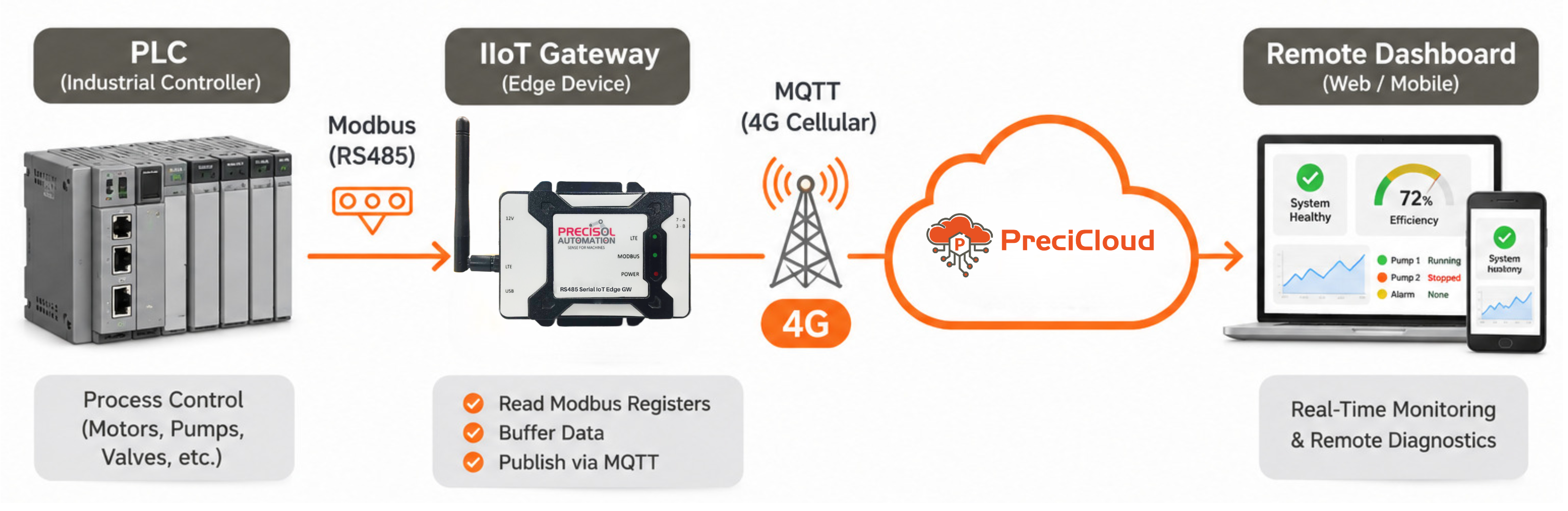
IoT PLC integration is transforming how industrial facilities monitor and manage their automation systems — enabling maintenance engineers, production managers, and operations teams to access real-time PLC data from any location via a smartphone or web browser, eliminating the need to be physically present at the SCADA workstation or PLC programming terminal for routine monitoring tasks. Programmable Logic Controllers are the backbone of industrial automation — controlling motors, pumps, valves, conveyors, compressors, and every other actuator in a manufacturing plant, water treatment facility, or remote pump station. Yet these critical assets have traditionally been information islands: the data inside the PLC (production counts, process temperatures, alarm states, energy consumption) is visible only on-site, only through a programming cable or SCADA terminal, and only by those with direct network access to the OT network. Remote PLC connectivity via IIoT gateways changes this fundamentally: a small hardware gateway device mounted in the PLC panel connects to the PLC's Modbus or Ethernet port, reads the specified registers at a configured interval, and transmits the values to a cloud platform over 4G cellular — making IoT PLC integration possible without modifying the PLC program, changing the network topology, or exposing the PLC to the internet. Remote PLC diagnostics extends the value further: bidirectional communication enables remote setpoint adjustment, alarm acknowledgement, and fault reset via cloud commands, reducing response time for minor operational issues from hours (wait for a technician to travel to site) to minutes (issue a cloud write command). This guide covers the architecture of IoT PLC integration, Modbus-based remote PLC connectivity, remote PLC diagnostics security considerations, and gateway selection criteria.
IoT PLC Integration: Architecture and Key Components
- IIoT Gateway Selection — IoT PLC Integration Hardware: The IIoT gateway is the core hardware in IoT PLC integration — bridging the PLC's OT communication protocol (Modbus RTU RS485, Modbus TCP Ethernet, Siemens S7, etc.) to the cloud via MQTT over 4G cellular or Wi-Fi. Gateway selection criteria: protocol support — the gateway must support the specific Modbus function codes needed (FC03 for holding registers, FC01 for coils, FC04 for input registers); connectivity — cellular 4G LTE for remote sites, Ethernet/Wi-Fi for factory LAN-connected PLCs; security — TLS 1.2/1.3 for MQTT encryption, X.509 certificate authentication, no open inbound ports; configuration — web-based configuration of Modbus addresses, polling intervals, MQTT topics, and cloud endpoint without requiring programming expertise; data buffering — the gateway should buffer data locally during cellular outages and transmit on reconnection to prevent data gaps in remote PLC connectivity deployments.
- Modbus Register Mapping — IoT PLC Integration Configuration: Configuring IoT PLC integration requires mapping the PLC's data registers to meaningful process variable names for the cloud dashboard. Typical Modbus register mapping for a pump station PLC: HR 40001 = suction pressure (bar, scale 0.01); HR 40002 = discharge pressure (bar, scale 0.01); HR 40003 = flow rate (L/min, scale 0.1); HR 40004 = pump motor current (A, scale 0.01); HR 40005 = running hours (h, scale 1); Coil 00001 = pump run status; Coil 00002 = high pressure alarm. The IIoT gateway polls all configured addresses in a single Modbus read transaction and publishes the complete dataset as a JSON payload — minimising poll overhead on the PLC's Modbus serial port and ensuring all values are time-stamped together.
- Remote PLC Diagnostics — Bidirectional Cloud Commands: Remote PLC diagnostics bidirectional capability enables: remote setpoint changes (write new pressure setpoint to HR 40010 — PLC adjusts pump speed accordingly); alarm reset (write 1 to Coil 00010 — PLC clears latched alarm); manual start/stop (write to output coil — with appropriate interlock and safety confirmation in the cloud application). Security for remote PLC diagnostics write operations requires: user authentication (MFA for write access); command confirmation in the cloud UI (operator must confirm before the write is executed); audit log entry for every write (user, timestamp, address, value); and optionally, a watchdog timer that reverts the setpoint if the connection is lost within a configurable timeout.
- Remote PLC Connectivity at Multi-Site Facilities: Remote PLC connectivity scales naturally to multi-site facilities where a central operations team monitors PLCs at multiple locations (pump stations, substations, remote factories) from a single dashboard. Each site has a local IIoT gateway with IoT PLC integration configured for the site's PLC; all gateways connect to the same cloud MQTT broker; the cloud dashboard displays all sites simultaneously with site-level aggregation of alarms, energy data, and production counts — enabling a small centralised operations team to monitor dozens of sites that previously required site visits for routine data collection.
IoT PLC Integration: Modbus Protocol Quick Reference
| Modbus Function Code | IoT PLC Integration Use | Register Type |
|---|---|---|
| FC01 — Read Coils | Read digital output status (pump run, valve open) | Coils (0xxxx) |
| FC02 — Read Discrete Inputs | Read digital input status (limit switches, field sensors) | Discrete Inputs (1xxxx) |
| FC03 — Read Holding Registers | Read process variables, setpoints — most common for remote PLC connectivity | Holding Registers (4xxxx) |
| FC06 — Write Single Register | Remote PLC diagnostics — write setpoint, reset counter | Holding Registers (4xxxx) |
| FC16 — Write Multiple Registers | Remote PLC diagnostics — write multiple setpoints in one transaction | Holding Registers (4xxxx) |
IoT PLC Integration with Precisol Automation
Precisol Automation's Serial IIoT Gateway provides plug-and-play IoT PLC integration for Modbus RTU (RS485) and Modbus TCP PLCs — connecting to the PLC's serial or Ethernet port, polling configured register addresses, and publishing data via MQTT over 4G cellular to the cloud. The gateway supports bidirectional Modbus write for remote PLC diagnostics commands and 4G failover for reliable remote PLC connectivity at remote sites. The PreciCloud IoT Cloud Dashboard receives PLC data streams, displays real-time process variable dashboards, and provides role-based access for remote monitoring and diagnostics.
See PLC cloud integration in our IT-OT bridge for process automation case study, or explore remote monitoring and control for Modbus PLCs for the complete IoT PLC integration hardware and software deployment workflow.
Frequently Asked Questions
What is IoT PLC integration and how does it enable remote PLC connectivity?
IoT PLC integration connects a PLC to a cloud platform via an IIoT gateway that reads PLC registers using Modbus RTU/TCP and publishes the data via MQTT over 4G cellular or Ethernet — enabling remote PLC connectivity from any location via web browser or mobile app without modifying the PLC program. The gateway polls configured Modbus register addresses at a set interval, transmits values as JSON payloads to a cloud MQTT broker, and stores data for dashboards, alerts, and analytics. Remote PLC diagnostics extends this with bidirectional cloud commands for setpoint changes and alarm resets.
How does Modbus-based IoT PLC integration work?
Modbus IoT PLC integration: the PLC is configured as a Modbus slave with its process variables mapped to holding registers and coils; the IIoT gateway is configured as a Modbus master that polls the PLC at a configured interval (5 s – 5 min) using FC03 (read holding registers) and FC01 (read coils); the gateway publishes the register values as MQTT JSON to the cloud MQTT broker. Remote PLC connectivity via Modbus RTU uses the RS485 serial port; Modbus TCP uses the Ethernet port and PLC IP address on port 502. Remote PLC diagnostics write commands use Modbus FC06/FC16 triggered by cloud MQTT messages.
What security considerations apply to remote PLC diagnostics and IoT PLC integration?
Security for remote PLC diagnostics: TLS 1.2/1.3 encryption for all MQTT data; X.509 device certificates for gateway authentication; MFA for user access to write commands; read-only vs write-access role separation; audit logging of all write operations (user, timestamp, address, old/new value); outbound-only cloud connections (no inbound ports open to the PLC network); and data buffering during outages without storing sensitive control data in cloud caches. IoT PLC integration deployments in regulated industries (water, power, pharmaceuticals) must comply with IEC 62443 security level requirements for remote access to industrial control systems.