AUTOSAR Architecture: How Modern Automotive ECUs Are Structured
04 September 2026
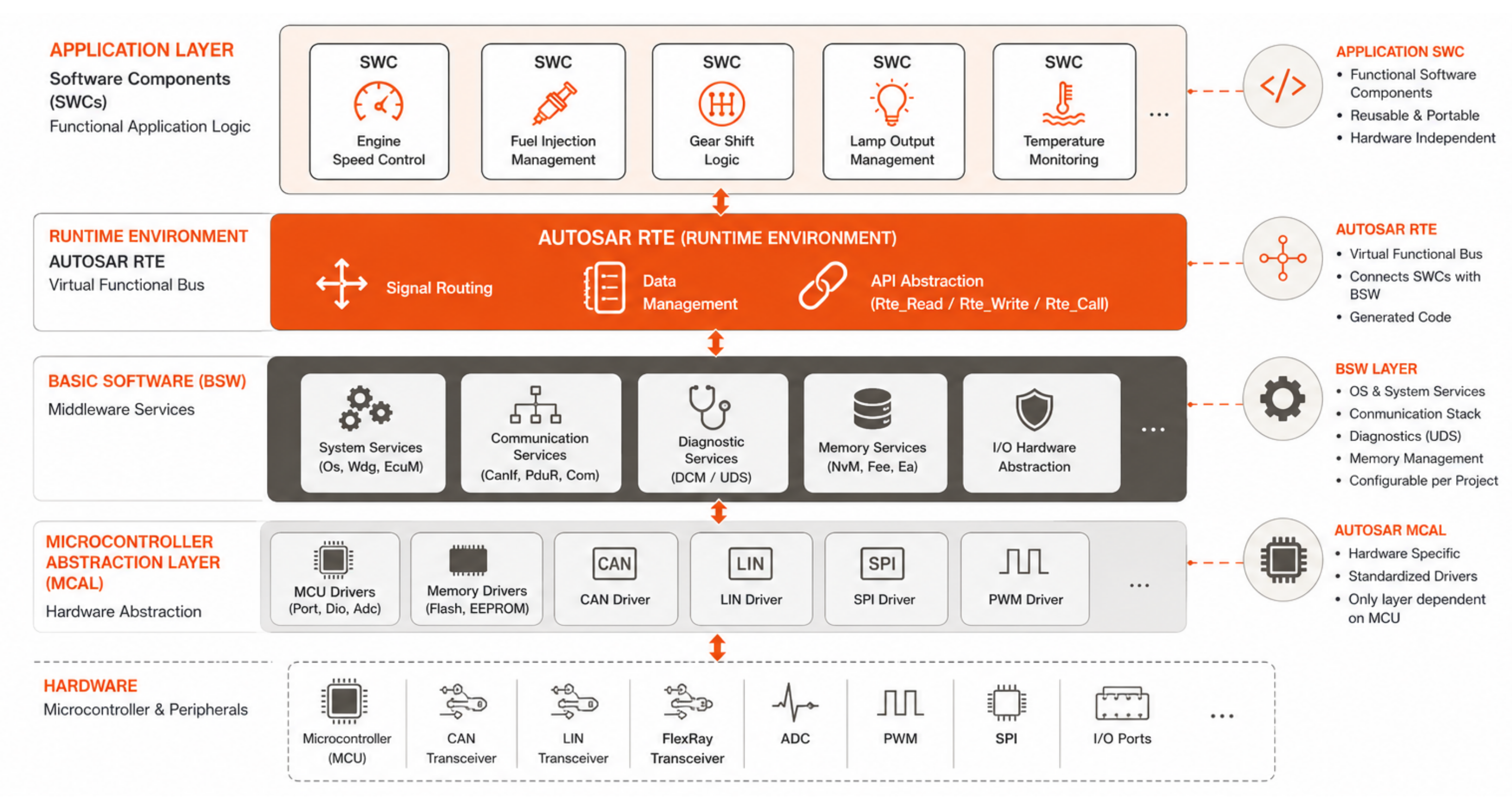
AUTOSAR architecture is the standardised software framework that defines how modern automotive ECUs are structured — separating hardware abstraction, operating system services, network communication, and application logic into defined layers with standardised interfaces that enable software portability and reuse across different vehicle platforms and ECU hardware. Developed by the AUTOSAR consortium (including BMW, Bosch, Continental, Delphi, Ford, and more than 200 partner companies), the automotive software platform addresses the fundamental challenge that had plagued AUTOSAR ECU development before its introduction: each ECU supplier wrote proprietary, hardware-specific code that was inseparable from the hardware it ran on — impossible to reuse, difficult to validate independently, and expensive to maintain. AUTOSAR architecture solves this by defining a layered platform where application software components (SWCs) are written against standardised APIs, completely unaware of the underlying microcontroller hardware — enabling the same engine control software to be retargeted to a different MCU simply by replacing the AUTOSAR MCAL layer. Understanding the AUTOSAR architecture layers — MCAL, BSW, AUTOSAR RTE, and Application — is fundamental for engineers working in AUTOSAR ECU development, ECU testing, or automotive software validation.
AUTOSAR Architecture Layers Explained
The AUTOSAR architecture divides ECU software into four main layers. From hardware to application:
- AUTOSAR MCAL (Microcontroller Abstraction Layer): The hardware interface layer — AUTOSAR MCAL provides standardised C APIs for microcontroller peripherals: ADC (analogue-to-digital converter), PWM (pulse width modulation), SPI (serial peripheral interface), CAN driver, LIN driver, FlexRay driver, and memory drivers (Flash, EEPROM). AUTOSAR MCAL is the only layer that is hardware-specific; all layers above the MCAL are hardware-independent.
- BSW (Basic Software): The middleware layer of the automotive software platform — provides operating system (AUTOSAR OS, derived from OSEK), communication stack (CAN interface, PduR, Com modules for CAN bus message management), diagnostic services (DCM module implementing the UDS diagnostic protocol), NvM (non-volatile memory management), and watchdog services. The BSW is configured for each project using AUTOSAR configuration tools.
- AUTOSAR RTE (Runtime Environment): The virtual functional bus of the AUTOSAR architecture — AUTOSAR RTE is automatically generated code that routes Runnables (periodic or event-triggered software functions) and port connections between SWCs, and between SWCs and the BSW. Application SWCs call AUTOSAR RTE APIs (Rte_Read, Rte_Write, Rte_Call) without knowing whether the data comes from a local SWC, a CAN bus signal, or a sensor input — the automotive software platform RTE handles all routing transparently.
- Application SWC Layer: The functional software components — engine speed control, fuel injection management, gear shift logic, lamp output management — written by application engineers against the standardised AUTOSAR architecture APIs. SWCs are the most reusable part of AUTOSAR ECU development: the same SWC can be deployed on a different ECU hardware simply by reconfiguring the MCAL and regenerating the AUTOSAR RTE.
Classic AUTOSAR vs Adaptive AUTOSAR
| Aspect | Classic AUTOSAR Architecture | Adaptive AUTOSAR (Automotive Software Platform) |
|---|---|---|
| Target Hardware | Real-time microcontrollers (Infineon AURIX, NXP S32K) | High-performance SoCs (Nvidia Orin, Qualcomm SA8155) |
| Operating System | AUTOSAR OS (OSEK-based, static task scheduling) | POSIX OS (Linux, QNX) — dynamic process model |
| Communication | COM module over CAN, LIN, FlexRay — signal-based | SOME/IP service-oriented communication over Ethernet |
| Typical ECU Applications | Engine, brake, steering, body control ECUs | ADAS compute, infotainment, central domain controller |
| Configuration | Static — compile-time AUTOSAR ECU development | Dynamic — service discovery, OTA update capability |
AUTOSAR ECU Development and CAN Bus Configuration
In AUTOSAR ECU development, CAN bus communication is configured through the AUTOSAR BSW communication stack — not written as manual CAN driver code. The network topology is described in ARXML (AUTOSAR XML) files: the System Description file defines all network messages and signals (equivalent to a DBC file but in AUTOSAR format); the BSW module configuration tools generate the AUTOSAR MCAL CAN driver configuration, CAN Interface (CanIf), PDU Router (PduR), and COM module signal routing automatically. Engineers configure AUTOSAR ECU development workflows in tools (VECTOR DaVinci, EB tresos, ARCCORE) that generate the BSW and AUTOSAR RTE code from the graphical configuration — the application SWC developer never writes CAN register-level code directly.
AUTOSAR ECU Development Support with Precisol Automation
Precisol Automation's CAN to USB Adapter provides the CAN bus interface for AUTOSAR ECU development bench testing — connecting AUTOSAR ECU hardware to PC-based analysis tools for CAN signal monitoring, UDS diagnostic protocol testing, and ECU software validation. The CAN Data Logger captures complete CAN bus communication during AUTOSAR architecture integration testing and vehicle validation.
See automotive software platform validation in practice in our automotive ECU software validation case study, or explore ECU simulator applications where AUTOSAR ECU development bench testing uses Precisol CAN tools.
Frequently Asked Questions
What is AUTOSAR and why is it used in automotive ECU development?
AUTOSAR architecture is a standardised automotive software platform that separates hardware abstraction, middleware, and application logic into defined layers. AUTOSAR ECU development uses it because standardised AUTOSAR MCAL and RTE interfaces enable application software reuse across different hardware platforms, reducing development cost and enabling independent software component validation.
What are AUTOSAR MCAL and AUTOSAR RTE?
AUTOSAR MCAL (Microcontroller Abstraction Layer) is the hardware-specific layer providing standardised APIs for MCU peripherals including CAN, LIN, ADC, and PWM drivers. AUTOSAR RTE (Runtime Environment) is the auto-generated middleware that routes data and calls between Application Software Components and the BSW without exposing hardware or network details. Together they form the automotive software platform's portability foundation for AUTOSAR ECU development.
What is the difference between Classic AUTOSAR and Adaptive AUTOSAR?
Classic AUTOSAR architecture targets real-time microcontrollers with static task scheduling — used for engine, brake, and body ECUs. Adaptive AUTOSAR targets high-performance SoCs running POSIX OS — used for ADAS, infotainment, and domain controllers requiring dynamic services and OTA updates. Classic AUTOSAR ECU development uses compile-time configuration; Adaptive uses runtime service discovery and SOME/IP Ethernet communication versus Classic's CAN-based automotive software platform.