DoIP: How Diagnostics Over IP Works in Modern Vehicle Networks
03 September 2026
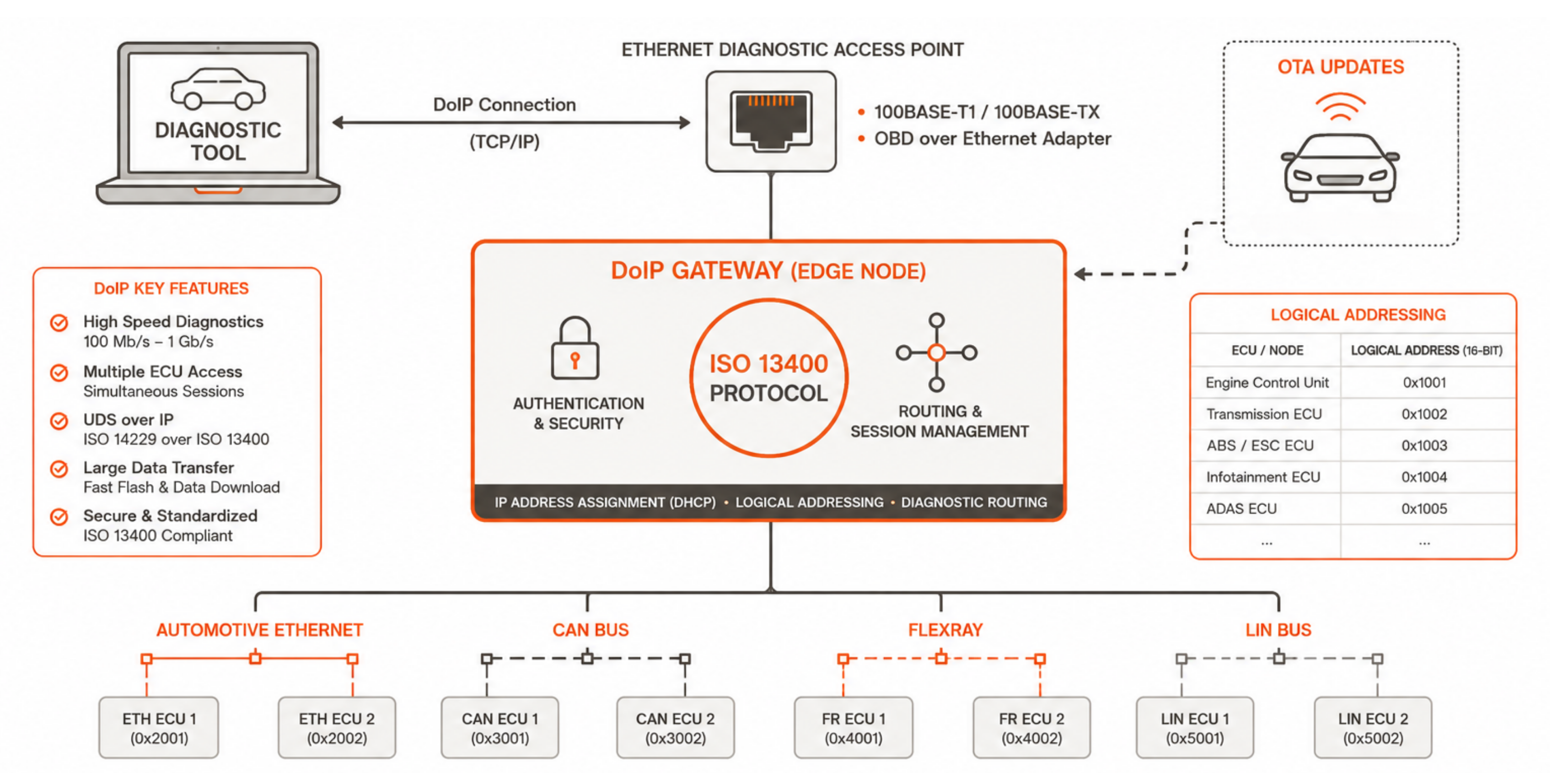
DoIP diagnostics — Diagnostics over Internet Protocol, standardised in ISO 13400 — is the vehicle diagnostics architecture that carries UDS diagnostic messages over Automotive Ethernet and TCP/IP, replacing the CAN bus ISO-TP transport that has been the foundation of automotive diagnostics since the 1990s. Diagnostics over IP automotive is not a new diagnostic protocol — the UDS (ISO 14229) service layer remains unchanged — but the transport beneath it shifts from the bandwidth-constrained CAN bus to high-speed Automotive Ethernet, enabling vehicle Ethernet diagnostics that are 100–1000 times faster than CAN-based equivalents. This matters enormously for over-the-air (OTA) software updates, multi-ECU simultaneous diagnostics, and the high-bandwidth ADAS and infotainment ECUs that modern vehicles require. DoIP diagnostics is now mandated in Regulation (EU) 2018/858 for type-approval of new vehicle models, and all modern OEMs are integrating ISO 13400 protocol support into their vehicle architectures. Engineers working in automotive diagnostics, ECU development, or aftermarket tooling need to understand how DoIP diagnostics works and how it differs from the CAN-based world they are used to.
DoIP Architecture: Gateway, Nodes, and Routing
The DoIP diagnostics architecture in a vehicle is built around a central gateway node — typically the central gateway ECU (CGW) — that acts as the ISO 13400 protocol entry point for all external diagnostic access. The DoIP gateway bridges the external Ethernet diagnostic access point (the physical connector at the OBD port) to all internal vehicle networks — CAN, LIN, FlexRay, and Automotive Ethernet segments. Key DoIP architecture elements:
- DoIP Gateway (Edge Node): The DoIP entity that handles external diagnostic connections, authenticates diagnostic clients, manages IP address assignment via DHCP, and routes UDS messages from the diagnostics over IP automotive client to the correct in-vehicle target ECU. The gateway advertises all reachable ECUs (logical addresses) to the diagnostic tool during the DoIP connection announcement phase.
- Logical Addressing: Each ECU in the vehicle has a DoIP logical address — a 16-bit identifier that the ISO 13400 protocol uses to route diagnostic messages to the correct target. The diagnostic tool specifies the target logical address in each UDS request; the DoIP gateway routes it accordingly — whether the target is on Automotive Ethernet or a legacy CAN bus segment.
- Vehicle Ethernet Access: Vehicle Ethernet diagnostics uses either a dedicated DoIP connector (100BASE-T1 or standard 100BASE-TX RJ45) or a wireless access point. Production line end-of-line testing typically uses a high-speed wired DoIP diagnostics connection; over-the-air updates use the vehicle's wireless interface (Wi-Fi, 5G) with OBD over Ethernet protocols.
DoIP vs CAN Diagnostics: Performance Comparison
| Parameter | CAN Bus Diagnostics (ISO-TP) | DoIP Diagnostics (ISO 13400 Protocol) |
|---|---|---|
| Bandwidth | 500 kbps CAN bus | 100 Mbit/s or 1 Gbit/s Automotive Ethernet |
| ECU Flash Time (20 MB) | 20–45 minutes | Under 2 minutes via vehicle Ethernet diagnostics |
| Simultaneous Sessions | One ECU at a time per CAN segment | Multiple ECUs simultaneously via DoIP diagnostics routing |
| Transport Standard | ISO 15765-2 (ISO-TP) | ISO 13400 protocol (TCP/IP) |
| Physical Connector | OBD-II port (CAN pins 6/14) | Ethernet RJ45, 100BASE-T1, or OBD over Ethernet adapter |
ISO 13400 Protocol in EOL Testing and OTA Updates
DoIP diagnostics delivers its greatest practical value in two applications. In production end-of-line testing, ISO 13400 protocol reduces per-vehicle diagnostic cycle time by 10–20× compared to CAN-based EOL — enabling multi-ECU flash and validation in under 5 minutes at production-line takt rates that CAN diagnostics cannot meet. In over-the-air (OTA) software updates, diagnostics over IP automotive provides the bandwidth for large ECU firmware packages (100 MB+) that connected car services require — ADAS update packages, infotainment firmware, and powertrain calibration updates that are impractical to deliver over CAN. Vehicle Ethernet diagnostics via DoIP is the infrastructure that enables the automotive industry to update vehicles remotely throughout their service life — transforming post-sale software delivery in the same way smartphone OTA updates changed consumer electronics.
DoIP Diagnostics Tools with Precisol Automation
Precisol Automation's CAN to USB Adapter bridges the gap between legacy CAN-based diagnostic workflows and modern vehicle architectures — supporting CAN ISO-TP diagnostics while enabling transition to DoIP diagnostics environments. The Testing and Validation Systems from Precisol provide the complete diagnostic infrastructure for vehicle Ethernet diagnostics and ISO 13400 protocol EOL test station integration.
See automotive diagnostic tooling in practice in our ECU software validation case study, or explore how Precisol enables automotive diagnostics tool development with CAN and DoIP diagnostics support.
Frequently Asked Questions
What is DoIP and why is it replacing CAN-based vehicle diagnostics?
DoIP diagnostics (ISO 13400 protocol) transports UDS diagnostic messages over TCP/IP via Automotive Ethernet instead of CAN bus. It replaces CAN-based diagnostics because vehicle Ethernet diagnostics offers 100–1000× higher bandwidth — enabling ECU software flashing in minutes instead of hours, simultaneous multi-ECU diagnostics, and support for high-bandwidth ADAS and infotainment ECUs that already operate on Ethernet networks.
How does DoIP diagnostics work technically?
A DoIP gateway ECU (central gateway) handles external Ethernet diagnostic connections via ISO 13400 protocol, routes UDS requests from the diagnostics over IP automotive client to target ECUs on internal CAN or Ethernet segments, and returns responses wrapped in DoIP. The UDS layer is unchanged — the same service identifiers work over DoIP as over CAN; only the transport (IP/TCP instead of ISO-TP/CAN) changes for vehicle Ethernet diagnostics.
What is the difference between DoIP and OBD-II over CAN?
OBD over Ethernet via DoIP diagnostics (ISO 13400 protocol) operates at 100–1000 Mbit/s Automotive Ethernet, versus CAN diagnostics at 500 kbps. A 20 MB ECU flash that takes 30+ minutes over CAN completes under 2 minutes via vehicle Ethernet diagnostics. DoIP also enables simultaneous multi-ECU sessions; CAN-based diagnostics typically addresses one ECU at a time per bus segment.