Borehole and Groundwater Monitoring with IoT: Level, Quality, and Pump Health
25 September 2026
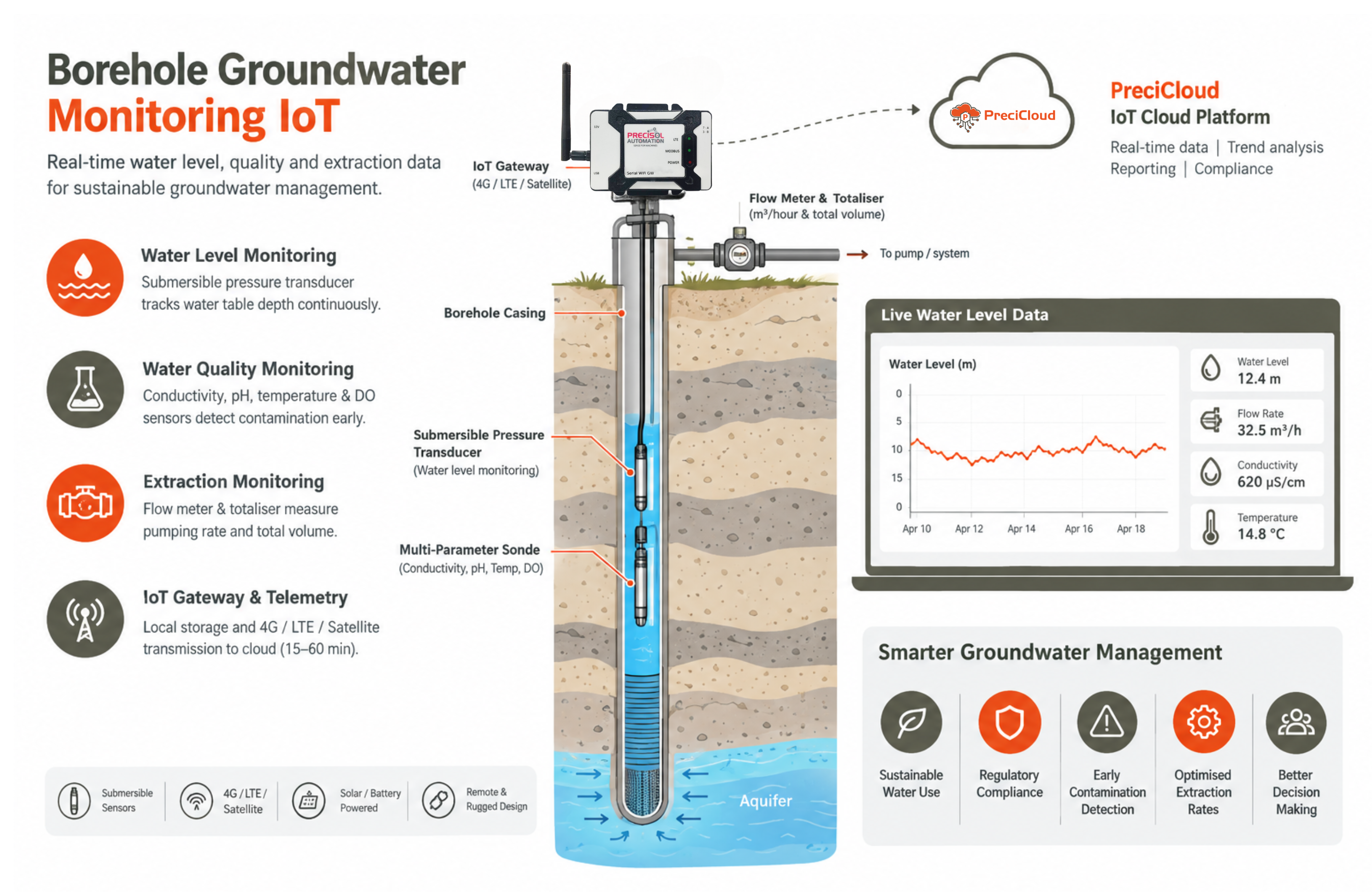
Borehole groundwater monitoring IoT provides the continuous water table, quality, and extraction data that water utilities, industrial facilities, agricultural operations, and environmental regulators need to manage groundwater resources sustainably, protect drinking water aquifers, and comply with increasingly stringent groundwater abstraction licence conditions. Groundwater is an invisible resource: water table levels fluctuate with rainfall, seasonal recharge, and extraction rates in ways that are completely unobservable without sensors in the borehole itself. Groundwater level monitoring via submersible pressure transducers connected to surface IoT gateways makes the aquifer's state visible continuously — tracking water table depth, calculating extraction yield, monitoring recovery rate after pumping periods, and detecting declining aquifer trends that indicate unsustainable extraction long before supply yields become inadequate. Water well IoT sensor systems installed in production boreholes, monitoring boreholes, and observation wells create a spatial network of aquifer data points that enables understanding of regional groundwater behaviour — rainfall infiltration timing, cone of depression development around pumping boreholes, and inter-aquifer connectivity. Beyond level, groundwater quality monitoring via in-situ conductivity, pH, and temperature sensors in the borehole provides early warning of contamination from agricultural fertiliser leaching, industrial spills, and saltwater intrusion — detecting plume migration to drinking water sources before it reaches hazardous concentrations. Aquifer monitoring IoT data is also the foundation of groundwater abstraction licence compliance — regulators increasingly require continuous telemetry of extraction volumes and water table levels as a condition of abstraction permissions.
Borehole Groundwater Monitoring IoT: Sensor Configuration
- Submersible Pressure Transducer (Water Well IoT Sensor): The primary groundwater level monitoring sensor — a stainless steel submersible transducer lowered into the borehole on a cable, measuring the water pressure above its diaphragm to calculate water head (depth to water table from surface). Water well IoT sensor transducers in 50mm to 150mm borehole casing diameters are available with measurement ranges of 0–10m to 0–200m and 4–20 mA or SDI-12 or RS485 Modbus output for connection to surface IoT gateways.
- Groundwater Quality Sensors: Multi-parameter sonde instruments with conductivity, pH, temperature, and DO sensors measure in-situ groundwater quality continuously — deployed at fixed depth in the borehole or lowered during sampling events. Groundwater quality monitoring via conductivity trend analysis is the most cost-effective early warning for contamination: baseline conductivity is established for each borehole; deviations above or below baseline trigger investigation. Borehole groundwater monitoring IoT platforms log quality parameter trends that are essential for regulatory reporting and contamination event documentation.
- Flow Meter and Totaliser: A flow meter on the borehole pump discharge pipe measures extraction rate (m³/hour) and cumulative extracted volume (m³ total) — the primary data for abstraction licence compliance and aquifer yield assessment. Aquifer monitoring IoT platforms correlate extraction volume with water table drawdown to calculate specific yield and safe extraction rate for each borehole.
- IoT Gateway and Telemetry: The surface-mounted IoT gateway reads the submersible transducer output, flow meter pulses, and quality sensor data — storing readings locally and transmitting to cloud platforms every 15–60 minutes via 4G LTE cellular or satellite (for remote boreholes outside cellular coverage). Borehole groundwater monitoring IoT gateways designed for solar or battery power enable deployment at genuinely remote sites with no mains power infrastructure.
Aquifer Monitoring IoT: Data and Applications
| Application | Borehole Groundwater Monitoring IoT Data | Management Action Enabled |
|---|---|---|
| Municipal Water Supply | Groundwater level monitoring — water table trend; extraction vs. licence | Abstraction licence compliance; sustainable yield management |
| Industrial Site Contamination | Groundwater quality monitoring — conductivity, pH, contaminant-specific sensors | Early contamination plume detection; regulatory notification; remediation trigger |
| Agricultural Irrigation | Water well IoT sensor level + flow totaliser | Irrigation scheduling; seasonal aquifer drawdown management |
| Construction Dewatering | Aquifer monitoring IoT — water table level adjacent to excavation | Settlement monitoring; dewatering pump control; regulatory compliance |
| Saltwater Intrusion Monitoring | Conductivity trend — detecting saline water upconing or lateral intrusion | Pumping rate reduction before aquifer damage; coastal water security |
Deploy Borehole Groundwater Monitoring IoT with Precisol Automation
Precisol Automation's Wireless Sensors and IIoT gateway portfolio provide the surface telemetry infrastructure for borehole groundwater monitoring IoT — connecting to submersible transducers, flow meters, and quality sensors via 4–20 mA, pulse, or Modbus RS485 inputs and transmitting groundwater level monitoring and quality data to cloud platforms via cellular or LoRa. The PreciCloud IoT Cloud Dashboard provides the aquifer monitoring IoT platform with water table trend charts, extraction volume totalising, groundwater quality monitoring trend displays, and abstraction licence compliance reporting.
See remote sensor IoT telemetry in practice in our IT-OT bridge for process automation case study, or explore borehole water level monitoring using wireless sensors for deployment guidance on water well IoT sensor and gateway installation at remote groundwater monitoring sites.
Frequently Asked Questions
What does borehole groundwater monitoring IoT measure?
Borehole groundwater monitoring IoT measures water table level (via submersible pressure transducer water well IoT sensor), pump flow rate and extraction volume totals, groundwater quality (conductivity/TDS, pH, temperature, dissolved oxygen — groundwater quality monitoring for contamination detection), pump motor current, and optionally rainfall. Aquifer monitoring IoT data enables water table trend analysis, abstraction licence compliance, and early contamination detection.
Why is groundwater level monitoring important for sustainable water management?
Groundwater level monitoring is fundamental because over-extraction depletes aquifer levels, reduces yields, degrades quality, and causes land subsidence — all without visible warning without sensor data. Borehole groundwater monitoring IoT provides continuous water table trends to detect declining aquifer health, calculate safe yield, characterise seasonal recharge, and comply with abstraction licence conditions. Without aquifer monitoring IoT, managers rely on infrequent manual dips that miss rapid drawdown events and long-term trends.
How does IoT enable groundwater quality monitoring for contamination detection?
Groundwater quality monitoring via borehole groundwater monitoring IoT uses in-situ conductivity, pH, and temperature sensors at established depth in the borehole — logging continuously to create a baseline against which contamination deviations are detected. Sudden conductivity increases indicate saltwater intrusion or industrial contamination; pH shifts indicate acid sources. Aquifer monitoring IoT provides time-series evidence of contamination onset and spread — critical for regulatory reporting and remediation planning — that periodic manual sampling cannot capture.