Pump Station Remote Monitoring with IoT: Health, Energy, and Flow Tracking
24 September 2026
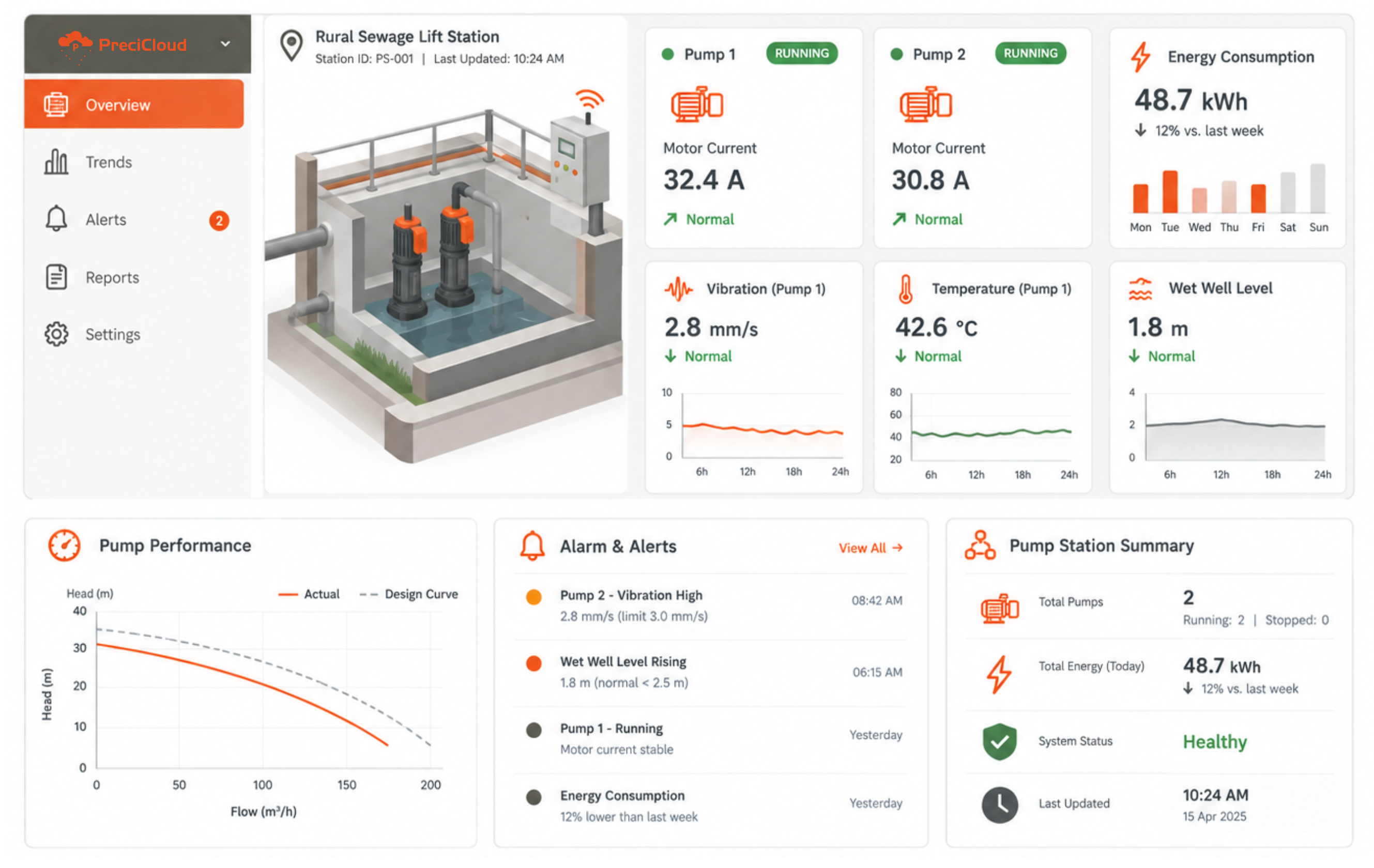
Pump station remote monitoring with IoT provides water utilities, sewage authorities, industrial operations, and building services teams with the real-time pump health, performance, and energy data needed to prevent unexpected pump failures, optimise energy consumption, and manage distributed pump station networks from a central operations centre. Pumps are the most maintenance-intensive rotating equipment in most industrial and utility operations — and pump failure consequences vary from mild inconvenience (a secondary HVAC pump) to major environmental and operational disaster (a sewage lift station pump failure causing wet well overflow). Pump IoT monitoring changes the maintenance model from reactive (responding after failure) to predictive: vibration sensors on pump and motor bearings detect the characteristic frequency signatures of bearing degradation weeks before seizure; motor current monitoring detects impeller blockage in sewage applications before the motor trips; and pump performance monitoring compares actual head-flow against the design curve to quantify wear and efficiency reduction that indicates the right time for impeller replacement. For remote sites — rural sewage lift stations, industrial cooling water pump stations, agricultural irrigation pumps — pump station remote monitoring via cellular IIoT gateways eliminates the need for constant site visits, replacing scheduled inspection rounds with condition-based site visits triggered by actual parameter deviations. Sewage pump station monitoring deserves specific attention because the consequences of failure are environmental (untreated sewage overflow to waterways), regulatory (sewage overflow reporting requirements), and reputational — making continuous pump IoT monitoring a regulatory risk management necessity as much as a maintenance efficiency tool.
Key Parameters for Pump Station Remote Monitoring
- Motor Current and Power: Motor current is the primary pump IoT monitoring parameter accessible at every pump station — a current transducer on the motor supply measures current without any pump modification. Normal pump operation produces a characteristic current profile at each duty point; increasing current at stable head and flow indicates mechanical degradation (worn wear rings, impeller blockage, bearing friction increase). Pump station remote monitoring platforms trend motor current over time and alert on deviations that indicate developing faults.
- Pump Vibration (Predictive Maintenance IoT): Wireless vibration and temperature sensors on pump bearing housings and motor bearing housing provide the frequency data for pump predictive maintenance IoT — bearing defect frequencies, cavitation signatures, and impeller imbalance patterns are detectable months before they cause pump failure. Pump IoT monitoring vibration sensors attach magnetically to bearing housings and transmit to IIoT gateways without any pump modification or cabling.
- Inlet/Outlet Pressure Monitoring: Differential pressure across the pump (outlet pressure minus inlet pressure) is the hydraulic head measurement that verifies pump duty point. Pump station remote monitoring compares actual differential pressure at measured flow rate against the pump design curve — deviation from the expected head-flow relationship quantifies pump wear and impeller clearance increase that reduces pump efficiency and output.
- Sewage Pump Station Monitoring — Wet Well Level: Wet well level is the primary operational parameter for sewage pump station monitoring — controlling pump start/stop, detecting inflow rate changes, and providing overflow warning. Pump station remote monitoring platforms integrate wet well level with pump run status to calculate inflow rate automatically — detecting upstream pipe blockage (reducing inflow below normal) or infiltration (increasing inflow above normal) from level and pump duty data alone.
Pump Station Remote Monitoring: Application Coverage
| Pump Station Type | Key Pump IoT Monitoring Parameters | Critical Alert Condition |
|---|---|---|
| Water Supply Booster | Pressure, flow, motor current, vibration, energy (pump energy efficiency IoT) | Low outlet pressure; pump not starting; vibration alarm |
| Sewage Lift Station | Wet well level, pump run/stop, current (ragging detection) | High wet well level (overflow risk); pump blocked; duty pump failure |
| Industrial Process Pump | Pump predictive maintenance IoT — vibration, temperature, seal leakage | Bearing defect alarm; seal leakage detected; performance curve deviation |
| Irrigation / Agricultural | Flow, inlet pressure, motor current, energy | Low flow (clogged intake); motor overload; pump station remote monitoring low pressure |
| Stormwater / Flood Pumping | Pump run/stop, sump level, kWh consumed | Pump not starting during storm event; high sump level override alarm |
Deploy Pump Station Remote Monitoring with Precisol Automation
Precisol Automation's Serial IIoT Gateway connects to pump VFDs, motor protection relays, and flow meters via Modbus RTU — providing the pump station remote monitoring interface for electrical and hydraulic parameters across distributed pump stations. Wireless vibration and temperature sensors from Precisol's Wireless Vibration and Temperature Sensor provide the bearing-level pump predictive maintenance IoT data for bearing health trending and fault detection.
See wireless predictive maintenance IoT in rotating equipment applications in our predictive maintenance in carbon manufacturing case study, or explore remote pump station monitoring using Precisol's Serial IIoT Gateway for sewage pump station monitoring and pump energy efficiency IoT implementations.
Frequently Asked Questions
What does pump station remote monitoring with IoT measure?
Pump station remote monitoring IoT measures motor current, pump vibration (bearing health via pump IoT monitoring sensors), inlet/outlet pressure, flow rate, wet well or sump level (for sewage pump station monitoring), motor temperature, energy consumption (pump energy efficiency IoT), and VFD parameters. Together these enable both real-time operational visibility and pump predictive maintenance IoT from vibration trending and performance curve analysis.
How does pump IoT monitoring detect pump failure before breakdown?
Pump IoT monitoring detects early failure through vibration signature analysis (bearing defect frequencies in FFT spectrum — detectable weeks before seizure), motor current signature analysis (detecting impeller blockage and mechanical faults in current spectrum), and pump performance monitoring (comparing actual head-flow against design curve — efficiency reduction indicates wear). Pump predictive maintenance IoT alerts maintenance teams to plan overhaul during scheduled downtime rather than emergency response after catastrophic failure.
What is sewage pump station monitoring and why is it different from clean water pumping?
Sewage pump station monitoring addresses ragging (impeller blockage from solids and wipes — detected by pump IoT monitoring current increase), wet well level management (overflow prevention), duty/standby pump alternation, and H2S safety monitoring — failure modes not present in clean water applications. Pump station remote monitoring for sewage lift stations is a regulatory necessity as well as a maintenance tool, since wet well overflow is an environmental compliance incident with mandatory reporting requirements.