Digital Twin Industrial Automation: IIoT-Powered Virtual Plant Models
28 August 2026
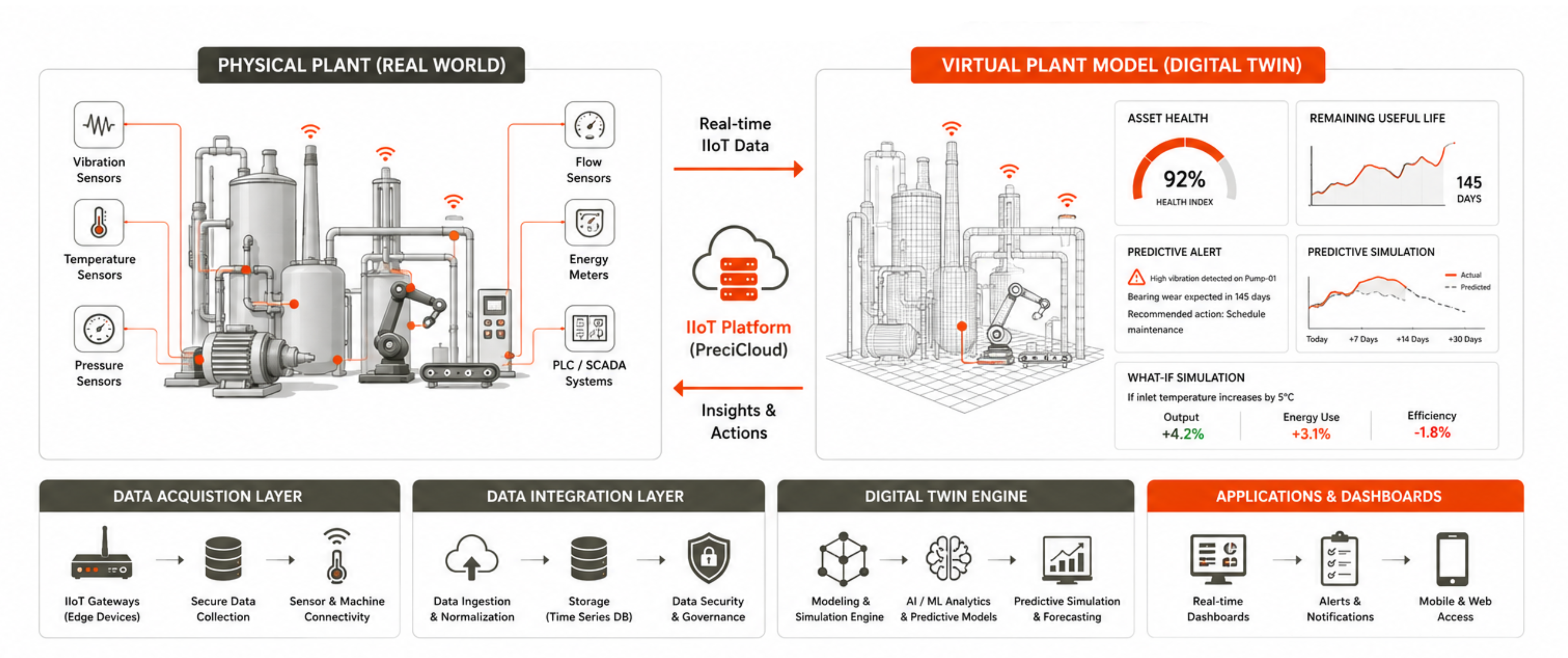
Digital twin industrial automation creates living, data-driven virtual models of physical assets, processes, and production systems — enabling manufacturers to monitor real-time asset health, run predictive simulation, optimise process performance, and test operational changes in a virtual environment before applying them to the physical plant. Unlike static engineering models or historical reports, an industrial digital twin is continuously updated by real-time IIoT sensor data and machine operational information — the virtual plant model reflects the actual current state of the physical asset, including its degradation history, current operating parameters, and any emerging anomalies. IIoT digital twin technology connects the physical and virtual worlds through IoT sensor networks, edge gateways, and cloud platforms that feed live production data into simulation and analytics models. The result is a digital twin industrial automation capability that gives engineers and operations teams unprecedented insight into plant behaviour — enabling proactive decisions about maintenance, process optimisation, and capital planning that were previously impossible with historical data alone.
Types of Industrial Digital Twin in Manufacturing
Digital twin industrial automation is applied at multiple scales — from individual equipment components through complete production lines to full plant simulations:
- Asset Digital Twin: The most common starting point — an industrial digital twin of a single critical asset (pump, compressor, motor, heat exchanger). The virtual plant model of the asset combines design specifications with real-time IIoT sensor data (vibration, temperature, current draw, efficiency) to monitor health, detect anomalies, and run predictive simulation of remaining useful life. Asset digital twins deliver the fastest, most measurable ROI in digital twin industrial automation programs.
- Process Digital Twin: A virtual plant model of a production process — a chemical reaction unit, a heat treatment furnace, a packaging line. Process digital twins use physics-based or data-driven models to simulate how the process responds to changes in feedstock composition, operating conditions, or equipment degradation. Predictive simulation enables process optimisation without production risk — the IIoT digital twin tests parameter changes virtually before implementing them on the live process.
- Production System Digital Twin: The most complex industrial digital twin — a model of the entire production system including multiple machines, material flow, quality interactions, and scheduling. Production system digital twins enable digital twin industrial automation of capacity planning, bottleneck identification, and scenario analysis for production scheduling and capital investment decisions.
- Connected Factory Digital Twin: At the highest level, a virtual plant model of the entire manufacturing facility — integrating asset, process, and production system digital twins with energy, logistics, and quality data streams into a comprehensive IIoT digital twin of the factory. This is the longest-horizon digital twin industrial automation goal — the foundation of truly autonomous, self-optimising manufacturing.
IIoT Digital Twin Data Requirements
| Digital Twin Level | IIoT Data Sources Required | Virtual Plant Model Capability |
|---|---|---|
| Asset Digital Twin (pump) | Vibration, temperature, flow, pressure, motor current | Predictive simulation of bearing failure, cavitation, seal wear |
| Process Digital Twin (heat exchanger) | Inlet/outlet temperature, flow rates, pressure drop, energy meter | Industrial digital twin fouling detection; cleaning schedule optimisation |
| Production Line Digital Twin | All machine OEE data, WIP counters, quality sensor outputs | Digital twin industrial automation bottleneck analysis; scheduling simulation |
| Connected Factory Digital Twin | Entire IIoT digital twin data fabric — all assets, processes, energy, logistics | Full virtual plant model; autonomous optimisation; predictive simulation at factory level |
Predictive Simulation: The Core Value of Industrial Digital Twin
Predictive simulation is what elevates an industrial digital twin from a monitoring dashboard to a true decision-support tool. Where a monitoring system tells operators what is happening now, predictive simulation in the virtual plant model answers: what will happen in the next 7, 14, or 30 days given current trends? What happens to production output if this compressor degrades by another 5%? Which maintenance action — immediate replacement vs. continue-and-monitor — minimises total cost? Digital twin industrial automation platforms that combine physics-based degradation models with machine learning trained on historical failure data can generate accurate predictive simulation forecasts for remaining useful life, energy consumption trajectories, and quality degradation trends. The IIoT digital twin continuously validates these forecasts against actual outcomes, improving model accuracy over time as the physical asset's operating history grows.
Deploy Digital Twin Industrial Automation with Precisol Automation
Precisol Automation's PreciCloud IoT Cloud Dashboard provides the real-time data platform that feeds digital twin industrial automation models — aggregating IIoT sensor and machine data into the time-series data foundation that virtual plant model analytics require. The PreciView IoT Monitoring Application enables IIoT digital twin visualisation and predictive simulation dashboards for asset and process monitoring applications.
See digital twin industrial automation driving operational improvements in our IT-OT bridge for process automation case study, or explore how Precisol enables smart energy metering as a measurable first IIoT data source for the industrial digital twin data foundation.
Frequently Asked Questions
What is a digital twin in industrial automation?
A digital twin in industrial automation is a real-time virtual replica of a physical asset or process, continuously updated by IIoT sensor and machine data. An industrial digital twin enables predictive simulation — forecasting future asset behaviour, simulating process changes, and optimising operations without risk to the physical plant. IIoT digital twin technology connects physical assets to virtual plant models via IoT gateways and cloud platforms.
How does an IIoT digital twin work technically?
An IIoT digital twin feeds real-time sensor data from IoT gateways and machine CAN bus or Modbus interfaces to a cloud-hosted virtual plant model. The industrial digital twin continuously updates to reflect current asset state and runs predictive simulation using physics-based or machine learning models to forecast failure, optimise processes, and recommend maintenance actions. The digital twin industrial automation platform validates model accuracy against actual measured outcomes as the asset history grows.
What is the difference between a digital shadow and a digital twin?
A digital shadow is unidirectional — physical asset data flows to the virtual plant model. A full industrial digital twin adds bidirectional capability — predictive simulation insights from the IIoT digital twin feed back to the physical asset via operator recommendations or automated control. Most current digital twin industrial automation deployments are digital shadows, with bidirectional feedback implemented via operator decisions rather than direct automated control.