Industry 4.0 Implementation Roadmap: From Strategy to Smart Factory
27 August 2026
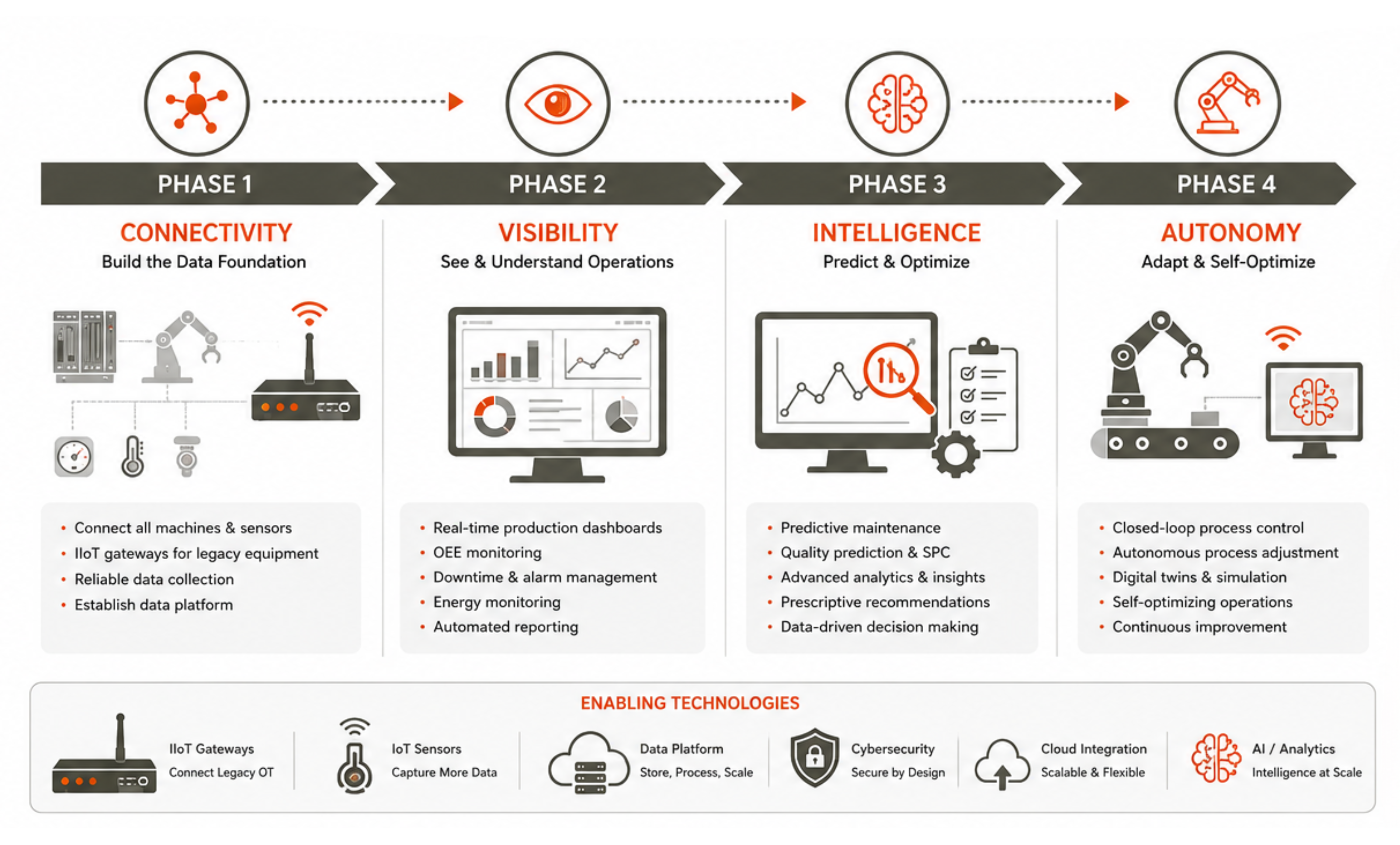
Industry 4.0 implementation transforms manufacturing operations by integrating digital technologies — IIoT, data analytics, cloud computing, AI, and autonomous systems — into production processes that have operated largely unchanged for decades. A successful smart factory roadmap does not begin with the most advanced technologies; it begins with data — connecting machines, sensors, and production systems to build the foundation from which industrial digital transformation value grows. The path from a traditional factory to a connected factory capable of real-time optimisation, predictive maintenance, and adaptive manufacturing automation is a multi-year journey that must be planned with clear business objectives, measurable milestones, and a phased approach that delivers ROI at each stage rather than waiting for a single large-scale transformation to complete. This guide outlines the practical Industry 4.0 implementation roadmap — from initial connectivity through intelligence and autonomy — that manufacturing leaders can use to plan, sequence, and prioritise their industrial digital transformation.
Phase 1: Connectivity — The Foundation of Industry 4.0 Implementation
Every Industry 4.0 implementation begins with the same prerequisite: reliable, consistent data from production machines. A factory that cannot collect machine data has nothing to analyse, optimise, or automate. Phase 1 of the smart factory roadmap establishes the data infrastructure:
- Machine Connectivity: Identify every production machine and its data interface — Modbus RS485, CAN bus, Ethernet/IP, OPC UA, or proprietary serial protocol. Deploy IIoT gateways to collect data from legacy equipment without native connectivity. The connected factory requires 100% data coverage of critical production assets — not a selective pilot that leaves blind spots in operational visibility.
- Sensor Deployment: Add wireless sensors for parameters not natively monitored by machine controllers — vibration on motors and pumps, temperature in compressed air systems, energy consumption per machine or production cell. IoT sensor data supplements PLC and SCADA data to complete the industrial digital transformation picture.
- Data Platform: A cloud or on-premises industrial IoT data platform that ingests machine and sensor data, stores it with time-series integrity, and makes it available for visualisation and analytics is the central infrastructure of Industry 4.0 implementation. Platform selection should prioritise data model flexibility, scalability, and integration capability over feature-rich applications that require mature data before they deliver value.
Industry 4.0 Implementation Roadmap: Phases and Milestones
| Phase | Smart Factory Roadmap Goal | Industry 4.0 Implementation Deliverables |
|---|---|---|
| 1 — Connectivity | Connect all critical machines and sensors to data platform | IIoT gateways deployed; connected factory data foundation established; OEE dashboards live |
| 2 — Visibility | Real-time production visibility and reactive problem-solving | Live dashboards; downtime tracking; energy monitoring; manufacturing automation of reporting |
| 3 — Intelligence | Predictive and prescriptive analytics on production data | Predictive maintenance; quality prediction; industrial digital transformation of decision-making |
| 4 — Autonomy | Closed-loop adaptive manufacturing | Digital twins; autonomous process adjustment; connected factory self-optimisation |
Industrial Digital Transformation: Choosing the Right Use Cases
Successful Industry 4.0 implementation selects initial use cases that combine high business value with achievable data requirements — delivering measurable ROI that builds organisational confidence and funds the next phase of the smart factory roadmap. The most consistently successful first use cases in industrial digital transformation: real-time OEE monitoring (the connected factory data foundation immediately reveals downtime causes that were previously invisible); energy monitoring per machine (energy cost visibility drives operational changes with rapid payback); and predictive maintenance on high-criticality, high-failure-cost equipment (the combination of new IIoT sensor data with CMMS maintenance history delivers the failure prediction value case). Use cases that require mature data science capabilities — AI quality prediction, autonomous manufacturing automation — should be sequenced after the data foundation is proven and data quality is established.
Deploy Industry 4.0 with Precisol Automation
Precisol Automation's PreciCloud IoT Cloud Dashboard provides the cloud data platform for Industry 4.0 implementation — aggregating IIoT gateway and sensor data into real-time production dashboards that deliver Phase 1–2 smart factory roadmap value immediately. The Serial IIoT Gateway connects legacy Modbus and serial OT equipment to modern networks — the essential industrial digital transformation bridge for manufacturers with legacy production assets.
See Industry 4.0 implementation delivering measurable ROI in our predictive maintenance in carbon manufacturing case study, or explore how Precisol enables smart energy metering as a rapid-return first step in the connected factory and manufacturing automation journey.
Frequently Asked Questions
What is Industry 4.0 and what are its core technologies?
Industry 4.0 is the digital integration of manufacturing — using IIoT, cloud computing, AI, digital twins, autonomous robots, and manufacturing automation to create intelligent, connected factory environments. Industry 4.0 implementation builds on a data foundation that enables industrial digital transformation from reactive operations to predictive, self-optimising smart factory production systems.
What does a practical Industry 4.0 implementation roadmap look like?
A practical smart factory roadmap follows four phases: Connectivity (IIoT gateways, sensor deployment, data platform); Visibility (OEE dashboards, downtime tracking, connected factory reporting); Intelligence (predictive maintenance, quality analytics, industrial digital transformation of decisions); Autonomy (digital twins, closed-loop manufacturing automation). Each phase delivers measurable ROI before committing to the next stage of industrial digital transformation investment.
What is the biggest mistake manufacturers make in Industry 4.0 implementation?
The biggest Industry 4.0 implementation mistake is deploying advanced analytics and manufacturing automation before establishing reliable machine data connectivity. No AI or digital twin delivers value without quality data. The smart factory roadmap must start with connected factory data foundations — IIoT gateways and sensor coverage of all critical assets — before any industrial digital transformation analytics investment can succeed.