IEC 62443 OT cybersecurity has become the foundational standard for protecting Industrial Automation and Control Systems (IACS) — the PLCs, SCADA servers, DCS platforms, HMIs, and IIoT gateways that control physical processes in power plants, refineries, water treatment facilities, and manufacturing plants worldwide. The urgency of industrial control system security has grown dramatically as IIoT connectivity has broken down the traditional air-gap between OT networks and IT networks, internet, and cloud platforms — creating attack surfaces that industrial facilities were never designed to defend. High-profile industrial cyberattacks in the past decade (Stuxnet, Ukraine power grid attacks, Colonial Pipeline, Oldsmar water treatment) have demonstrated that compromised OT systems can cause physical damage to equipment, environmental releases, and public safety incidents far beyond the data-theft impacts of IT cybersecurity breaches. IEC 62443 OT cybersecurity provides the structured, risk-based framework that industrial plant operators, system integrators, and product manufacturers need to assess, reduce, and manage these risks systematically — through the IACS cybersecurity standard series covering management systems (Part 2), system-level architecture (Part 3), and component security requirements (Part 4). The IEC 62443 security level zones and conduit model provides a flexible, practical approach to OT network security IIoT segmentation that scales from a simple single-facility installation to a complex multi-site distributed control system.
IEC 62443 OT Cybersecurity: Core Framework
- Security Levels (SL) — Risk-Based Classification: IEC 62443 OT cybersecurity uses Security Levels (SL 1–4) to quantify the threat resistance required: SL 1 — protection against casual or unintentional violations (basic access control); SL 2 — protection against intentional attack using low-cost means (typical industrial cybercriminal); SL 3 — protection against sophisticated attack with moderate resources (organised threat actor); SL 4 — protection against nation-state-level attack with unlimited resources. Most industrial facilities target SL 2 for the majority of their IACS zones, with SL 3 for the most critical process control systems in industrial control system security programmes.
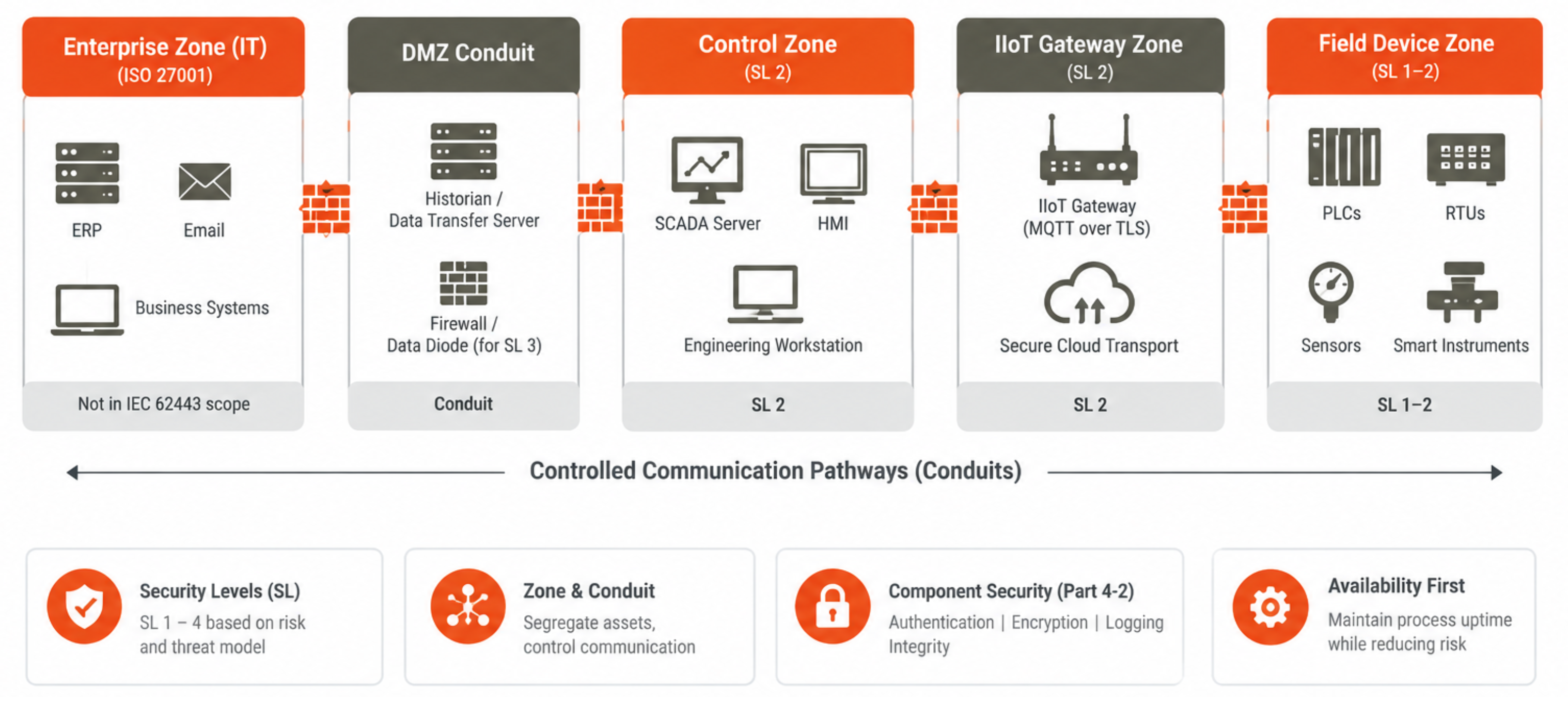
- Zone and Conduit Model — OT Network Security IIoT Architecture: The IEC 62443 security level zones and conduit model divides the IACS into zones (groups of assets sharing a security level) connected by conduits (controlled communication pathways between zones). Each conduit enforces the OT network security IIoT boundary between zones — typically a firewall allowing only approved protocols and directions of flow, or a data diode for highest-security unidirectional data export. The zone/conduit model maps naturally onto modern IIoT architectures: field devices in a process zone; IIoT gateways in a gateway zone; SCADA and historian servers in a control zone; and a DMZ conduit separating OT from IT networks.
- IEC 62443 Component Requirements (Part 4-2) — IIoT Gateway Security: IIoT gateways deployed in IEC 62443 OT cybersecurity compliant installations must meet Part 4-2 component security requirements including: authenticated access (username/password minimum SL 1; certificate-based mutual TLS for SL 2+); encrypted communications (TLS 1.2+ for all cloud and IT-facing connections); security event logging (audit trail of login attempts, configuration changes, connection events); and software integrity checking (firmware signed and verified before execution). The IACS cybersecurity standard Part 4-2 is increasingly required by asset owners in regulated industries (power, water, chemical) for new gateway deployments.
- IEC 62443 vs IT Cybersecurity Standards: The IACS cybersecurity standard IEC 62443 differs from IT security standards (ISO 27001, NIST CSF) in its treatment of availability: in IT security, confidentiality, integrity, and availability are weighted equally or with confidentiality first; in IEC 62443 OT cybersecurity, availability is paramount — a SCADA system or PLC that is shut down by a cybersecurity measure (false positive IDS block, mandatory patch reboot) may cause more harm than the cyber incident it was preventing. Industrial control system security under IEC 62443 therefore prioritises countermeasures that maintain process availability while reducing attack surface.
IEC 62443 Security Level Zones and Conduit Architecture
| Zone | Typical Assets | OT Network Security IIoT — Target SL |
|---|---|---|
| Enterprise Zone (IT) | ERP, email servers, business systems | IT security standards (ISO 27001) — not IEC 62443 OT cybersecurity scope |
| DMZ Conduit | Historian, data transfer server, firewall | Conduit: strict protocol/port filtering; data diode option for SL 3 |
| Control Zone | SCADA servers, HMIs, engineering workstations | SL 2 — industrial control system security with authentication and audit |
| IIoT Gateway Zone | IIoT gateways, edge devices, protocol converters | SL 2 — IEC 62443 security level zones with encrypted cloud transport |
| Field Device Zone | PLCs, RTUs, smart instruments, sensors | SL 1–2 — IACS cybersecurity standard basic authentication and integrity |
OT Cybersecurity and IIoT with Precisol Automation
Precisol Automation's Serial IIoT Gateway connects field devices to cloud platforms via encrypted MQTT with TLS — meeting the IEC 62443 OT cybersecurity data confidentiality requirements for the gateway zone. The PreciCloud IoT Cloud Dashboard provides the cloud-side of the OT network security IIoT architecture with role-based access control, audit logging, and secure API access — supporting the IACS cybersecurity standard IEC 62443 Part 4-2 data confidentiality and access control requirements.
See IT-OT secure connectivity in practice in our IT-OT bridge for process automation case study, or explore remote monitoring for Modbus PLCs for the industrial control system security gateway layer that bridges Modbus field devices to secure cloud connectivity within an IEC 62443 security level zones architecture.
Frequently Asked Questions
What is IEC 62443 OT cybersecurity and who does it apply to?
IEC 62443 OT cybersecurity is the international IACS cybersecurity standard series securing PLCs, SCADA, DCS, HMIs, and IIoT gateways. It applies to system operators (industrial plants), system integrators, and product suppliers. The standard assigns Security Levels (SL 1–4) to IACS zones based on risk, and requires industrial control system security countermeasures at each level — from basic access control (SL 1) to sophisticated layered defences against organised threat actors (SL 3). OT network security IIoT deployments in critical infrastructure routinely require IEC 62443 compliance.
What are IEC 62443 security level zones and conduits?
IEC 62443 security level zones are groups of IACS assets sharing the same security requirements and protected as a unit (field zone, control zone, enterprise zone). Conduits are controlled communication pathways between zones — firewalls or data diodes enforcing the OT network security IIoT boundary. Each zone is assigned a target Security Level (SL 1–4). The zone/conduit model provides flexible, risk-based industrial control system security segmentation that maps naturally onto IIoT gateway and SCADA architectures.
How does IEC 62443 apply to IIoT gateways and edge devices?
IEC 62443-4-2 (Component Security Requirements) applies to IIoT gateways as embedded IACS components. At SL 2, gateways must implement: certificate-based mutual TLS authentication; encrypted cloud communications; role-based access control; security event logging; firmware integrity verification; and denial-of-service resilience. The IACS cybersecurity standard Part 4-2 certification is increasingly required by asset owners in energy, water, and chemical sectors for OT network security IIoT gateway procurement.