ISO 26262 Functional Safety: ASIL Levels, Safety Goals, and Automotive Engineering Guide
16 October 2026
ISO 26262 functional safety is the standard that every automotive OEM, Tier 1 supplier, and ECU developer working on series production vehicles must follow for any electrical or electronic system where a failure could injure or kill a vehicle occupant or road user. As vehicle electronics have expanded from basic engine management to encompass steer-by-wire, electric power steering, autonomous emergency braking, lane keeping, and full ADAS stacks, the number of automotive ECUs subject to ISO 26262 functional safety requirements has grown dramatically — making ISO 26262 ECU development process knowledge an essential competency for automotive engineers at every tier of the supply chain. The standard's core tool for quantifying how much safety rigour is required is the ASIL automotive safety levels classification — a four-level scale (ASIL A through ASIL D) derived from a structured Hazard Analysis and Risk Assessment (HARA) that evaluates the severity, exposure, and controllability of each potential hazardous event. Functions classified ASIL D (the highest level — fatal injury, frequent exposure, uncontrollable) require the most demanding ISO 26262 ECU development practices: formal safety case documentation, systematic fault detection and mitigation, dual-redundant hardware architectures, and comprehensive functional safety automotive testing through fault injection and FMEA verification. Understanding how ISO 26262 functional safety applies to CAN bus networks, ECU software, and embedded system test campaigns is fundamental for any team developing or validating automotive control systems.
ISO 26262 Functional Safety: Lifecycle and Key Concepts
- ASIL Automotive Safety Levels — HARA Process: Every ISO 26262 functional safety programme begins with the Hazard Analysis and Risk Assessment (HARA). For each identified hazardous event (item failure in a vehicle driving situation), engineers estimate Severity (S0–S3), Exposure (E0–E4), and Controllability (C0–C3). The HARA table maps these three parameters to ASIL automotive safety levels (QM, A, B, C, D). ASIL D — the highest classification — results from combinations like S3+E4+C3 (fatal injury, highway driving, uncontrollable). Airbag non-deployment, loss of steering, and unintended acceleration are typical ASIL D hazardous events. ASIL decomposition allows a system to split an ASIL D requirement into two ASIL B components implemented independently — reducing the cost of meeting the highest ASIL automotive safety levels in redundant architectures.
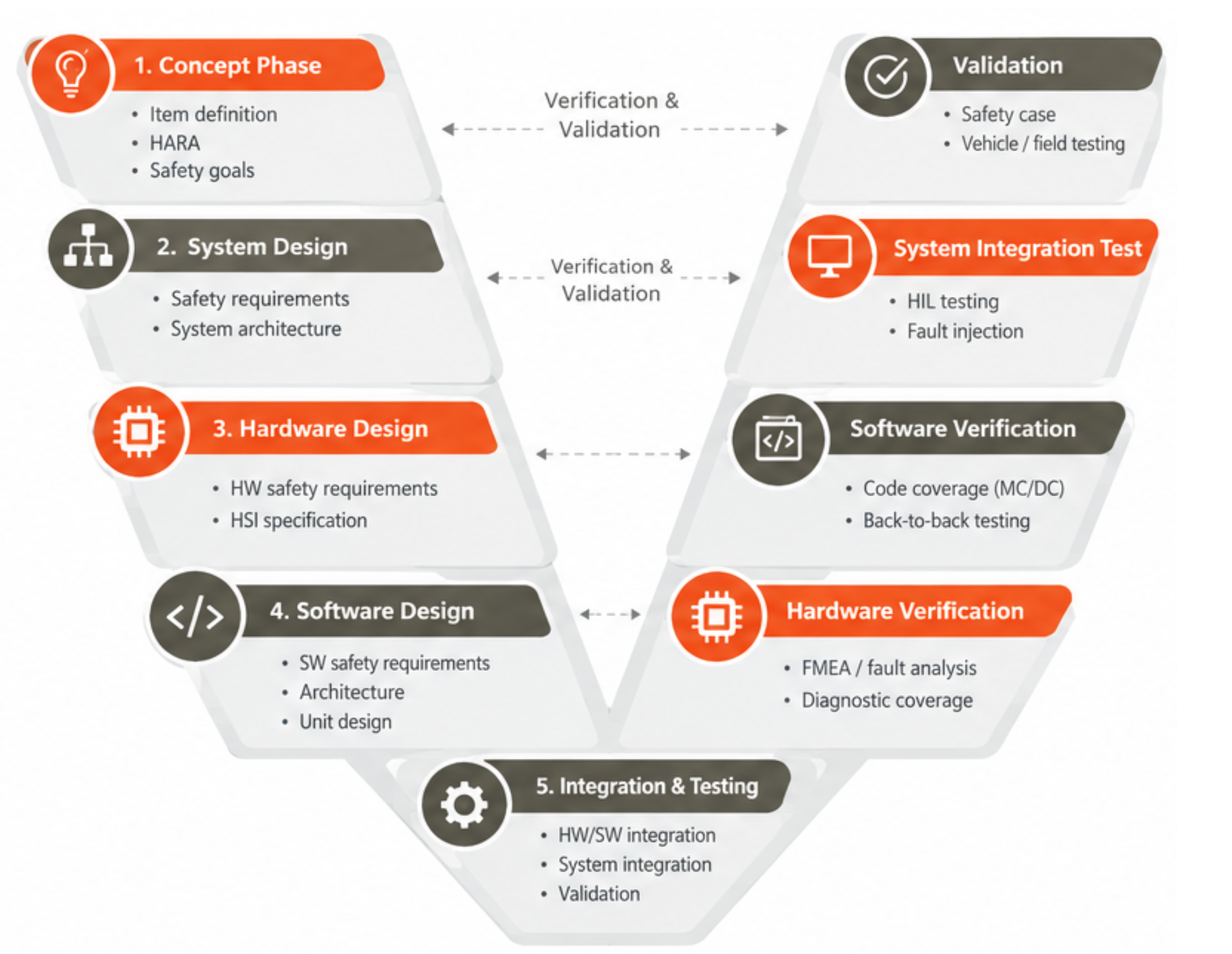
- ISO 26262 ECU Development — Safety Lifecycle: ISO 26262 ECU development follows a structured V-model safety lifecycle: concept phase (item definition, HARA, safety goals) → system design (technical safety requirements, system architecture) → hardware design (hardware safety requirements, HSI specification) → software design (software safety requirements, architecture, unit design) → integration and testing (hardware-software integration, system integration, validation). At each level, ISO 26262 ECU development requires design verification, safety analysis, and test coverage evidence proportional to the ASIL level. ASIL D software requires formal methods or exhaustive structural coverage (MC/DC — Modified Condition/Decision Coverage at 100%).
- ISO 26262 FMEA HAZOP — Safety Analysis Methods: ISO 26262 FMEA HAZOP analysis is the systematic failure mode analysis required to demonstrate that all hazardous failure modes are identified and mitigated. FMEA (Failure Mode and Effects Analysis) at the hardware level identifies each component failure mode (open, short, stuck-at) and traces its propagation through the system to determine whether it can cause a violation of a safety goal without detection. HAZOP (Hazard and Operability Study) applies a structured guideword approach to identify deviations in system behaviour. Both ISO 26262 FMEA HAZOP analyses must show that each identified failure mode either has diagnostic coverage (detected and reacted to) or has sufficiently low probability to meet the PMHF target.
- Functional Safety Automotive Testing — Verification Evidence: Functional safety automotive testing generates the test evidence that forms the safety case. Key functional safety automotive testing activities include: software unit testing against requirements with code coverage measurement (MC/DC for ASIL D); back-to-back testing comparing host-compiled simulation results with target binary execution; HIL fault injection testing — verifying that hardware safety mechanisms detect introduced faults and trigger the correct safe state reactions; and system-level validation testing confirming that all safety goals derived from the HARA are met under worst-case conditions.
ISO 26262 ASIL Classification Reference
| ASIL Level | Typical Automotive Application | ISO 26262 ECU Development Key Requirement |
|---|---|---|
| ASIL D | Steer-by-wire, brake-by-wire, airbag, electric power steering | Dual redundancy, 100% MC/DC coverage, systematic FMEA, formal safety case |
| ASIL C | Electronic throttle control, ABS, ESC | High diagnostic coverage, structured testing, ISO 26262 FMEA HAZOP |
| ASIL B | Transmission control, ADAS camera, EV BMS | Moderate diagnostic coverage, functional safety automotive testing with fault injection |
| ASIL A | Instrument cluster warnings, lighting control | Basic diagnostic checks, standard test coverage |
| QM | Infotainment, comfort features, non-safety ADAS | Standard quality management — no ISO 26262 functional safety requirements |
ISO 26262 ECU Development Support with Precisol Automation
Precisol Automation's CAN Data Logger captures complete CAN bus network traffic during functional safety automotive testing campaigns — providing the timestamped, synchronised network log needed to correlate fault injection events with ECU responses and verify safe state transitions in ISO 26262 ECU development validation testing. The CAN Bus Gateway enables multi-network test configurations where safety-critical CAN networks (ASIL D powertrain and chassis buses) are isolated from diagnostic and logging networks as required by ISO 26262 functional safety network architecture principles.
See CAN bus data logging in vehicle safety system testing in our autonomous mobile robot testing case study, or explore AMR field testing with CAN bus gateway for multi-ECU CAN network test configurations applicable to ISO 26262 FMEA HAZOP verification and ASIL automotive safety levels integration testing.
Frequently Asked Questions
What is ISO 26262 functional safety and which vehicles does it apply to?
ISO 26262 functional safety is the international standard for E/E system safety in road vehicles — applying to any series production passenger car, truck, or motorcycle with an E/E system that could cause injury if it malfunctions. It defines the safety lifecycle from concept to decommissioning, ASIL automotive safety levels (A–D) quantifying required rigour, safety goals from HARA, and ISO 26262 ECU development processes for hardware and software. All OEMs and Tier 1 suppliers developing safety-relevant automotive ECUs must comply.
What are ASIL automotive safety levels and how are they determined?
ASIL automotive safety levels (QM, A, B, C, D) are determined by the HARA process: for each hazardous event, engineers estimate Severity (S0–S3), Exposure (E0–E4), and Controllability (C0–C3). High S+E+C combinations yield high ASIL — a fatal (S3), frequent (E4), uncontrollable (C3) hazard is ASIL D. ASIL D ISO 26262 ECU development requires the most rigorous safety measures: 100% MC/DC test coverage, systematic ISO 26262 FMEA HAZOP, dual hardware redundancy, and comprehensive functional safety automotive testing.
What functional safety automotive testing is required for ISO 26262 ECU development?
ISO 26262 functional safety automotive testing covers: software unit testing with MC/DC coverage; back-to-back testing (host simulation vs. target binary); HIL fault injection testing verifying safe state transitions; ISO 26262 FMEA HAZOP analysis confirming all failure modes are mitigated; and system validation testing confirming all safety goals are met. Evidence from functional safety automotive testing is assembled into the ISO 26262 ECU development safety case — the structured argument that the system is sufficiently safe for its ASIL automotive safety levels classification.