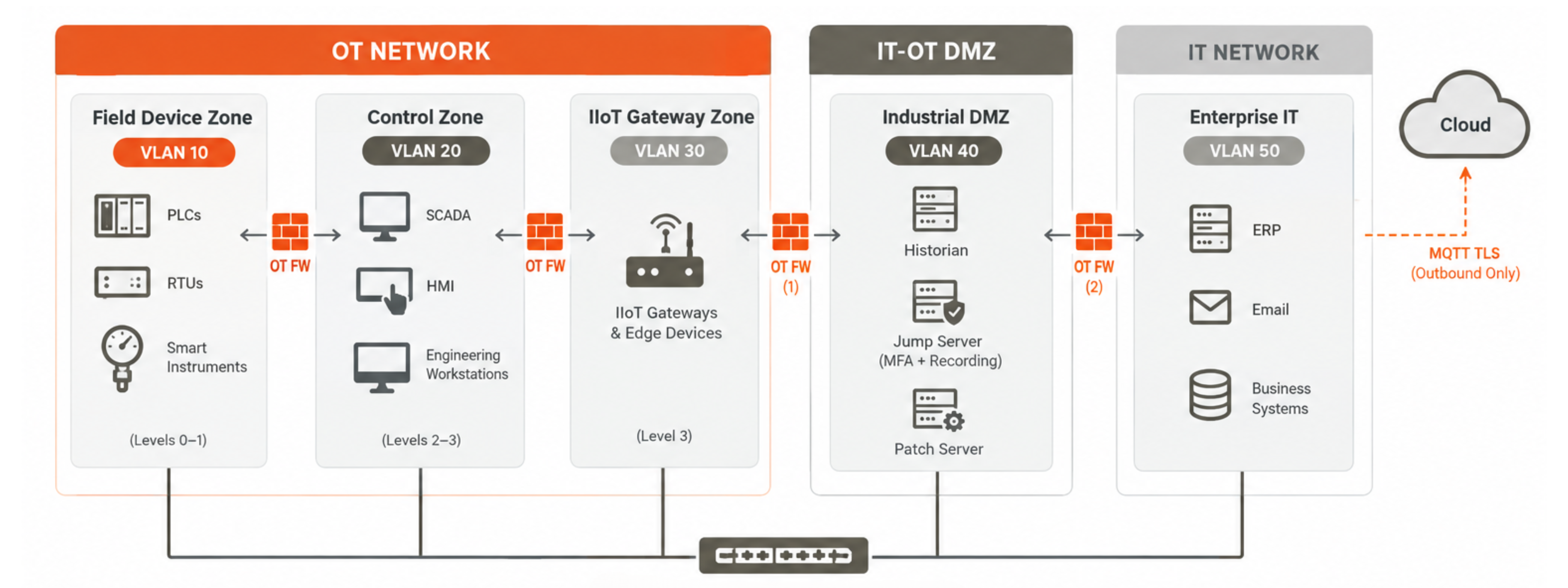
Industrial network segmentation IIoT is the most impactful single cybersecurity control that an industrial plant can implement — converting a flat, undefended network where any compromise becomes a plant-wide crisis into a layered architecture where each zone is individually defended and a breach in one zone is contained before it reaches critical OT systems. The evidence from major industrial cyber incidents is clear: Colonial Pipeline (2021) — ransomware entered via IT but IT and OT shared network pathways that made OT shutdown the prudent response; Norsk Hydro (2019) — LockerGoga ransomware spread from IT to OT-adjacent systems because network segmentation between production and IT was incomplete; Oldsmar water treatment (2021) — an attacker accessed the HMI remotely because remote access was not properly segmented from other network segments. All three incidents point to the same root cause: inadequate industrial network segmentation IIoT and IT-OT DMZ design industrial. Implementing proper industrial network segmentation IIoT — with a structured IIoT network zone design that places OT firewalls between every zone pair, enforces strict industrial VLAN segmentation, and implements the IT-OT DMZ design industrial layer between OT and IT networks — is the foundational security architecture that all subsequent IIoT deployments must be built upon.
Industrial Network Segmentation IIoT: Zone Architecture
- Field Device Zone — Highest OT Isolation: The field device zone contains PLCs, RTUs, safety systems, and smart field instruments at Purdue Model Levels 0–1. Industrial network segmentation IIoT treats this as the highest-sensitivity zone — no outbound internet, no IT access, and inbound Modbus/PROFIBUS access only from the specific SCADA servers in the control zone. Industrial VLAN segmentation places all field devices on a dedicated VLAN with the OT firewall IIoT architecture permitting only the control zone SCADA subnet to reach Modbus TCP port 502. No other traffic crosses this firewall.
- IIoT Gateway Zone — Controlled Outbound Connectivity: The IIoT gateway zone is the critical architectural addition that industrial network segmentation IIoT must address when deploying IIoT alongside SCADA. IIoT gateways need Modbus read access to field devices (inbound from control zone or directly from field device zone with strict read-only rules) and MQTT TLS outbound to cloud (through the DMZ conduit). IIoT network zone design places gateways in their own VLAN, firewalled separately from SCADA and HMI systems — so that a compromised IIoT gateway cannot reach SCADA servers, and a SCADA server compromise cannot access the cloud connectivity of the gateway zone. OT firewall IIoT architecture for the gateway zone: inbound Modbus TCP read-only from control zone VLAN only; outbound MQTT TCP 8883 (TLS) to specific cloud FQDN only; all other traffic denied.
- IT-OT DMZ Design Industrial — The Security Boundary: IT-OT DMZ design industrial creates the mandatory buffer between OT and IT networks using a dual-firewall architecture. Firewall 1 (OT side) permits only OPC-UA or Modbus read flows from Level 3 to DMZ historian; Firewall 2 (IT side) permits only SQL or REST read queries from IT business systems to DMZ historian. No Layer 3 routing path exists between OT subnet and IT subnet — the IT-OT DMZ design industrial servers are the only point of data transfer. Jump servers in the DMZ provide the only authorised path for remote maintenance access, with MFA, session recording, and strict time-window enforcement.
- Industrial VLAN Segmentation — Implementation: Industrial VLAN segmentation uses managed Layer 2 switches with 802.1Q VLAN tagging to physically separate traffic on shared switch infrastructure. Inter-VLAN routing is performed exclusively by the OT firewall IIoT architecture appliance — not the managed switch — ensuring that firewall policy is enforced for every cross-zone packet. Industrial VLAN segmentation alone (without a firewall performing inter-VLAN inspection) provides only logical separation — a misconfigured switch port or VLAN ACL can leak traffic between zones. The firewall is the enforcement point.
IIoT Network Zone Design: Recommended Architecture
| Zone (VLAN) | Devices | OT Firewall IIoT Architecture — Permitted Traffic |
|---|---|---|
| Field Device Zone (VLAN 10) | PLCs, RTUs, smart instruments | Modbus TCP inbound from VLAN 20 only — industrial network segmentation IIoT |
| Control Zone (VLAN 20) | SCADA, HMI, engineering workstations | Modbus/OPC-UA to VLAN 10; OPC-UA read to VLAN 40 DMZ; no internet |
| IIoT Gateway Zone (VLAN 30) | IIoT gateways, edge devices | Modbus read-only from VLAN 20; MQTT TLS to cloud via VLAN 40 only |
| Industrial DMZ (VLAN 40) | Historian, jump server, patch server | IT-OT DMZ design industrial — dual firewall; no direct OT-IT routing |
| Enterprise IT (VLAN 50) | ERP, email, business systems | SQL/REST read from VLAN 40 DMZ historian only |
Industrial Network Segmentation IIoT with Precisol Automation
Precisol Automation's Serial IIoT Gateway is architecturally designed for the IIoT gateway zone in an industrial network segmentation IIoT deployment — collecting Modbus field data through a dedicated read-only interface and publishing via encrypted MQTT TLS to cloud, without requiring any inbound internet connectivity (outbound-only connections eliminate inbound firewall port forwarding risk). The PreciCloud IoT Cloud Dashboard sits in the cloud/IT layer, receiving data through the IT-OT DMZ design industrial MQTT conduit without any direct OT network exposure.
See IT-OT secure network architecture in practice in our IT-OT bridge for process automation case study, or explore remote monitoring for Modbus PLCs for the IIoT network zone design and OT firewall IIoT architecture that enables secure read-only Modbus field data collection within an industrial VLAN segmentation framework.
Frequently Asked Questions
What is industrial network segmentation and why is it essential for IIoT?
Industrial network segmentation IIoT divides plant networks into isolated zones — field devices, control systems, IIoT gateways, industrial DMZ, and enterprise IT — each protected by OT firewall IIoT architecture rules. Without segmentation, a flat network allows any compromise to reach all PLCs, SCADA servers, and engineering workstations. IIoT network zone design with industrial VLAN segmentation contains incidents to the breached zone, preventing lateral movement to critical OT control systems.
How do you design an IT-OT DMZ for an industrial plant with IIoT connectivity?
IT-OT DMZ design industrial uses dual firewalls creating a buffer zone: Firewall 1 (OT side) allows only OPC-UA/Modbus read from OT to DMZ historian; Firewall 2 (IT side) allows only SQL/REST read from IT to DMZ historian. No direct OT-IT routing. IIoT gateways in their own zone connect via MQTT TLS to cloud through the DMZ conduit. Jump servers in the DMZ provide MFA-secured remote maintenance access with session recording — the only authorised IT-to-OT path.
What VLAN design should be used for OT firewall IIoT architecture?
Industrial VLAN segmentation uses separate VLANs for each zone (field, control, IIoT gateway, DMZ, IT) with 802.1Q tagging on managed switches. Inter-VLAN routing is performed exclusively by the OT firewall IIoT architecture appliance — not the switch — so every cross-zone packet passes policy enforcement. VLAN alone without firewall inspection is insufficient for industrial network segmentation IIoT. IIoT gateway zone: Modbus TCP read-only inbound from control VLAN; MQTT TLS outbound to cloud only.