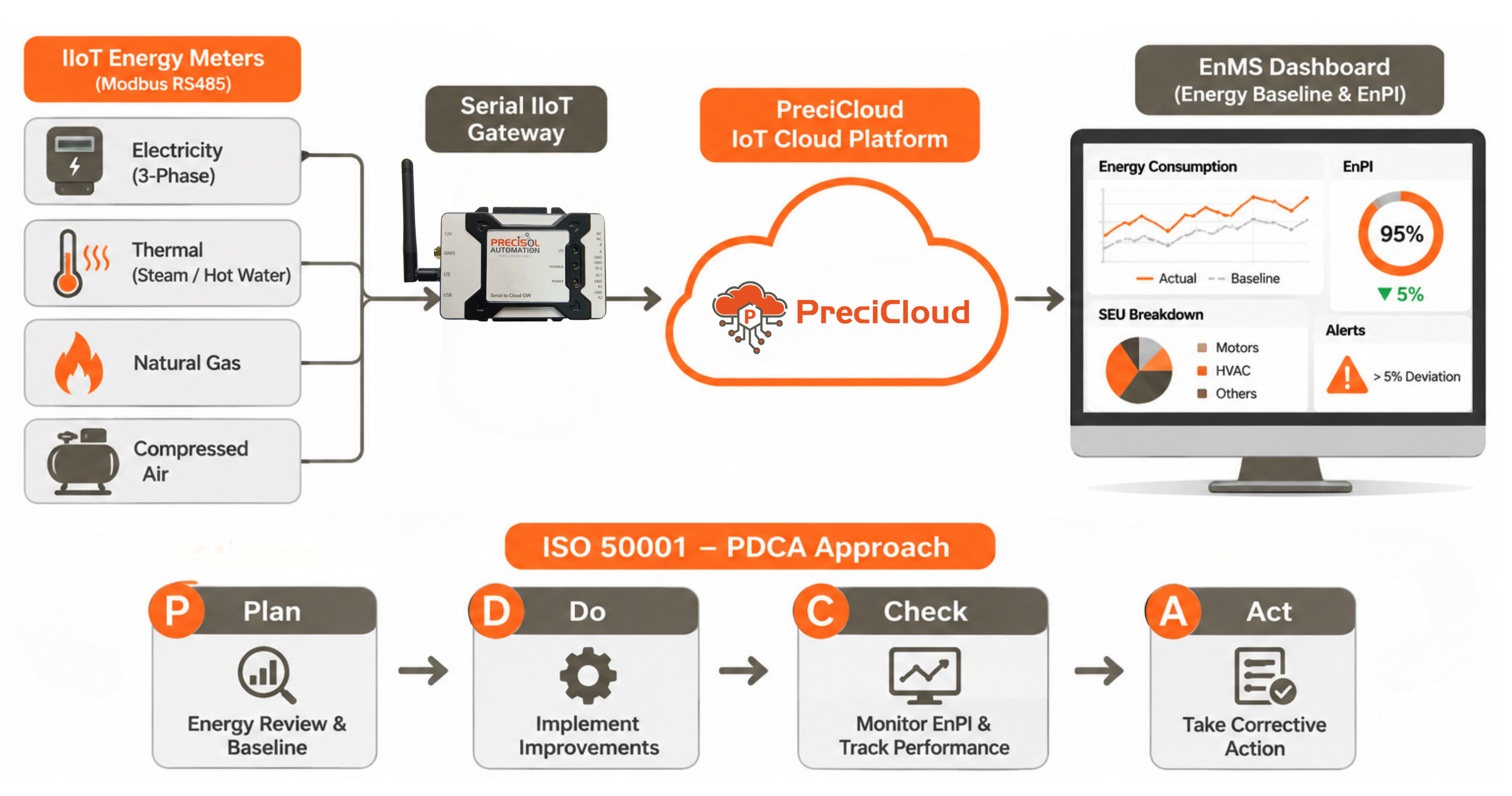
ISO 50001 energy management IoT brings together the structured improvement framework of the ISO 50001 Energy Management System standard and the continuous sub-metering and analytics capability of Industrial IoT platforms to create the data-driven energy management system that manufacturers, buildings operators, and public institutions need to achieve and sustain the energy efficiency improvements that both economics and regulatory pressure now require. ISO 50001 certification signals to customers, regulators, and investors that an organisation systematically manages its energy use and continuously improves its energy performance — but the standard's requirements for energy performance measurement, baseline comparison, and continuous improvement tracking only have practical meaning when backed by adequate sub-metering infrastructure that can attribute energy consumption to specific equipment, processes, or departments. Many organisations that have attempted ISO 50001 EnMS implementation based on utility bills and manual meter reads alone find that they cannot identify their Significant Energy Uses (SEUs) with enough granularity, cannot track the impact of specific improvement projects on energy consumption, and cannot maintain the ongoing energy performance monitoring that the standard requires for continued certification — because utility bills arrive monthly and aggregate the entire facility, while ISO 50001 energy baseline monitoring needs sub-daily, sub-system resolution to be actionable. An energy management system IIoT platform — with Modbus RS485 energy meters on every significant load connected via IIoT gateways to a cloud analytics platform calculating Energy Performance Indicators (EnPIs) against regression-based baselines — provides exactly the measurement infrastructure that makes ISO 50001 energy management IoT practically achievable rather than a documentation exercise. This guide covers the ISO 50001 standard structure, the ISO 50001 EnMS implementation phases and IoT role at each phase, the ISO 50001 energy baseline monitoring methodology, and the metering infrastructure required for a credible energy management system IIoT.
ISO 50001 Energy Management IoT: PDCA Implementation Phases
- Plan — Energy Review and Baseline with IIoT Sub-Metering: ISO 50001 EnMS implementation planning begins with an energy review identifying all energy sources, all energy uses, and the Significant Energy Uses (SEUs) — the subset of uses that together account for the majority of energy consumption and have the most improvement potential. ISO 50001 energy management IoT sub-metering during the energy review phase reveals which equipment, production lines, or building systems are the actual major consumers — data that utility bills and nameplated motor ratings cannot provide. The energy review also establishes the energy baseline: 12 months of sub-meter data from all SEUs forms the regression model (EnPI = f(production variables, environmental variables)) against which future performance is compared in ISO 50001 energy baseline monitoring.
- Do — Improvement Projects with IIoT Performance Verification: ISO 50001 EnMS implementation improvement projects — installing VFDs on pump and fan motors, LED lighting retrofits, compressed air leak repairs, boiler efficiency tuning — must demonstrate measurable energy savings attributed to the specific project. Energy management system IIoT sub-metering before and after the improvement project provides the M&V (Measurement and Verification) data required by ISO 50001 to confirm that the project achieved its energy saving objective. Without IoT sub-metering, M&V relies on nameplate ratings and operating hours — a far less credible approach for ISO 50001 audit purposes.
- Check — Ongoing EnPI Monitoring and Alert: The Check phase of ISO 50001 energy management IoT is where the energy management system IIoT provides its most continuous value: comparing actual energy consumption against the EnPI baseline model every week or month, flagging deviations that indicate performance degradation (compressed air leak growth, boiler efficiency decline, HVAC setpoint drift). ISO 50001 energy baseline monitoring deviations >5% trigger corrective action records in the EnMS — the cloud platform auto-generates these records from the sub-meter data, replacing manual spreadsheet comparison and reducing EnMS administration burden.
- SEP Energy Certification IoT — Superior Energy Performance: SEP energy certification IoT (Superior Energy Performance — the US DOE EnMS certification under ISO 50001 Plus) requires verified energy intensity reduction of 5% or more over a 3-year period, with measurement and verification to IPMVP protocol. ISO 50001 energy management IoT sub-metering data provides the M&V measurement baseline and post-implementation monitoring data required for SEP verifier audit — the granular, timestamped sub-meter records are far more auditable than manual records or utility bills for documenting SEP energy savings claims.
Energy Management System IIoT: Required Metering Infrastructure
| Energy Type | ISO 50001 Energy Management IoT Meter | ISO 50001 Energy Baseline Monitoring Use |
|---|---|---|
| Electricity (3-phase) | Class 1 kWh meter, Modbus RTU RS485 | Motor, drive, HVAC, compressor SEU monitoring |
| Thermal (steam/hot water) | Ultrasonic flow meter + temperature sensors | Boiler, heat exchanger, process heater SEU baseline |
| Natural Gas | Turbine or Coriolis meter, Modbus output | Combustion SEU — kiln, furnace, boiler gas baseline |
| Compressed Air | Thermal mass flow meter | Compressed air system SEU — ISO 50001 EnMS implementation |
ISO 50001 Energy Management IoT with Precisol Automation
Precisol Automation's Serial IIoT Gateway connects to Modbus RS485 electricity, gas, and thermal energy meters — providing the sub-metering data collection infrastructure for ISO 50001 EnMS implementation across all energy types. The PreciCloud IoT Cloud Dashboard provides energy management system IIoT dashboards with EnPI calculation, baseline comparison, and consumption trend reporting aligned to ISO 50001 energy baseline monitoring requirements.
See energy metering in practice in our IT-OT bridge for process automation case study, or explore smart energy metering for the complete IIoT sub-metering deployment pattern used in ISO 50001 energy management IoT industrial implementations.
Frequently Asked Questions
What is ISO 50001 and how does IoT support its implementation?
ISO 50001 energy management IoT uses IIoT sub-metering and cloud analytics to provide the continuous energy data that the ISO 50001 EnMS standard requires for Significant Energy Use (SEU) identification, energy baseline establishment, and ongoing performance monitoring. ISO 50001 EnMS implementation without adequate sub-metering relies on utility bills (monthly, whole-facility) that cannot identify which equipment or process is the actual driver of consumption or verify whether specific improvement projects delivered their projected savings — making the EnMS a documentation exercise rather than a genuine improvement system.
How does IoT energy baseline monitoring work for ISO 50001 EnMS?
ISO 50001 energy baseline monitoring with IIoT: deploy Modbus RS485 energy meters on all SEUs → collect 12 months of sub-meter data synchronised with production output and relevant variables → develop EnPI regression model (kWh = f(tonnes_produced, temperature, operating_hours)) for each SEU from the baseline period → energy management system IIoT continuously compares actual consumption against EnPI prediction → deviations >5% trigger corrective action records. The IoT platform auto-generates the monthly energy review reports required by ISO 50001 audit from sub-meter data.
What IIoT energy meters and sensors are needed for ISO 50001 EnMS?
Energy management system IIoT for ISO 50001 energy management IoT requires: three-phase kWh meters (Class 1 or 0.5, Modbus RTU) on motor, drive, HVAC, and lighting circuits; thermal energy meters (flow meter + temperature sensors) for steam and chilled water SEUs; thermal mass flow meters for compressed air systems; and gas meters (turbine or Coriolis, Modbus output) for combustion processes. All meters connect via IIoT gateways to cloud EnMS platforms calculating EnPIs against ISO 50001 energy baseline monitoring models and generating M&V documentation for certification audit.