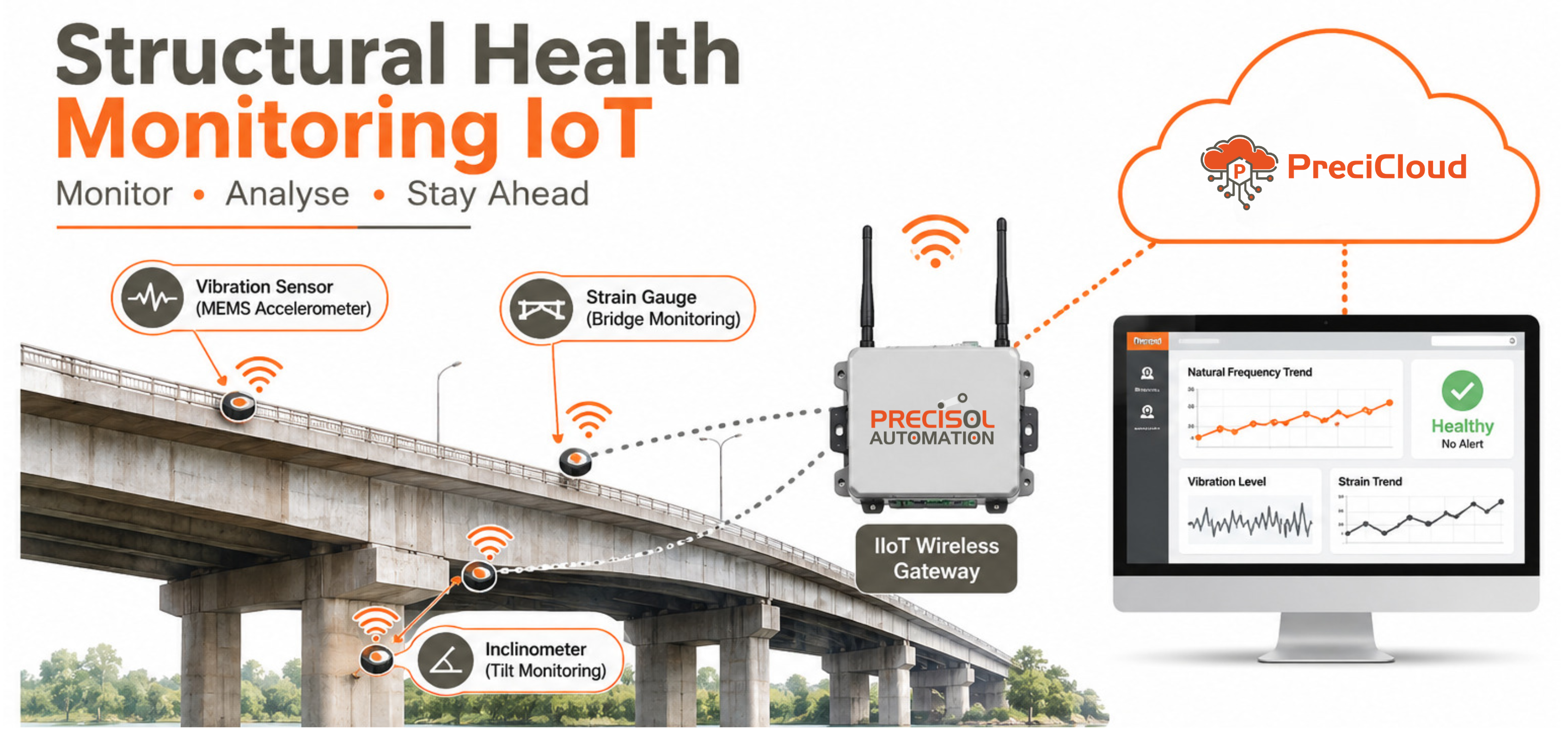
Structural health monitoring IoT is transforming infrastructure asset management by replacing periodic manual inspections — which can only assess visible surface conditions at the time of inspection — with continuous sensor-based monitoring that captures the actual structural response of bridges, industrial structures, and civil infrastructure under real operational loading. The economic and safety case for structural health monitoring IoT is compelling: infrastructure inspections are expensive (a detailed bridge inspection with lane closure costs $50,000–$200,000), infrequent (typically every 2–6 years for bridges), and subjective (visual condition ratings depend on inspector experience and access to all structural components). Between inspection cycles, undetected damage can progress — fatigue cracks in steel bridges, tendon corrosion in prestressed concrete, scour erosion of bridge foundations — to the point where sudden partial or total structural failure occurs, as demonstrated by the 2018 Morandi Bridge collapse in Genoa (43 fatalities) and the 2021 Surfside condominium collapse in Miami (98 fatalities). SHM vibration sensor industrial arrays, strain gauges, and displacement sensors providing continuous data to cloud monitoring platforms can detect the structural response changes characteristic of developing damage weeks or months before the damage becomes visually apparent or structurally critical — enabling targeted inspection, proactive maintenance, and safety closures at the right time rather than waiting for the next scheduled inspection cycle. Industrial applications are equally important: chimney stacks, cooling towers, elevated conveyors, offshore jacket platforms, and mining headframes all benefit from civil structure IoT monitoring with natural frequency tracking and strain monitoring to detect the onset of fatigue damage, foundation settlement, or corrosion loss in critical structural members. This guide covers the sensor technologies for bridge monitoring IoT sensor deployments, the structural vibration analysis IoT algorithms that detect damage from sensor data, and the SHM vibration sensor industrial network architecture for civil and industrial structure monitoring.
Structural Health Monitoring IoT: Sensor System Design
- SHM Vibration Sensor Industrial — MEMS Accelerometers for Modal Analysis: SHM vibration sensor industrial for civil structures uses low-noise MEMS accelerometers (±2g range, 0.1–100 Hz bandwidth, noise floor <10 μg/√Hz) to capture the low-frequency ambient vibration from which natural frequencies are extracted. For a highway bridge with a fundamental frequency of 2–5 Hz, a 100 Hz sample rate provides adequate frequency resolution. Bridge monitoring IoT sensor arrays deploy 4–20 accelerometers across the bridge span — sufficient to characterise the first 5–10 vibration modes. Wireless SHM vibration sensor industrial nodes synchronise via GPS timing or network time protocol (NTP) to ensure phase relationships between distributed sensors are preserved for mode shape extraction — critical for mode shape-based damage localisation.
- Bridge Monitoring IoT Sensor — Strain Monitoring: Vibrating wire strain gauges (typical range ±1500 μɛ, resolution 1 μɛ) on steel girders and concrete sections provide the static and quasi-static strain data that complements dynamic SHM vibration sensor industrial data. Live load event monitoring using strain gauges records the strain time history under heavy vehicle crossings, enabling weighing-in-motion (WIM) calculations from the strain response and detecting when vehicles exceed the design live load envelope. Temperature-compensated strain monitoring tracks seasonal thermal strain vs. mechanical strain to isolate structural load effects. Bridge monitoring IoT sensor strain data over 1–3 years builds the fatigue damage accumulation model required for remaining fatigue life estimation.
- Structural Vibration Analysis IoT — Natural Frequency Tracking: Structural vibration analysis IoT algorithms extract natural frequencies from ambient vibration data using Operational Modal Analysis (OMA) — stochastic subspace identification (SSI) or frequency domain decomposition (FDD) applied to 10–60 minute vibration data windows. Natural frequencies are tracked weekly or monthly in the structural health monitoring IoT platform, with statistical control limits flagging frequency shifts exceeding 3–5% from the baseline mean. Temperature correction using linear regression of frequency vs. temperature removes seasonal thermal effects, improving sensitivity to genuine structural damage detection. Cumulative frequency shift trends — even small shifts (<2%) sustained over multiple months — indicate progressive stiffness loss from corrosion, fatigue cracking, or deterioration that warrants targeted inspection.
- Civil Structure IoT Monitoring — Industrial Applications: Civil structure IoT monitoring for industrial assets (cooling towers, chimneys, offshore platforms, mining headframes) focuses on natural frequency and tilt monitoring. A cooling tower fan deck with developing column corrosion shows a measurable natural frequency decrease before visual inspection reveals significant section loss. Chimney stack tilt monitoring with precision inclinometers (±0.001° resolution) detects foundation settlement before the tilt becomes visually apparent. Structural health monitoring IoT on offshore platforms uses strain monitoring on jacket members to accumulate fatigue damage cycles under wave loading — estimating remaining fatigue life for certification renewal without the risk and cost of underwater inspection every year.
Structural Health Monitoring IoT: Sensor Technology Comparison
| Sensor | SHM Measurement | Bridge Monitoring IoT Sensor / Civil Structure IoT Application |
|---|---|---|
| MEMS Accelerometer | Natural frequency, mode shape, damping | Modal analysis, traffic event monitoring — SHM vibration sensor industrial |
| Vibrating Wire Strain Gauge | Static and quasi-static strain | Live load monitoring, fatigue accumulation — bridge monitoring IoT sensor |
| Biaxial Inclinometer | Tilt, differential settlement | Foundation settlement, pier movement — civil structure IoT monitoring |
| Displacement LVDT | Mid-span deflection, crack width | Live load deflection limits, crack propagation — structural vibration analysis IoT |
Structural Health Monitoring IoT with Precisol Automation
Precisol Automation's Wireless Vibration and Temperature Sensor provides the SHM vibration sensor industrial node for structural monitoring deployments — battery-powered, IP67 rated, with wireless mesh connectivity for bridge, building, and industrial structure applications where cable infrastructure is impractical. The PreciCloud IoT Cloud Dashboard provides the structural health monitoring IoT data aggregation and trend visualisation layer for natural frequency tracking and alert management.
See continuous structural monitoring in our predictive maintenance in carbon manufacturing plant case study, or explore predictive maintenance for rotating machinery for the vibration sensor and wireless gateway configuration applicable to civil structure IoT monitoring structural deployments.
Frequently Asked Questions
What is structural health monitoring (SHM) with IoT sensors?
Structural health monitoring IoT continuously monitors the response of bridges, buildings, and industrial structures using distributed sensors — SHM vibration sensor industrial (MEMS accelerometers), strain gauges, inclinometers, and displacement transducers — connected to IIoT gateways and cloud platforms. Natural frequency tracking, strain monitoring, and statistical anomaly detection detect structural damage, stiffness reduction, or overloading earlier than periodic visual inspection, enabling proactive maintenance and safety decisions before structural integrity reaches a critical threshold.
What sensors are used for bridge monitoring IoT sensor deployments?
Bridge monitoring IoT sensor systems use: MEMS accelerometers (SHM vibration sensor industrial, 0.1–100 Hz) for natural frequency and mode shape monitoring via OMA; vibrating wire strain gauges for live load strain and fatigue accumulation; biaxial inclinometers for pier tilt and foundation settlement; displacement LVDTs for mid-span deflection; and temperature/wind sensors for environmental correlation. Wireless SHM vibration sensor industrial nodes synchronised via NTP transmit to IIoT gateways for cloud structural vibration analysis IoT and natural frequency tracking dashboards.
How does structural vibration analysis IoT detect structural damage?
Structural vibration analysis IoT detects damage through natural frequency tracking — structural damage reduces stiffness, lowering natural frequencies (even 2–5% shifts are significant). OMA algorithms (SSI, FDD) extract frequencies from ambient vibration data windows collected by SHM vibration sensor industrial arrays. Temperature-corrected frequency trends in the structural health monitoring IoT cloud platform detect genuine stiffness loss vs. seasonal thermal variation. Mode shape changes localise damage to specific structural zones. Statistical control charts (CUSUM) on frequency trends detect progressive degradation in civil structure IoT monitoring deployments weeks to months before visible damage appears.