Private 5G industrial IoT is moving from pilot projects and trade show demonstrations to production deployments in leading manufacturing and logistics facilities — driven by the convergence of mature 5G standalone (SA) core network technology, the commercial availability of CBRS spectrum-band private LTE/5G radios, and the manufacturing industry's genuine need for a wireless connectivity technology that can replace the unreliable Wi-Fi and expensive cable infrastructure that current industrial IoT deployments depend on. The case for private 5G industrial IoT is not simply that it is faster than Wi-Fi — it is that the architecture of 5G cellular (licensed or managed shared spectrum, deterministic QoS via 5QI scheduling, seamless mobility handover, purpose-built for industrial-grade device density) eliminates the fundamental limitations of unlicensed Wi-Fi that have prevented wireless from replacing wired connections in time-sensitive industrial applications. 5G private network manufacturing deployments at BMW, Volkswagen, Bosch, and other automotive manufacturers have demonstrated AGV fleet management, wireless process control, and connected worker AR assistance operating on the same campus 5G network without the interference, handover disruption, and unpredictable QoS that made the same applications impractical on Wi-Fi. The private 5G vs Wi-Fi 6 industrial comparison is not a binary choice — most manufacturers will deploy both, using campus 5G network IIoT for mobility-critical and latency-critical applications while retaining Wi-Fi 6 for static high-throughput applications where its lower infrastructure cost is justified. Understanding when 5G URLLC industrial automation is genuinely needed versus when Wi-Fi 6 is sufficient — and what a campus 5G network IIoT deployment actually costs and requires — is critical for manufacturers evaluating private 5G as part of their Industry 4.0 infrastructure roadmap. This guide covers the private 5G industrial IoT technology foundations, 5G private network manufacturing use cases, the private 5G vs Wi-Fi 6 industrial comparison, and the campus 5G network IIoT deployment architecture.
Private 5G Industrial IoT: Technology Architecture
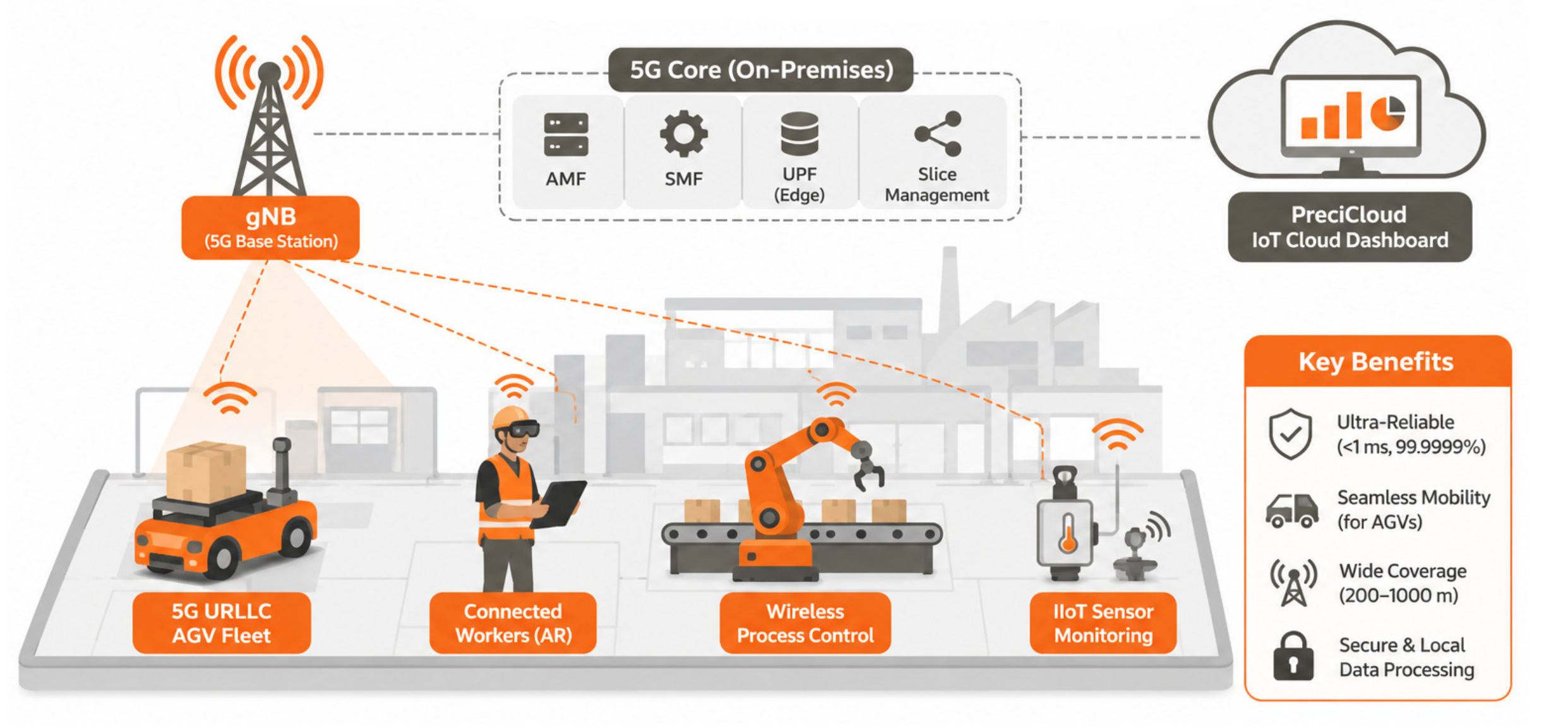
- 5G NR Components — Campus 5G Network IIoT Architecture: A campus 5G network IIoT deployment consists of: gNB (Next Generation NodeB) — the 5G base station (radio access node) deploying 3.5 GHz or CBRS band mid-power small cells or macro radios; typically 2–6 gNBs cover a 50,000 m² factory floor with adequate signal depth. 5G Core (5GC) — the software-defined core network functions running on-premises or at the campus edge: AMF (Access and Mobility Management), SMF (Session Management), UPF (User Plane Function at the edge for local data processing with <1 ms latency to edge servers), and Network Slice Management for 5G URLLC industrial automation slice configuration. 5G devices — UEs (User Equipment): industrial 5G modules embedded in AGVs, sensors, cameras, and wearables; CBRS or sub-6 GHz 5G CPE for fixed sensor gateways. The private 5G industrial IoT data plane processes all plant data locally at the edge UPF — no data leaves the campus to a public 5G core — providing data sovereignty and the local processing latency required for time-critical control applications.
- 5G URLLC Industrial Automation — Time-Sensitive Control: 5G URLLC industrial automation (Ultra-Reliable Low-Latency Communication) is the 5G NR service category targeting <1 ms end-to-end latency and 99.9999% availability for closed-loop control applications. URLLC uses: mini-slots (2 OFDM symbols vs 14 for normal scheduling) for sub-millisecond scheduling granularity; frequency diversity (multiple frequency resources per transmission) for reliability; and dedicated network slice with pre-allocated radio resources preventing contention with other devices. 5G URLLC industrial automation enables wireless PLC I/O (replacing Modbus/PROFINET cables in harsh environments), AGV safety system commands (emergency stop latency guarantee), and motion control synchronisation — applications that Wi-Fi cannot support due to CSMA/CA contention access and variable latency.
- Private 5G vs Wi-Fi 6 Industrial — Selection Decision Matrix: Choose private 5G industrial IoT when: AGV or AMR fleets require seamless handover during movement at 5+ km/h (Wi-Fi handover too slow); closed-loop control applications require guaranteed worst-case latency <10 ms (5G URLLC); device density exceeds 50 simultaneous devices per 100 m² (Wi-Fi capacity limit); or coverage area is large (>10,000 m²) and minimising infrastructure access point count is important (5G mid-band cells cover 5–10× the area of Wi-Fi 6 APs). Choose Wi-Fi 6 when: devices are static or slow-moving (<1 km/h); application latency tolerance is >30 ms; infrastructure team has Wi-Fi expertise; or capital budget limits require minimum infrastructure cost. The private 5G vs Wi-Fi 6 industrial decision for most factories will be hybrid — 5G private network manufacturing for the mobility-critical OT applications, Wi-Fi 6 for office overlay and handheld scanner networks.
- 5G Private Network Manufacturing — Key IIoT Applications: 5G private network manufacturing IoT applications delivering demonstrated ROI: AGV/AMR fleet — wireless safety-rated vehicle networking replacing Wi-Fi with reliable handover (automotive factories: 500+ AGVs per facility); connected worker AR — remote assistance for maintenance reduces MTTR by 40–60% in documented deployments; wireless quality cameras — 4K inspection cameras at every assembly station without cable installation cost ($1,000–$5,000 per camera position for fibre); and dense IIoT sensor monitoring — 1000+ wireless vibration and temperature sensors on a single campus 5G network IIoT without per-sensor gateway hardware.
Private 5G vs Wi-Fi 6 Industrial: Comparison
| Criteria | Private 5G Industrial IoT | Wi-Fi 6 Industrial |
|---|---|---|
| Spectrum | Licensed/CBRS — interference-protected | Unlicensed 2.4/5/6 GHz — shared, interference risk |
| Mobility handover | <50 ms handover — AGV safe at 5 km/h | 100–300 ms (802.11r) — connection drop risk |
| Latency guarantee | 5G URLLC: <1 ms guaranteed (industrial automation) | EDCA priority: 5–50 ms typical, variable worst-case |
| Coverage per node | 200–1000 m (gNB mid-band) — campus 5G network IIoT | 20–50 m (indoor AP) |
| Infrastructure cost | Higher (gNB + 5G core) — 5G private network manufacturing | Lower (AP + standard switch/controller) |
Private 5G Industrial IoT with Precisol Automation
Precisol Automation's Serial IIoT Gateway supports cellular 4G LTE connectivity for remote Modbus device cloud integration — the predecessor path to private 5G industrial IoT for current deployments. As 5G private network manufacturing infrastructure becomes available at customer sites, Precisol's IIoT gateways with 5G module options connect Modbus field devices to the campus 5G network IIoT backhaul for cloud data integration. The PreciCloud IoT Cloud Dashboard receives data from both 4G cellular and private 5G-connected gateways through the same MQTT TLS cloud interface.
See cellular and wireless connectivity integration in our IT-OT bridge for process automation case study, or explore smart energy metering for wireless IIoT gateway energy monitoring deployments applicable to 5G private network manufacturing infrastructure environments.
Frequently Asked Questions
What is private 5G and how is it used in industrial IoT?
Private 5G industrial IoT is a dedicated 5G cellular network deployed within an industrial campus using licensed or shared spectrum (CBRS, 3.5–4.2 GHz) with on-premises core functions — providing interference-protected wireless connectivity with deterministic QoS, seamless AGV handover, and 5G URLLC industrial automation capability for closed-loop control. 5G private network manufacturing deployments provide coverage with 3–5 gNBs (vs 50+ Wi-Fi APs) across large facilities, support 1 million devices/km² for massive IoT sensor connectivity, and process all industrial data locally at the campus 5G network IIoT edge UPF for data sovereignty and minimum latency.
What is the difference between private 5G vs Wi-Fi 6 for industrial wireless?
Private 5G vs Wi-Fi 6 industrial: private 5G uses licensed/CBRS spectrum (interference-protected, deterministic QoS via 5QI), <50 ms handover for AGV mobility, 5G URLLC industrial automation latency guarantee (<1 ms), and 200–1000 m cell coverage per gNB. Wi-Fi 6 uses unlicensed spectrum (interference-variable), 100–300 ms handover (causes drops during AGV movement), EDCA priority (variable worst-case latency), and 20–50 m AP coverage. Most factories deploy hybrid — private 5G industrial IoT for AGV, wireless control, and dense IIoT; Wi-Fi 6 for office, handheld scanners, and low-mobility devices.
What are the main use cases for private 5G in manufacturing and IIoT?
5G private network manufacturing use cases: AGV/AMR fleet (seamless handover at 5+ km/h for safety-critical control); connected worker AR assistance (50+ Mbit/s uplink per device for 4K video streaming); wireless quality cameras (4K inspection at every assembly station without cable installation); 5G URLLC industrial automation (wireless PLC I/O replacing Modbus/PROFINET cables in harsh environments); and massive IIoT sensor networks (1000+ vibration/temperature sensors on a single campus 5G network IIoT without per-sensor gateway hardware). These represent the applications where private 5G industrial IoT's deterministic performance advantage over Wi-Fi is commercially justified.