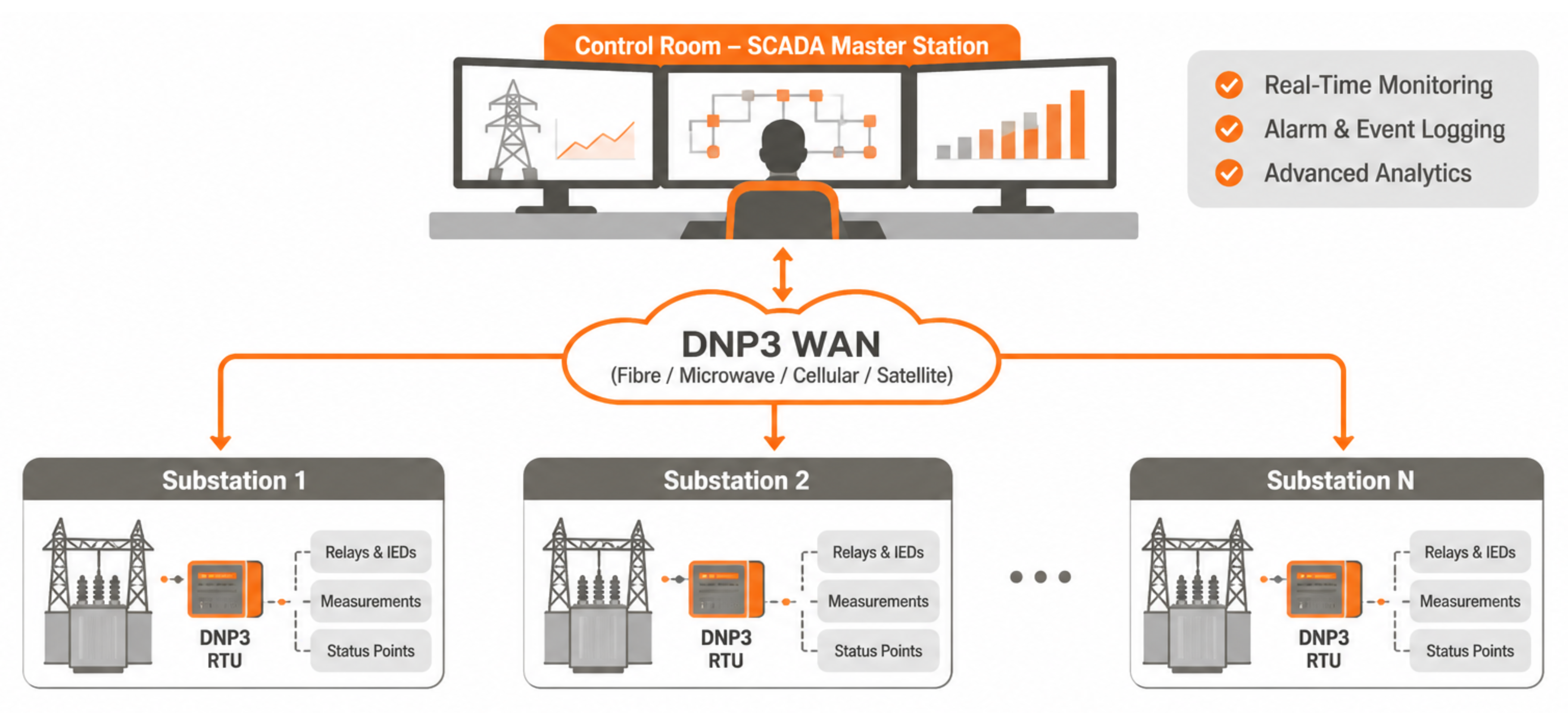
DNP3 protocol SCADA is the dominant telecontrol protocol in North American utility SCADA systems — used in electric power transmission and distribution substations, water utility pumping stations, oil and gas pipeline SCADA, and water/wastewater treatment plant remote monitoring across the United States, Canada, and Australia. Designed specifically for the reliability and timestamping requirements of utility SCADA — where accurate sequence-of-events data during a substation fault trip, or reliable data delivery over a slow satellite link to a remote pumping station, is critical for operations — DNP3 protocol SCADA provides capabilities that general-purpose protocols like Modbus simply do not have: millisecond-accurate change-of-state timestamps at the DNP3 RTU protocol outstation level, unsolicited reporting to reduce polling load on constrained communication links, application-layer data integrity with CRC and retransmission, and a class-based data priority system that ensures critical alarm data reaches the SCADA master quickly even when the communication channel is busy with lower-priority status updates. DNP3 substation automation deployments connect every relay, IED (Intelligent Electronic Device), and protection controller in the substation to the substation RTU or directly to the substation HMI via DNP3 serial or DNP3 TCP, providing the control room SCADA with complete visibility of all substation measurements, status points, and protection relay events. Understanding the DNP3 vs Modbus utility SCADA differences is essential for engineers designing or specifying communication architectures for utility infrastructure projects, and the DNP3 IEC 60870 comparison matters for engineers working on international projects where the choice between the US standard (DNP3) and the European/international standard (IEC 60870-5-104) depends on client requirements, geographic location, and existing SCADA infrastructure compatibility.
DNP3 Protocol SCADA: Architecture and Communication Model
- DNP3 RTU Protocol — Outstation Data Model: A DNP3 RTU protocol outstation organises its data into DNP3 point groups: Analog Inputs (Group 30) for measurements (voltage, current, power, flow, pressure); Analog Outputs (Group 40/41) for setpoints and control values; Binary Inputs (Group 1/2) for digital status points (breaker open/closed, pump running/stopped, valve position) — Group 1 for current status, Group 2 for change events with timestamps; Binary Outputs (Group 12) for control commands (trip/close breaker, start/stop pump). The DNP3 protocol SCADA master polls Class 0 for all current values, Class 1–3 for recent change events at configured intervals. Timestamps attached to Binary Input Group 2 (change event) objects record the exact millisecond when the status change occurred at the outstation — regardless of when the master polled and retrieved the event.
- DNP3 Substation Automation — IED Integration: DNP3 substation automation integrates protection relays, numeric overcurrent relays, bay controllers, and power quality monitors at each substation into a hierarchical RTU or substation automation system. Each IED exposes its measurements (voltage, current, watts, VARs, frequency) and protection events (relay picked up, fault trip, reclosure, lockout) as DNP3 data objects. The substation RTU or gateway aggregates all IED data via DNP3 serial (RS485) and presents a consolidated outstation data set to the control room SCADA via DNP3 TCP over the SCADA WAN (fibre, microwave, or cellular). DNP3 substation automation SOE (sequence of events) records reconstructed from timestamped Binary Input change events from multiple IEDs enable protection engineers to reconstruct the exact sequence of relay pickups, trips, and reclosures during a fault in microsecond resolution — critical for post-fault protection analysis.
- DNP3 vs Modbus Utility SCADA — Practical Impact: In a DNP3 vs Modbus utility SCADA practical comparison for a new water utility SCADA project: a Modbus RTU polling system polling 20 remote pump stations every 30 seconds provides current flow, pressure, and status — but if a pump trips and restarts in 5 seconds between polls, Modbus never captures the event; the operator sees only the current running status. A DNP3 RTU protocol system using unsolicited reporting delivers the trip event (with millisecond timestamp) to the SCADA master within 1–2 seconds of occurrence, and the restart event 5 seconds later — the SCADA alarm log captures both events with accurate times for investigation. For wide-area SCADA with slow satellite links (19.2 kbit/s typical), DNP3 unsolicited reporting also dramatically reduces bandwidth consumption compared to Modbus continuous polling of all points.
- DNP3 IEC 60870 Comparison — Standard Selection: DNP3 IEC 60870 comparison for international projects: use DNP3 when the client is a North American or Australian utility with existing DNP3 SCADA master infrastructure; use IEC 60870-5-104 (TCP/IP) or IEC 60870-5-101 (serial) when the client is a European or Asian utility with IEC 60870 SCADA master. Both protocols achieve comparable functionality — the choice is driven by client SCADA master compatibility rather than technical superiority of either protocol. IEC 61850 is the forward-looking choice for new greenfield substations requiring high-speed protection-grade communications and standardised configuration.
DNP3 vs Modbus: SCADA Protocol Comparison
| Criteria | DNP3 Protocol SCADA | Modbus for Utility SCADA |
|---|---|---|
| Timestamps | Millisecond change-of-state at outstation | No timestamps — only current polled value |
| Reporting mode | Unsolicited (event-driven) + polling | Poll-only master-slave |
| DNP3 Substation Automation | Standard in US/AU utility SCADA | Not native to utility SCADA |
| Communication reliability | Application-layer CRC, confirmation, retransmit | CRC only; no application-layer retransmit |
| DNP3 IEC 60870 Comparison | North America, Australia standard | IEC 60870-5-104 is European equivalent |
DNP3 Protocol SCADA with Precisol Automation
Precisol Automation's Serial IIoT Gateway supports RS485 serial connectivity applicable to DNP3 RTU protocol outstation integration — connecting to DNP3 RS485 networks and providing protocol translation for IIoT cloud integration alongside existing DNP3 protocol SCADA systems. The PreciCloud IoT Cloud Dashboard provides the cloud analytics layer for utility SCADA data integrated alongside process data from IIoT gateways in hybrid DNP3 substation automation and IIoT deployments.
See multi-protocol industrial integration in our IT-OT bridge for process automation case study, or explore remote monitoring for Modbus PLCs for the IIoT gateway architecture applicable to brownfield utility SCADA integration projects where DNP3 vs Modbus utility SCADA coexist.
Frequently Asked Questions
What is DNP3 protocol and how is it used in SCADA systems?
DNP3 protocol SCADA (IEEE 1815) is a telecontrol protocol designed for utility SCADA — electric substations, water pumping stations, pipeline RTUs — providing millisecond-accurate change-of-state timestamps, unsolicited event reporting, class-based data prioritisation, and application-layer reliability for unreliable communication links. DNP3 RTU protocol outstations report Binary Input change events with timestamps to the master SCADA for sequence-of-events reconstruction during faults. DNP3 substation automation connects every relay and IED to the RTU master via DNP3 serial or TCP for complete substation monitoring.
What is the difference between DNP3 vs Modbus for utility SCADA?
DNP3 vs Modbus utility SCADA: DNP3 provides millisecond timestamps on change events (Modbus has none); unsolicited reporting where the RTU initiates data on change (Modbus is poll-only master-slave); class-based event priority for critical alarms; and application-layer reliability for slow WAN links. DNP3 substation automation is standard in North American utility infrastructure; Modbus is general-purpose and ubiquitous in process instrumentation but lacks the SCADA-specific features of DNP3 for wide-area utility monitoring. Modbus TCP remains practical for brownfield IIoT integration where DNP3 SCADA already exists as the primary system.
How does DNP3 compare to IEC 60870-5 for utility SCADA and substation automation?
DNP3 IEC 60870 comparison: DNP3 (IEEE 1815) is the North American/Australian utility SCADA standard; IEC 60870-5-104 (TCP/IP) and IEC 60870-5-101 (serial) are the European/international equivalents. Both provide millisecond timestamps, unsolicited reporting, and reliable serial/TCP communication for utility SCADA. Protocol choice follows client and regional standard: North American utilities specify DNP3 protocol SCADA; European and international utility projects specify IEC 60870-5. IEC 61850 is the forward-looking replacement for new substation automation systems requiring GOOSE protection-grade messages and standardised SCL configuration.