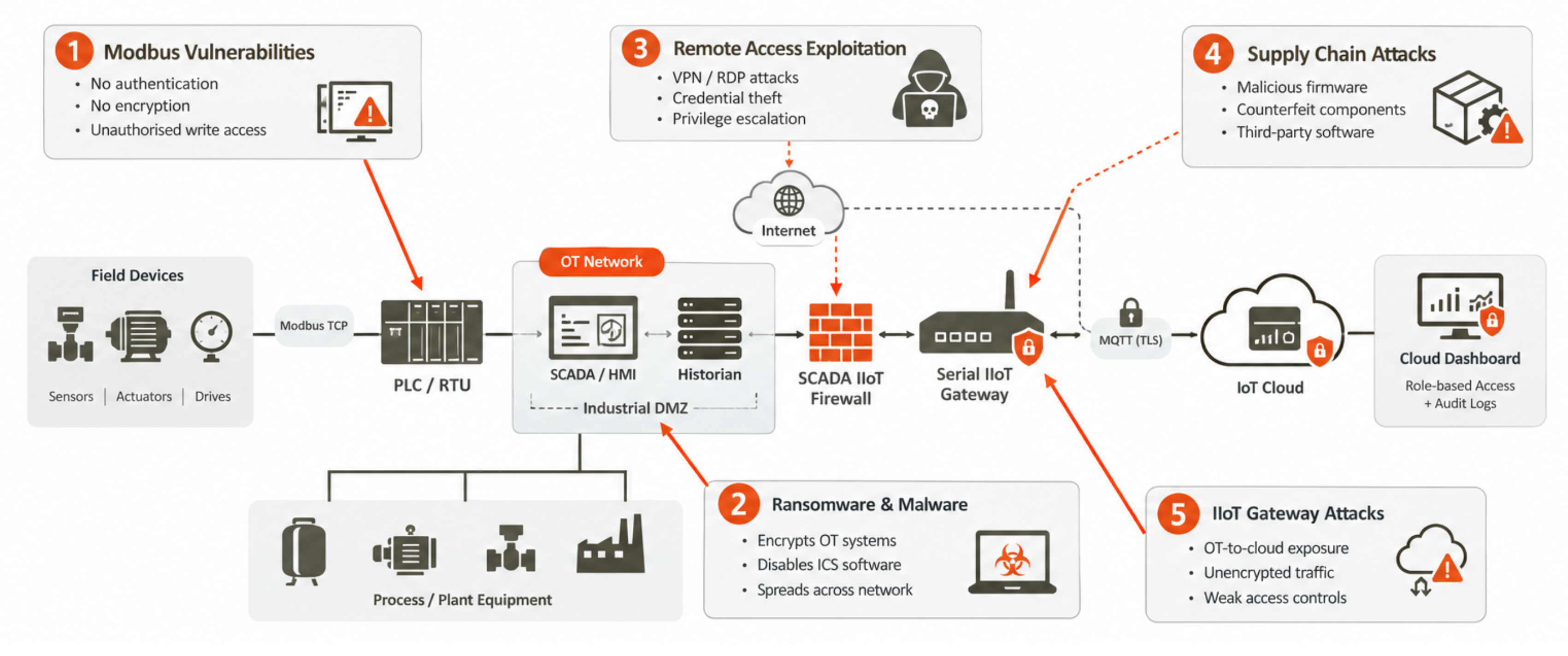
SCADA cybersecurity threats have moved from theoretical concern to operational reality for industrial plant operators worldwide — with high-profile industrial control system cyber attacks demonstrating that compromised OT systems can trigger physical equipment damage, environmental incidents, and sustained operational outages with consequences far beyond what IT cybersecurity breaches typically cause. The Colonial Pipeline ransomware attack in 2021 resulted in fuel shortages across the US East Coast from a precautionary OT shutdown triggered by an IT network incident. The Oldsmar water treatment plant attack in 2021 saw an attacker remotely increase sodium hydroxide concentration to dangerous levels via compromised remote access software. These incidents are not isolated — ICS-CERT and CISA report hundreds of SCADA cybersecurity threats and incidents annually in critical infrastructure sectors. The root causes are consistent: industrial protocols like Modbus have fundamental Modbus security vulnerabilities with no authentication or encryption; OT networks that were air-gapped for decades have been connected to IT and internet for IIoT and remote access without adequate security controls; and SCADA IIoT firewall controls that would catch these attacks are often absent or misconfigured. Implementing SCADA security best practices is no longer optional for industrial plant operators — it is a baseline requirement for business continuity, insurance coverage, and regulatory compliance in critical infrastructure sectors.
SCADA Cybersecurity Threats: Key Attack Vectors
- Modbus Security Vulnerabilities — Protocol-Level Weakness: Modbus (1979) has no security features: no authentication, no authorisation, no encryption. Any device on a Modbus TCP network can write to any PLC register — forcing outputs, changing setpoints, injecting false readings. Modbus security vulnerabilities cannot be fixed in the protocol — mitigation is entirely network-level: SCADA IIoT firewall rules restricting Modbus TCP to known source IPs; function code allowlisting (read-only FC01-04, block write FC05/06/15/16 for IIoT monitoring connections); and VLAN isolation of Modbus devices. Unmitigated Modbus security vulnerabilities in IIoT deployments — where gateways open a Modbus TCP port accessible from the cloud — are a critical SCADA cybersecurity threats risk.
- Ransomware and Malware — OT-Targeted Attacks: The EKANS/Snake ransomware (2020) targeted ICS-specific processes including GE Proficy, Honeywell HMIWeb, and OSIsoft PI historian. Industrial control system cyber attack campaigns now specifically identify and disable OT software before deploying ransomware — maximising operational impact. SCADA security best practices against ransomware include: application allowlisting on SCADA servers and HMIs (only approved executables can run — malware cannot execute); regular offline backups of PLC programs, SCADA databases, and HMI configurations; and network segmentation that limits ransomware propagation across OT network segments.
- Remote Access Exploitation — VPN and RDP Attacks: Maintenance remote access to SCADA and PLC programming software via VPN or RDP is the most commonly exploited entry point in industrial control system cyber attack campaigns. SCADA security best practices for remote access include: mandatory MFA (multi-factor authentication) for all remote OT access; jump servers in the industrial DMZ with session recording and automatic disconnect; vendor access limited to specific maintenance windows; and privileged access management (PAM) tools that vault credentials for PLC programming software accounts. Never expose SCADA HMI or PLC engineering software directly to the internet.
- Supply Chain Attacks — Hardware and Software: Stuxnet (2010) is the canonical supply chain attack: malicious code delivered via infected USB drives and software update servers targeting Siemens S7 PLCs. Modern supply chain SCADA cybersecurity threats include: counterfeit PLC components with backdoors; malicious code in third-party ICS software libraries; and compromised firmware updates from legitimate vendors. SCADA security best practices for supply chain risk include: software integrity verification (code signing and checksum validation for all ICS software updates); USB device control on OT workstations; and vendor security assessment for all OT software and hardware suppliers.
SCADA Security Best Practices: Priority Countermeasures
| Threat Category | SCADA Cybersecurity Threats Risk | SCADA Security Best Practices Countermeasure |
|---|---|---|
| Modbus Protocol | Modbus security vulnerabilities — unauthenticated PLC write access | SCADA IIoT firewall function code allowlisting; IP allowlisting; VLAN isolation |
| Ransomware | Industrial control system cyber attack encrypting OT systems | Application allowlisting; offline backups; OT/IT network segmentation |
| Remote Access | VPN/RDP credential theft leading to SCADA access | MFA; jump server; session recording; PAM — SCADA security best practices |
| Supply Chain | Malicious firmware/software in OT components | Code signing verification; USB control; vendor security assessment |
| IIoT Gateways | New attack surface from OT-to-cloud connectivity | SCADA IIoT firewall; TLS-only cloud transport; gateway zone segmentation |
SCADA IIoT Firewall and Secure Connectivity with Precisol Automation
Precisol Automation's Serial IIoT Gateway implements SCADA security best practices for IIoT connectivity: Modbus TCP read-only access to field devices (write commands are not forwarded from cloud to Modbus devices), encrypted MQTT TLS to cloud with certificate authentication, and configurable IP allowlisting — addressing the core Modbus security vulnerabilities and gateway-zone attack surface in SCADA cybersecurity threats assessments. The PreciCloud IoT Cloud Dashboard enforces role-based access control and audit logging — SCADA security best practices for cloud-side access control.
See IT-OT secure connectivity architecture in our IT-OT bridge for process automation case study, or explore remote monitoring for Modbus PLCs for the gateway configuration that addresses Modbus security vulnerabilities through read-only protocol enforcement and encrypted transport.
Frequently Asked Questions
What are the main SCADA cybersecurity threats facing industrial plants?
Main SCADA cybersecurity threats include: Modbus security vulnerabilities (no authentication or encryption — any network device can write to PLCs); ransomware targeting OT-specific software (EKANS/Snake); remote access exploitation (VPN/RDP credential theft); supply chain attacks (malicious firmware or software); and new attack surfaces from IIoT gateway OT-to-cloud connectivity. Industrial control system cyber attacks can cause physical equipment damage, environmental incidents, and sustained operational shutdowns beyond typical IT cybersecurity impact.
What are Modbus security vulnerabilities and how can they be mitigated?
Modbus security vulnerabilities stem from the 1979 protocol having no authentication, authorisation, or encryption — any Modbus TCP device can read or write any PLC register. Mitigation is network-only: SCADA IIoT firewall rules restricting Modbus TCP to known IPs; Modbus function code allowlisting (read FC01-04 only, block write FC05/06/15/16 for IIoT monitoring connections); and VLAN isolation of Modbus devices from all non-essential network segments.
What are the SCADA security best practices for industrial plants deploying IIoT?
SCADA security best practices for IIoT deployments: place gateways in a dedicated zone firewalled from SCADA with read-only Modbus rules (SCADA IIoT firewall); use TLS-encrypted MQTT for cloud transport with certificate authentication; apply MFA and jump servers for all remote access; maintain application allowlisting on SCADA servers; keep offline PLC program backups; monitor OT network traffic with OT-aware IDS; and conduct annual industrial control system security risk assessments against IEC 62443.