Smart Diagnostics using CAN and LIN Data Acquisition
18 June 2026
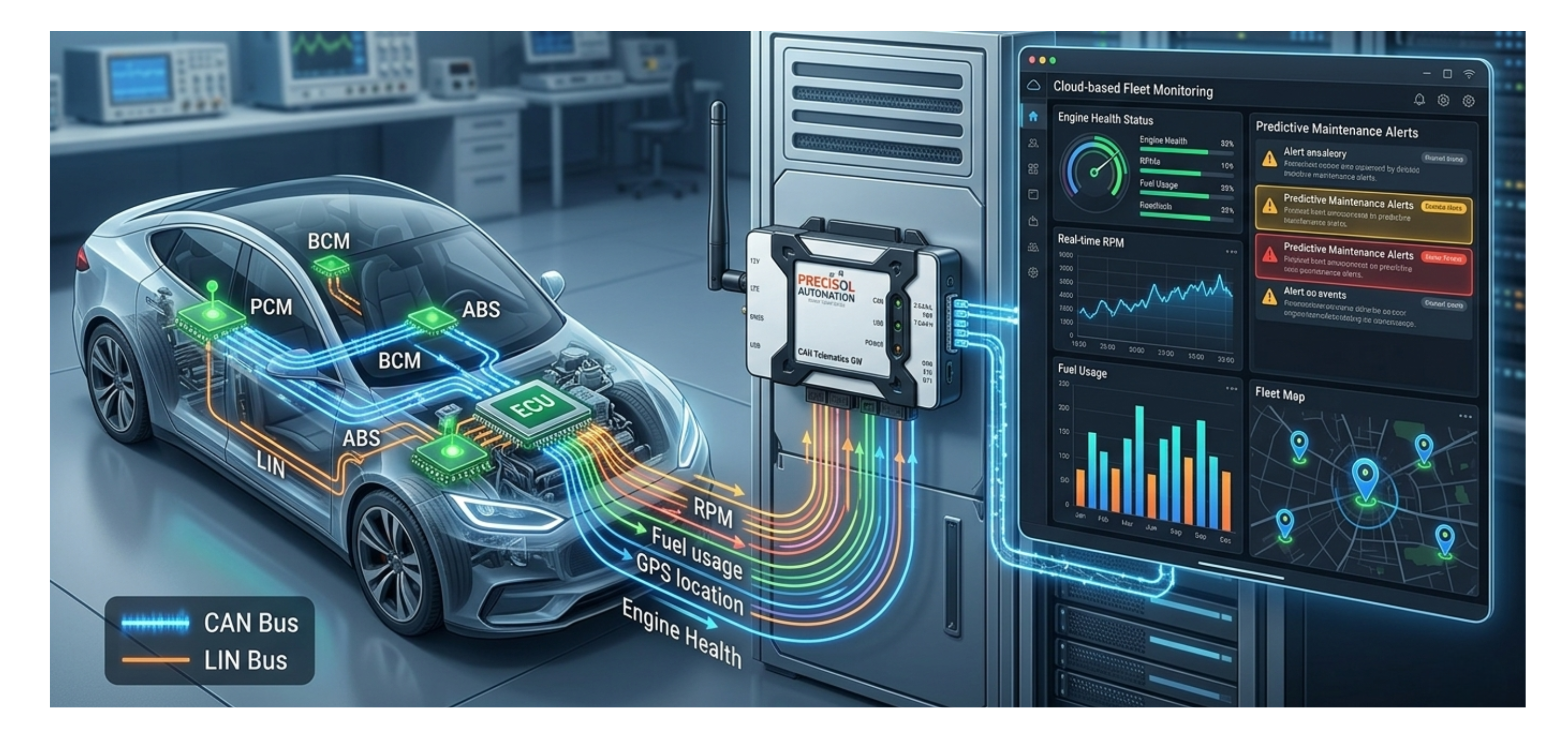
Smart Diagnostics: Revolutionizing Vehicle Health via CAN and LIN Data Acquisition
Imagine driving down a highway when a warning light suddenly flashes on your dashboard. For most drivers, this brings an immediate wave of anxiety. What does it mean? Is it a minor sensor glitch, or a critical engine failure?
Historically, troubleshooting these issues meant scheduling an appointment, leaving your vehicle at a shop, and waiting for a mechanic to plug in a massive diagnostic tool. But the automotive world is shifting. We are moving away from reactive, "fix-it-when-it-breaks" maintenance and entering the era of Smart Diagnostics. By leveraging real-time data acquisition through the twin pillars of automotive networking—CAN (Controller Air Network) and LIN (Local Interconnect Network)—modern vehicles are transforming into self-aware, predictive machines. Here is a deep dive into how smart diagnostics works, why it matters, and how it is reshaping the future of mobility.
The Nervous System of the Modern Vehicle
Modern automobiles are essentially rolling supercomputers. A single high-end vehicle can feature over 100 Electronic Control Units (ECUs) managing everything from adaptive cruise control and braking systems to power windows and seat adjustments.
For these isolated computers to function as a cohesive machine, they need to communicate flawlessly. This is where CAN and LIN buses come into play. They act as the nervous system of the vehicle, constantly transmitting streams of data.
- The CAN Bus: The High-Speed Backbone: Developed by Bosch in the 1980s, the CAN bus remains the undisputed standard for critical, high-speed vehicle communications. It connects primary systems like the Engine Control Module (ECM), transmission, and anti-lock braking systems (ABS). The CAN bus allows these vital components to share massive amounts of telemetry data at high speeds with incredible reliability, ensuring that safety-critical commands are processed in microseconds.
- The LIN Bus: The Cost-Effective Subsystem: While the CAN bus is powerful, it is also complex and relatively expensive to implement for every single component. Enter the LIN bus. LIN is a single-wire, low-cost, lower-speed network designed for localized subsystems. It manages non-safety-critical, comfort-focused components—such as windshield wipers, climate control sensors, mirrors, and power seats. By offloading these minor tasks from the main CAN network, LIN prevents bandwidth congestion.
What Makes Diagnostics "Smart"?
Traditional diagnostics relies on Diagnostic Trouble Codes (DTCs). When a component fails, an ECU logs a code, and the check engine light turns on. This is a post-mortem approach: the failure has already occurred. Smart Diagnostics turns this model on its head through continuous, real-time CAN and LIN data acquisition. Instead of waiting for a threshold to be crossed and a fault code to trigger, smart systems constantly harvest live telemetry data across both networks.
By capturing parameters like subtle voltage drops on a LIN-controlled window motor, or minute RPM fluctuations and temperature spikes on the CAN-connected powertrain, advanced software can run predictive algorithms.
The Key Benefits of Smart Data Acquisition:
- Predictive Maintenance: Algorithms analyze historical and real-time data to predict exactly when a component is going to fail, allowing fleet managers or drivers to schedule service before a breakdown occurs.
- Remote Fleet Telematics: For commercial fleets, CAN and LIN data can be beamed over the cloud via IoT gateways. Fleet managers can monitor the health of hundreds of vehicles simultaneously, optimizing maintenance schedules and reducing costly downtime.
- Accelerated R&D: Automotive engineers utilize captured data logs to understand how components perform in real-world environments, accelerating the development of safer, more efficient future vehicles.
The Core Challenge: Bridging the Protocol Gap
Capturing this data is easier said than done. Because CAN and LIN operate at different speeds, use different voltages, and follow entirely different communication protocols, harmonizing their data streams presents a major engineering challenge. Passenger cars heavily rely on OBD2 protocols, while light and heavy commercial vehicles communicate via J1939 protocols. To build an effective smart diagnostic system, developers and fleet operators require specialized hardware that can connect to these networks simultaneously, interpret multiple standard protocols, and securely stream that information into a unified data flow. This is exactly where the convergence of edge hardware and cloud telematics becomes critical.
The Future: AI, Edge Computing, and Cloud Integration
As we move closer to fully autonomous vehicles and software-defined vehicles (SDVs), the role of smart diagnostics will only expand. We are already seeing the integration of Edge AI—where data filtering and initial analysis run directly on the vehicle’s diagnostic hardware.
Instead of sending terabytes of raw CAN and LIN data to the cloud, smart gateways filter the streams locally and utilize global cellular networks to beam processed vitals directly to cloud dashboards. This dramatically slashes data transmission costs and enables split-second decision-making, ensuring that operators can be instantly alerted to engine malfunctions, tampering, or unusual behaviors from thousands of miles away.
Unlocking Smart Diagnostics with Precisol Automation
Building, testing, and deploying robust smart diagnostic systems requires hardware that you can trust implicitly. Whether you are developing advanced fleet telematics, designing automotive test benches, or setting up a remote maintenance framework, your data must be accurate, secure, and instant. This is where Precisol Automation changes the game.
Precisol Automation provides off-the-shelf, industrially verified LIN CAN Gateways specifically engineered to transform raw vehicle network traffic into real-world performance improvements.
How Precisol Gateways Power Your Diagnostics Strategy:
- Seamless Multi-Protocol Support: Precisol's gateways effortlessly interpret diverse vehicle networks, supporting standard automotive protocols like OBD2 and J1939, alongside custom OEM frames. This guarantees hassle-free integration across passenger cars, commercial heavy trucks, and electric vehicles (EVs).
- Plug-and-Play Cloud Telematics: Equipped with high-speed 4G / 2G cellular connectivity and optional GNSS (GPS) tracking, these gateways securely stream raw or decoded data frames directly to cloud servers.
- End-to-End Software Ecosystem: Manage your hardware with ease using PreciCon, a free configuration tool that lets you set up custom DBC files, data formats (.CSV, .MF4), and upload intervals via USB. On the receiving end, Precisol’s PreciCloud platform displays all vehicle vitals, fuel usage, and engine status on an intuitive, remote web dashboard.
- Industrial-Grade Reliability: Designed for automotive environments, Precisol gateways feature robust enclosures with built-in galvanic isolation and ESD surge protection, alongside 100% power-safe cyclic data logging (up to 32GB) to eliminate data corruption.
Don't let fragmented protocols delay your data-driven goals. Explore the high-performance capabilities of the Precisol Automation LIN-CAN Gateways and bring the power of smart, remote diagnostics to your fleet or automotive testing application today.