Agriculture Machinery Monitoring: Precision Farming IoT and Farm Equipment Telematics
18 August 2026
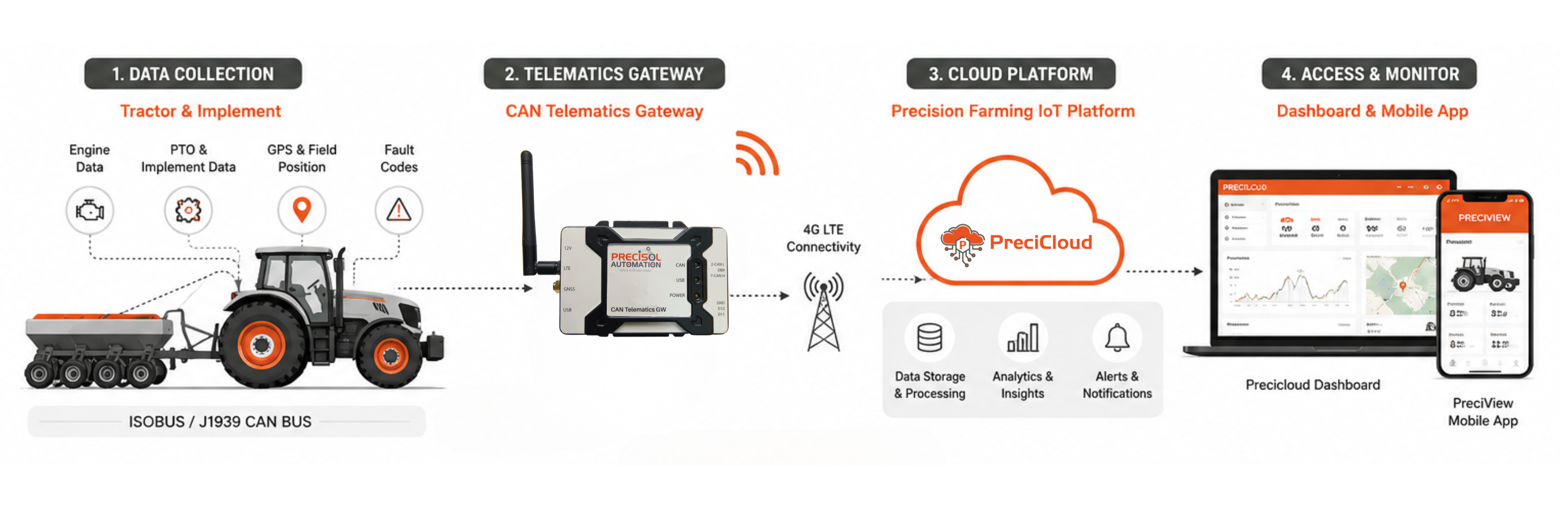
Agriculture machinery monitoring with IoT and farm telematics gives farmers, agronomists, and agricultural fleet managers real-time visibility of tractor and implement health, fuel consumption, field operations, and productivity — data that was previously only available from the machine's instrument cluster or end-of-season service records. A farm equipment telematics device connected to the tractor's ISOBUS or J1939 CAN bus captures engine data, PTO engagement, implement operation parameters, and GPS field position — transmitting this agricultural vehicle data to a cloud precision farming IoT platform where it is displayed, analysed, and used to optimise field operations and maintenance scheduling. A well-deployed tractor monitoring system enables a farm manager to know exactly which field each machine is in, what work it is performing, how much fuel it is consuming per hectare, and whether any engine fault codes are active — all without leaving the farm office. Agriculture machinery monitoring is the foundation of data-driven precision farming and the key to improving machinery ROI on large arable, pastoral, and horticultural operations.
ISOBUS: The CAN Bus Standard Behind Agriculture Machinery Monitoring
ISOBUS (ISO 11783) is the agricultural machinery equivalent of J1939 — a CAN bus standard that defines how tractors, implements, and farm management systems communicate. ISOBUS is what makes true agriculture machinery monitoring possible across mixed-brand tractor-implement combinations. A John Deere tractor with ISOBUS can communicate seeding rate commands and actual application data to a Horsch seeder — and a farm equipment telematics logger on the tractor's ISOBUS backbone captures the complete implement operation record. Key data the tractor monitoring system captures via ISOBUS:
- Tractor Machine Data: Engine RPM, fuel consumption rate and total, engine hours, coolant temperature, hydraulic oil temperature, transmission gear and ground speed, four-wheel drive engagement, and differential lock status — the core tractor health and utilisation data captured by farm equipment telematics.
- PTO and Implement Data: PTO engagement state and speed, implement-reported application rate (seeding, spraying, fertiliser), cutting width and header engagement (harvest), yield monitor data (combine harvesters), and bale count — agricultural vehicle data that quantifies field productivity per machine and operator.
- Precision Farming IoT Field Data: GPS position correlated with work state — distinguishing in-work passes from headland turns, field boundaries from tracked routes — enabling precision farming IoT analysis of field coverage efficiency, overlap mapping, and yield geo-referencing.
- Fault Codes: J1939 DTCs from the engine and transmission ECUs, ISOBUS fault messages from implements, and hydraulic system alerts — agriculture machinery monitoring fault data that enables proactive maintenance before failure during a time-critical operation window.
Farm Equipment Telematics: Key Performance Metrics
| Metric | Agriculture Machinery Monitoring Data Source | Precision Farming IoT Benefit |
|---|---|---|
| Fuel per Hectare | CAN fuel consumption + GPS area calculated | Benchmark efficiency across operators and field types |
| Field Efficiency | GPS working time vs. headland time ratio | Optimise headland management; reduce non-productive time |
| Engine Hours | Tractor monitoring system engine hour counter | Service scheduling on actual use; accurate depreciation accounting |
| Idle Time % | Agricultural vehicle data — engine RPM at zero ground speed | Identify and reduce unnecessary idling; fuel savings |
| Machinery Availability | Farm equipment telematics operational vs. downtime hours | Track contractor fleet utilisation; identify underused assets |
Precision Farming IoT for Agribusiness Fleet Management
Large agribusinesses and agricultural contractors operating multi-machine fleets benefit most from agriculture machinery monitoring at scale. A precision farming IoT platform aggregating agricultural vehicle data from 10–100 machines across multiple farms provides the fleet-level visibility needed for efficient deployment: which machines are available for the next job, which are in service, which have active fault codes, and which are approaching service intervals. Farm equipment telematics data also informs capital replacement decisions — machines with high fuel consumption per hectare, frequent fault codes, or declining performance relative to fleet benchmarks are objectively identified for priority replacement rather than relying on operator reports.
Deploy Agriculture Machinery Monitoring with Precisol Automation
Precisol Automation's CAN Telematics Gateway connects to tractor ISOBUS and J1939 CAN buses for real-time agriculture machinery monitoring — transmitting agricultural vehicle data via 4G LTE to cloud precision farming IoT platforms. The Wireless Sensors range extends farm equipment telematics monitoring to grain bins, chemical storage, and environmental monitoring across the farm — providing a complete agricultural IoT data ecosystem.
See farm equipment telematics and precision farming IoT in practice in our machinery monitoring case study, or explore how Precisol enables agriculture machinery optimisation with comprehensive tractor monitoring system capabilities.
Frequently Asked Questions
What is agriculture machinery monitoring and what data does it collect?
Agriculture machinery monitoring uses farm equipment telematics devices on tractors and implements to collect engine data, fuel consumption, PTO engagement, implement application rates, GPS field position, and fault codes via ISOBUS and J1939 CAN bus. A precision farming IoT platform correlates this agricultural vehicle data with field maps and crop records — turning a tractor monitoring system into a full operational intelligence platform for farm management.
What is ISOBUS and why is it important for agriculture machinery monitoring?
ISOBUS (ISO 11783) is the agricultural CAN bus standard enabling communication between tractors and implements across different manufacturers. Farm equipment telematics loggers on the ISOBUS backbone capture implement data (seeding rate, spray rate, yield) alongside tractor engine data — making cross-brand precision farming IoT and agricultural vehicle data collection possible without OEM-specific interfaces.
How does farm equipment telematics reduce agricultural operating costs?
Farm equipment telematics reduces costs through 10–20% fuel savings from agriculture machinery monitoring of idle time and inefficient field speeds; proactive maintenance from tractor monitoring system fault alerts; precision farming IoT field efficiency improvements reducing overlap and headland time; and fleet right-sizing from agricultural vehicle data on actual machine utilisation across the season.