End-of-Line Testing in Automotive Manufacturing: CAN Bus Tools and Methods
19 August 2026
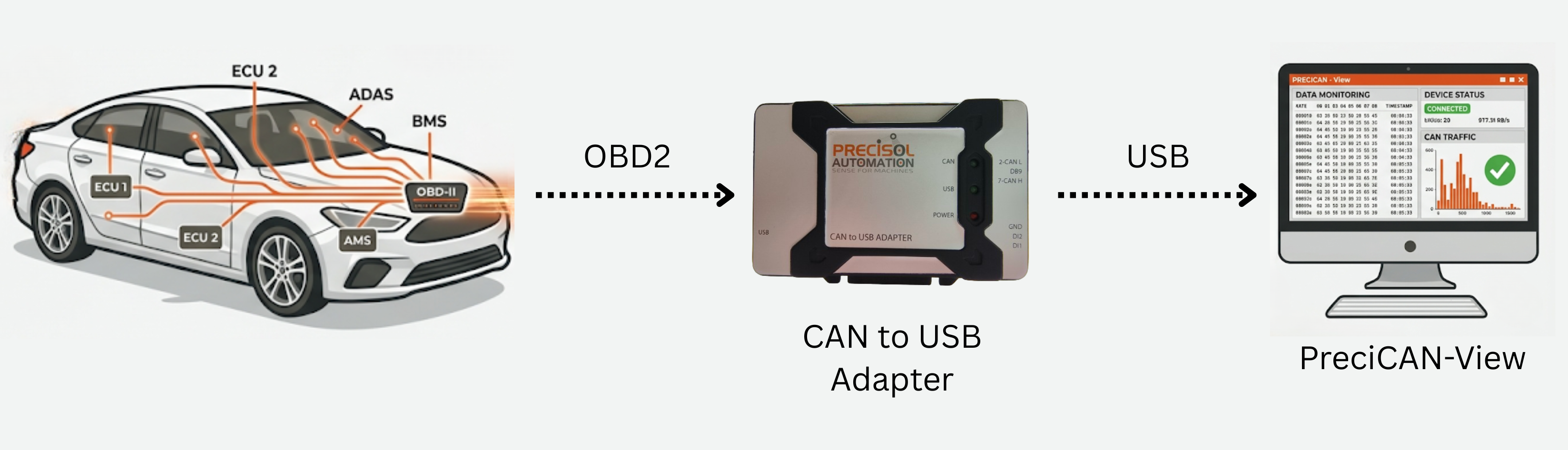
End-of-line testing is the critical final quality gate in automotive and electronics manufacturing — a comprehensive functional verification of every unit before it leaves the production line, ensuring that assembly errors, software misconfigurations, and component faults are detected and corrected before reaching the customer. Automotive EOL testing uses CAN bus communication tools connected to the vehicle's diagnostic port to interrogate every ECU, verify software versions, clear and check fault memory, and execute automated functional test sequences that confirm all vehicle systems operate correctly. Production line testing at the EOL station typically runs in under five minutes for passenger cars — a fully automated sequence of CAN bus EOL test diagnostics, functional actuator tests, and vehicle functional testing routines executed without manual intervention. As vehicles incorporate more ECUs, more software-defined features, and more complex network architectures, end-of-line testing has become both more important and more technically demanding — requiring sophisticated CAN bus test tools capable of communicating with dozens of ECUs simultaneously.
What Automotive EOL Testing Covers
A comprehensive end-of-line testing sequence on a modern vehicle covers multiple test domains, all orchestrated through the vehicle's CAN bus diagnostic interface:
- ECU Network Verification: The CAN bus EOL test begins by confirming all expected ECUs are present and communicating on the network — no missing nodes, no ECUs in bus-off state due to assembly errors, and all ECUs responding within specification timing. Network scan via UDS (ISO 14229) service 0x27 identifies all ECUs on the CAN bus for automotive EOL testing.
- Software Version Check: Production line testing reads ECU hardware and software version identifiers (UDS service 0x22) and compares them against the vehicle build specification — confirming correct software versions are flashed on every ECU and no wrong-specification parts are installed.
- DTC Reading and Clearing: All ECU fault memories are read via UDS service 0x19, confirmed against an allowed DTC list (some installation DTCs are expected and permitted), and then cleared. Any unexpected DTCs flag the vehicle for investigation before end-of-line testing is passed.
- Functional Actuator Tests: Vehicle functional testing via CAN bus sends commands to ECUs and verifies that physical outputs respond correctly — door lock/unlock actuation, window motor direction, headlight output switching, HVAC blower speed, horn, horn, and ADAS system sensor wake-up responses.
CAN Bus EOL Test Architecture
| Test Layer | End-of-Line Testing Tool | Production Line Testing Scope |
|---|---|---|
| Network Scan | CAN bus EOL test adapter (ISO 15765-4 compliant) | All ECU node presence; bus-off detection; network health |
| Software Verification | UDS 0x22 read data via CAN to EOL test PC | ECU hardware/software version vs. BOM specification |
| Fault Code Audit | UDS 0x19 read DTC information; 0x14 clear DTC | All ECU DTC memories; comparison against allowed DTC list |
| Functional Test | Automotive EOL testing sequences via CAN stimulus-response | Vehicle functional testing of all ECU-controlled outputs |
| End-of-Line Data Upload | EOL test result archival to manufacturing execution system (MES) | Per-vehicle test result traceability for warranty and quality audit |
CAN to USB Adapters for Automotive EOL Testing
The fundamental hardware in an end-of-line testing station is the CAN bus interface — a hardware adapter that connects the EOL test PC to the vehicle's OBD-II or CAN bus connector and translates CAN bus frames to USB or Ethernet for the EOL test software. For automotive EOL testing, the CAN interface must support multi-bus architectures (simultaneous high-speed CAN, LIN, and potentially CAN FD channels), diagnostic protocols (UDS, OBD-II, KWP2000), and high throughput for automated production line testing without latency that would extend cycle time. The CAN interface's reliability is paramount — a single interface hardware failure in an automotive EOL testing station on a high-volume production line creates significant production downtime.
Deploy End-of-Line Testing with Precisol Automation
Precisol Automation's CAN to USB Adapter provides a robust, multi-channel CAN bus interface for end-of-line testing stations — supporting UDS diagnostics, raw CAN frame logging, and automated CAN bus EOL test sequences. Compatible with all major EOL test software platforms, the adapter delivers the reliability and throughput that automotive EOL testing on production lines demands. The Testing and Validation Systems from Precisol provide complete production line testing solutions for vehicle manufacturers and tier-1 suppliers.
See end-of-line testing and automotive EOL testing in practice in our CAN to USB adapter for EOL testing case study, or explore how Precisol supports CAN bus analysis for vehicle functional testing and diagnostics applications.
Frequently Asked Questions
What is end-of-line testing in automotive manufacturing?
End-of-line testing is the final quality gate — a functional verification of every vehicle at the conclusion of assembly, before customer delivery. Automotive EOL testing uses CAN bus tools to verify ECU presence, software versions, DTC absence, and vehicle functional testing of all electronic systems. Production line testing at the EOL station detects assembly errors, software misconfigurations, and component faults in an automated CAN bus EOL test sequence taking 2–5 minutes per vehicle.
What does a CAN bus EOL test verify?
A CAN bus EOL test verifies ECU network presence, software version correctness, DTC absence across all ECU fault memories, functional response of actuators to CAN commands, and network timing. Vehicle functional testing via automated production line testing sequences confirms hundreds of parameters in 2–5 minutes — the speed required for high-volume automotive EOL testing on modern assembly lines.
How long does automotive EOL testing take on a production line?
Automated CAN bus EOL test sequences for passenger cars typically take 2–5 minutes — constrained by production line takt time. Commercial vehicles and complex machinery with many ECUs require 10–30 minutes for full vehicle functional testing. End-of-line testing automation is essential for high-volume production line testing where manual functional verification at 60–120 vehicles per hour is not feasible.