EV Battery Monitoring with CAN Data Loggers: BMS Data and Electric Vehicle Diagnostics
17 August 2026
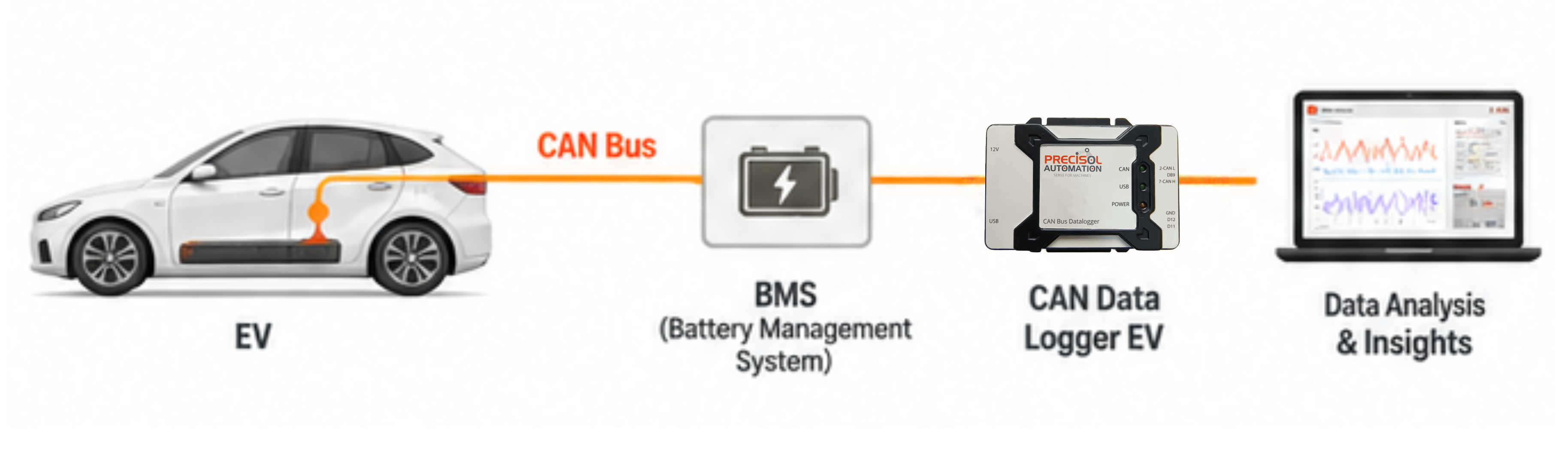
EV battery monitoring using a CAN data logger provides the deep, high-frequency dataset that electric vehicle engineers and fleet operators need to understand battery pack behaviour, detect degradation, and diagnose faults. The battery management system (BMS) continuously broadcasts comprehensive battery health data on the vehicle's CAN bus — individual cell voltages, pack current, State of Charge, State of Health, multi-point temperature measurements, thermal management system status, and fault codes — and a CAN data logger EV captures this entire BMS broadcast at high sample rates, building the detailed dataset that BMS data logging analysis requires. Electric vehicle diagnostics based on OBD-II alone cannot access most of this data — only direct CAN bus logging provides the cell-level resolution and real-time fidelity needed for comprehensive EV battery monitoring in R&D validation, fleet health management, and warranty engineering.
What the Battery Management System Broadcasts on CAN
The battery management system is the central controller of the EV battery pack, responsible for monitoring every cell, managing thermal systems, controlling charge and discharge limits, and protecting the pack from damage. The BMS broadcasts its entire monitoring dataset on the CAN bus, and CAN data logger EV devices capture this stream for EV battery monitoring. Key data the battery management system broadcasts:
- Cell and Pack Voltage: Individual cell voltages (or cell group voltages in large packs), minimum and maximum cell voltage identifiers, pack terminal voltage, and cell voltage spread — the most important metrics in EV battery monitoring for detecting imbalanced, degraded, or failing cells.
- State of Charge and State of Health: SOC (remaining capacity as a percentage of usable capacity) and SOH (current usable capacity as a percentage of original rated capacity) — the two headline battery management system parameters that electric vehicle diagnostics platforms track for range prediction and degradation trending.
- Temperature Monitoring: Cell stack temperatures at multiple measurement points, coolant inlet and outlet temperatures, and ambient temperature — BMS data logging of temperature gradients across the pack identifies thermal management inefficiency and hot-spot development.
- Current and Power: Pack current (positive for discharge, negative for charge), charge power, discharge power limit, and regenerative braking current — parameters that CAN data logger EV records for energy efficiency analysis and charge cycle characterisation.
EV Battery Monitoring Applications by Use Case
| Use Case | EV Battery Monitoring Data Required | CAN Data Logger EV Configuration |
|---|---|---|
| R&D Validation | All cell voltages, temperatures, current at 100 Hz+ | High-speed BMS data logging; multi-bus capture (battery + vehicle CAN) |
| Fleet Health Monitoring | SOC, SOH, DTC alerts, temperature extremes | Telematics with CAN data logger EV; cloud dashboard with SOH trending |
| Warranty Engineering | Duty cycle analysis; charging behaviour; thermal events | BMS data logging with trip-triggered recording; event freeze-frame capture |
| Second-Life Assessment | SOH history; cell voltage spread; deep discharge events | Electric vehicle diagnostics via historic BMS data log export and analysis |
BMS Data Logging for EV Battery Degradation Analysis
EV battery monitoring over the vehicle's lifecycle builds the historical dataset that reveals degradation mechanisms. BMS data logging from a CAN data logger EV captures the full charge-discharge cycle profile — enabling engineers to correlate specific operating conditions with accelerated degradation. Key degradation indicators visible in EV battery monitoring data: increasing cell voltage spread during charge and discharge (stronger cells reaching end-of-charge earlier than weaker cells); SOH decline rate exceeding calendar-ageing models (indicating cycle-ageing stress from fast charging or deep discharge); and temperature hotspot development in specific cell groups (indicating cooling system degradation or cell internal resistance increase). Electric vehicle diagnostics based on longitudinal BMS data logging also enables warranty claim validation — determining whether a failure was caused by normal degradation or an extraordinary event such as a thermal excursion or chronic over-discharge.
Deploy EV Battery Monitoring with Precisol Automation
Precisol Automation's CAN Data Logger connects directly to EV battery CAN bus and BMS networks, capturing complete battery management system broadcasts at high sample rates for BMS data logging in development and validation applications. The CAN Telematics Logger extends EV battery monitoring to fleet health applications — transmitting SOC, SOH, DTC alerts, and temperature data to cloud platforms via cellular for continuous electric vehicle diagnostics across EV fleets.
See CAN data logger EV in practice in our automotive ECU software validation case study, or explore how Precisol enables EV battery degradation analysis with comprehensive BMS data logging.
Frequently Asked Questions
What data does a battery management system (BMS) broadcast on the CAN bus?
A battery management system broadcasts cell voltages, pack voltage and current, SOC, SOH, multi-point temperatures, thermal management status, charge/discharge power limits, and fault codes on the CAN bus. A CAN data logger EV captures this full BMS data logging stream for EV battery monitoring — including data not accessible via standard electric vehicle diagnostics OBD-II interfaces.
How is CAN data logger EV different from OBD-II diagnostics for EVs?
OBD-II electric vehicle diagnostics provides a limited standardised parameter set via the diagnostic port. A CAN data logger EV connected directly to the battery management system CAN bus captures all cell voltages, all temperature sensors, balancing status, and proprietary BMS fault codes — 10–100x more data channels at higher sample rates. Direct BMS data logging is essential for EV battery monitoring in development, validation, and fleet health management.
What causes EV battery degradation and how does monitoring detect it?
EV battery degradation is caused by calendar ageing, cycle ageing, high-temperature exposure, deep discharge, and over-charging. EV battery monitoring via BMS data logging detects it through declining SOH trending, increasing cell voltage spread, rising internal resistance, and temperature anomalies in specific cell groups. Long-term CAN data logger EV records build the historical dataset needed for electric vehicle diagnostics of degradation root causes.