Ammonia Gas Detection in Industrial Facilities: Why IoT Matters
04 August 2026
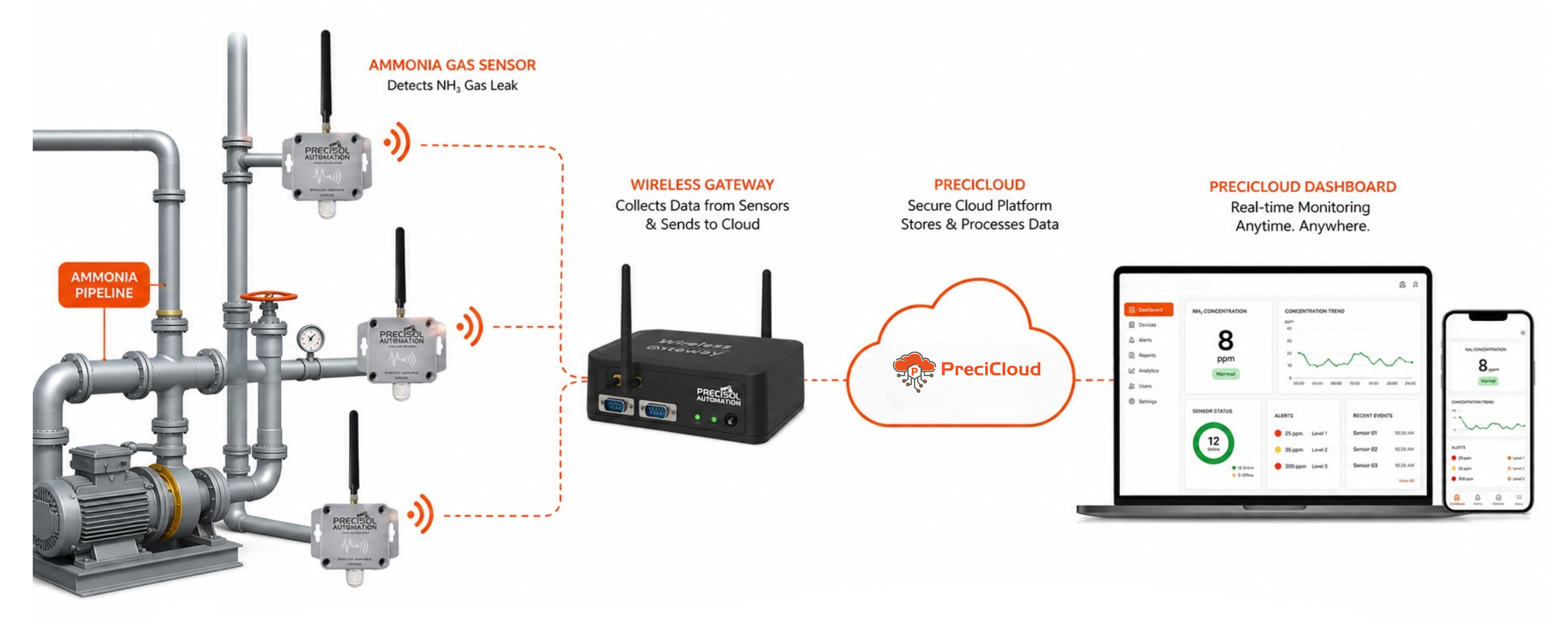
Ammonia gas detection is a life-safety requirement in any industrial facility using NH₃ as a refrigerant or process chemical — cold storage facilities, dairy plants, breweries, food processing operations, and chemical manufacturing sites. Ammonia is an effective and widely used industrial refrigerant, but its toxicity makes ammonia gas detection non-negotiable: OSHA's IDLH (Immediately Dangerous to Life and Health) level for ammonia is 300 ppm, and even low-level exposure (above 25 ppm TLV-TWA) causes eye, nose, and throat irritation that impairs worker performance. Industrial gas monitoring with connected ammonia sensor IoT devices provides continuous detection at these threshold levels, alerting personnel and triggering automated safety responses before a refrigerant leak escalates to a hazardous event. A toxic gas alert system built on IoT connectivity is far more reliable than portable gas detectors carried by individual workers — it provides 24/7 refrigeration plant safety coverage even when the plant is unmanned.
Ammonia Hazard Overview: Why Continuous Industrial Gas Monitoring Is Essential
Ammonia (NH₃) presents multiple hazard types that make continuous ammonia gas detection critical in refrigeration plant safety programmes:
- Toxic Hazard: Ammonia is severely toxic at high concentrations. The occupational exposure limit (TLV-TWA) is 25 ppm; the STEL (Short-Term Exposure Limit) is 35 ppm. At 300 ppm, immediate life threat begins. Ammonia sensor IoT devices continuously monitor below the TLV-TWA to provide the earliest possible warning for refrigeration plant safety.
- Flammability Hazard: Ammonia has a narrow flammability range of 16–25% by volume — an ignition source in a confined space with a major refrigerant leak can cause explosion. Industrial gas monitoring with multi-level toxic gas alert system responses prevents accumulation to flammable concentrations.
- Corrosive Hazard: Even at sub-toxic concentrations, ammonia corrodes copper-based materials and attacks respiratory tissue. Ammonia gas detection at 25 ppm protects both personnel and equipment from corrosive exposure.
- Environmental and Regulatory Hazard: Ammonia releases above threshold quantities trigger mandatory emergency notification under OSHA PSM (Process Safety Management) and EPA RMP (Risk Management Plan) regulations. Industrial gas monitoring records from ammonia sensor IoT systems provide the incident documentation required for regulatory reporting.
Ammonia Sensor IoT Detection Levels and Alert Thresholds
| Concentration | Ammonia Gas Detection Significance | Toxic Gas Alert System Response |
|---|---|---|
| 1–5 ppm | Odour threshold — perceptible to most people | Log event in industrial gas monitoring platform |
| 25 ppm (TLV-TWA) | Occupational exposure limit — 8-hour threshold | Level 1 ammonia gas detection alert — activate ventilation, notify duty engineer |
| 35 ppm (STEL) | 15-minute short-term exposure limit | Level 2 toxic gas alert — evacuate non-essential personnel, close refrigerant isolation valves |
| 300 ppm (IDLH) | Immediately dangerous to life and health | Level 3 — full evacuation, emergency services notification, refrigeration plant safety shutdown |
| 16,000 ppm (LEL) | Lower explosive limit — flammability hazard begins | Industrial gas monitoring system should trigger well before LEL via Level 2/3 toxic gas alert |
Building a Reliable Refrigeration Plant Safety Monitoring System
Effective ammonia gas detection systems for refrigeration plant safety place ammonia sensor IoT nodes at all high-probability leak points — compressor room, evaporator coil connections, expansion valve banks, and refrigerant pump stations. Since ammonia is lighter than air, sensors are mounted high (within 300 mm of ceiling) in enclosed machine rooms. The industrial gas monitoring platform connects all ammonia sensor IoT nodes to a cloud dashboard that displays real-time concentration at each location, logs all exceedance events, and triggers the configured toxic gas alert system responses at each threshold. Automated relay outputs from the IoT gateway can directly activate ventilation fans and refrigerant isolation solenoids — providing immediate physical refrigeration plant safety responses without waiting for human intervention.
Deploy Ammonia Gas Detection with Precisol Automation
Precisol Automation's Wireless Ammonia Sensor provides electrochemical NH₃ detection with multi-level toxic gas alert system relay outputs and wireless connectivity — enabling rapid ammonia gas detection deployment without fixed wiring to each sensor location. The Wireless Gateway aggregates readings from all ammonia sensor IoT nodes and delivers real-time industrial gas monitoring data to a cloud platform with SMS/email alerting and regulatory-grade incident logging.
See IoT-based gas monitoring in dairy silo operations in our dairy silo temperature monitoring case study, or explore how Precisol supports vaccine storage monitoring as part of a broader cold storage environmental and refrigeration plant safety monitoring solution.
Frequently Asked Questions
Why is ammonia gas detection critical in industrial facilities?
Ammonia is toxic above 25 ppm (TLV-TWA) and immediately dangerous at 300 ppm IDLH — making continuous ammonia gas detection mandatory for refrigeration plant safety. Industrial gas monitoring with ammonia sensor IoT devices detects leaks before they reach hazardous concentrations, triggering toxic gas alert system responses automatically even when the plant is unmanned.
Where should ammonia sensors be placed in a refrigeration plant?
Place ammonia sensor IoT devices near compressor discharge connections, evaporator coil fittings, expansion valves, and pump-out connections — the most probable leak sources. Mount sensors high (within 300 mm of ceiling) since ammonia is lighter than air. Industrial gas monitoring requires coverage at each machine room zone for comprehensive refrigeration plant safety.
What concentration levels should trigger a toxic gas alert system?
Configure ammonia gas detection at three thresholds: 25 ppm (TLV-TWA) — ventilation activation and duty engineer alert; 35 ppm (STEL) — personnel evacuation and refrigerant isolation; 300 ppm (IDLH) — full emergency evacuation. Industrial gas monitoring records all detection events with timestamps for regulatory reporting and refrigeration plant safety audits.