Wireless Pressure Sensor Applications Across Industrial Environments
03 August 2026
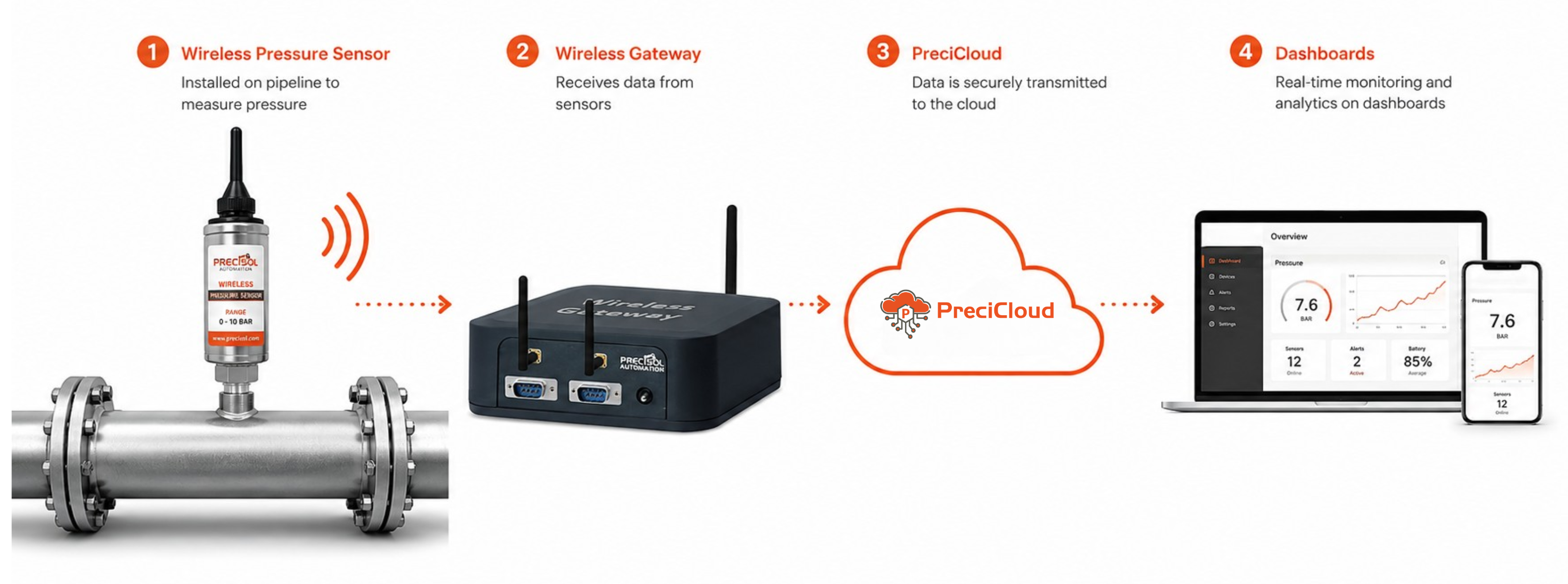
A wireless pressure sensor is a self-contained pressure measurement device that combines an industrial pressure sensor element with a wireless radio transceiver and battery power supply — transmitting pressure readings to a gateway and cloud platform without any signal wiring. Wireless pressure sensors solve the most persistent challenge in pressure monitoring IoT deployment: the cost and disruption of running cable to every pressure measurement point in a plant. A wireless pressure sensor simply threads into an existing ¼″ NPT or G1/4 process port, pairs with the wireless gateway, and immediately begins contributing to the pressure monitoring IoT platform — no conduit, no cable trays, no wiring labour. This guide covers the major industrial pressure sensor application areas for wireless deployment, from pneumatic pressure monitoring in compressed air networks to hydraulic pressure IoT monitoring in heavy machinery.
Industrial Wireless Pressure Sensor Applications
- Pipeline Pressure Monitoring: Multi-point wireless pressure sensor networks along liquid and gas pipelines detect pressure drops indicative of leaks, blockages, and demand surges. Pressure monitoring IoT at multiple pipeline nodes enables leak location triangulation without the cable infrastructure that wired industrial pressure sensor deployment would require along long pipeline routes.
- Compressed Air / Pneumatic Pressure Monitoring: Pneumatic pressure monitoring with wireless pressure sensors tracks compressed air system pressure at distribution points, tools, and machinery. Pressure monitoring IoT of the compressed air network identifies pressure drops caused by leaks (compressed air leaks typically waste 20–30% of compressor output) and demand peaks that indicate undersized distribution infrastructure.
- Hydraulic Pressure IoT: Hydraulic pressure IoT monitoring on press machines, injection moulding equipment, and mobile hydraulic systems tracks system pressure, accumulator performance, and pump output. A wireless pressure sensor on the hydraulic return line detects filter bypass conditions (high differential pressure) before heat buildup damages seals and valves.
- Pump Monitoring: A wireless pressure sensor on pump suction and discharge ports enables suction head and differential pressure monitoring without wiring to the pump skid. Pressure monitoring IoT of differential pressure trending detects impeller wear and cavitation conditions over time.
- HVAC and Chiller Systems: Industrial pressure sensor monitoring via wireless pressure sensors tracks refrigerant pressures, chilled water differential pressure, and air duct static pressure — enabling building engineers to optimise HVAC performance and detect refrigerant leaks.
Wireless Pressure Sensor Specification Comparison
| Parameter | Typical Wireless Pressure Sensor Specification | Pressure Monitoring IoT Implication |
|---|---|---|
| Pressure Range | 0–10 bar, 0–40 bar, 0–100 bar, 0–400 bar options | Match industrial pressure sensor range to process — overpressure reduces accuracy |
| Accuracy | ±0.1–0.5% FS, temperature compensated | Adequate for most pressure monitoring IoT applications (process, leak detection) |
| Process Connection | ¼″ NPT, G1/4, G1/2 threaded | Wireless pressure sensor installs on existing industrial pressure sensor ports |
| Battery Life | 3–7 years at 15-minute intervals | Maintenance interval planning for distributed pressure monitoring IoT deployments |
| IP Rating | IP65–IP67 | Suitable for outdoor and wash-down industrial pressure sensor locations |
| Temperature Rating | −20°C to +70°C operating | Covers most pneumatic pressure monitoring and hydraulic pressure IoT environments |
Deploying Wireless Pressure Sensors Across Your Plant
Precisol Automation's Wireless Pressure Sensor provides industrial-grade industrial pressure sensor accuracy with battery-powered wireless connectivity — enabling pressure monitoring IoT at any process port without cable infrastructure. Its threaded process connection installs in minutes on pipelines, pump ports, HVAC systems, hydraulic circuits, and pneumatic pressure monitoring test points. The compatible Wireless Gateway aggregates readings from multiple wireless pressure sensor nodes across the plant and delivers pressure monitoring IoT data to your cloud dashboard with real-time alerting.
See wireless pressure sensor deployment enabling automated pipeline integrity monitoring in our pipeline monitoring case study, or explore how Precisol supports greenhouse irrigation monitoring with wireless pressure sensor network technology.
Frequently Asked Questions
What is a wireless pressure sensor used for in industry?
Wireless pressure sensors are used for pipeline monitoring, pneumatic pressure monitoring, hydraulic pressure IoT, pump differential pressure tracking, boiler pressure monitoring, and HVAC system pressure monitoring IoT — eliminating the cable runs required for traditional wired industrial pressure sensor installations at remote or difficult-access measurement points.
How accurate are wireless pressure sensors for industrial pressure monitoring IoT?
Industrial-grade wireless pressure sensors achieve ±0.1–0.5% FS accuracy with temperature compensation — comparable to wired industrial pressure sensor transmitters. Pressure monitoring IoT accuracy is maintained by cloud-based calibration tools, enabling field calibration of the wireless pressure sensor without removal from the process connection.
How long do wireless pressure sensor batteries last?
At 15-minute transmission intervals, a wireless pressure sensor achieves 3–7 years on a lithium battery. Higher-frequency pressure monitoring IoT (1-minute intervals) reduces life to 6–18 months. For continuous pneumatic pressure monitoring or hydraulic pressure IoT requiring sub-minute updates, use wireless pressure sensors with external power supply or energy harvesting.