Smart Energy Metering in Industry: Cutting Costs with IoT Monitoring
05 August 2026
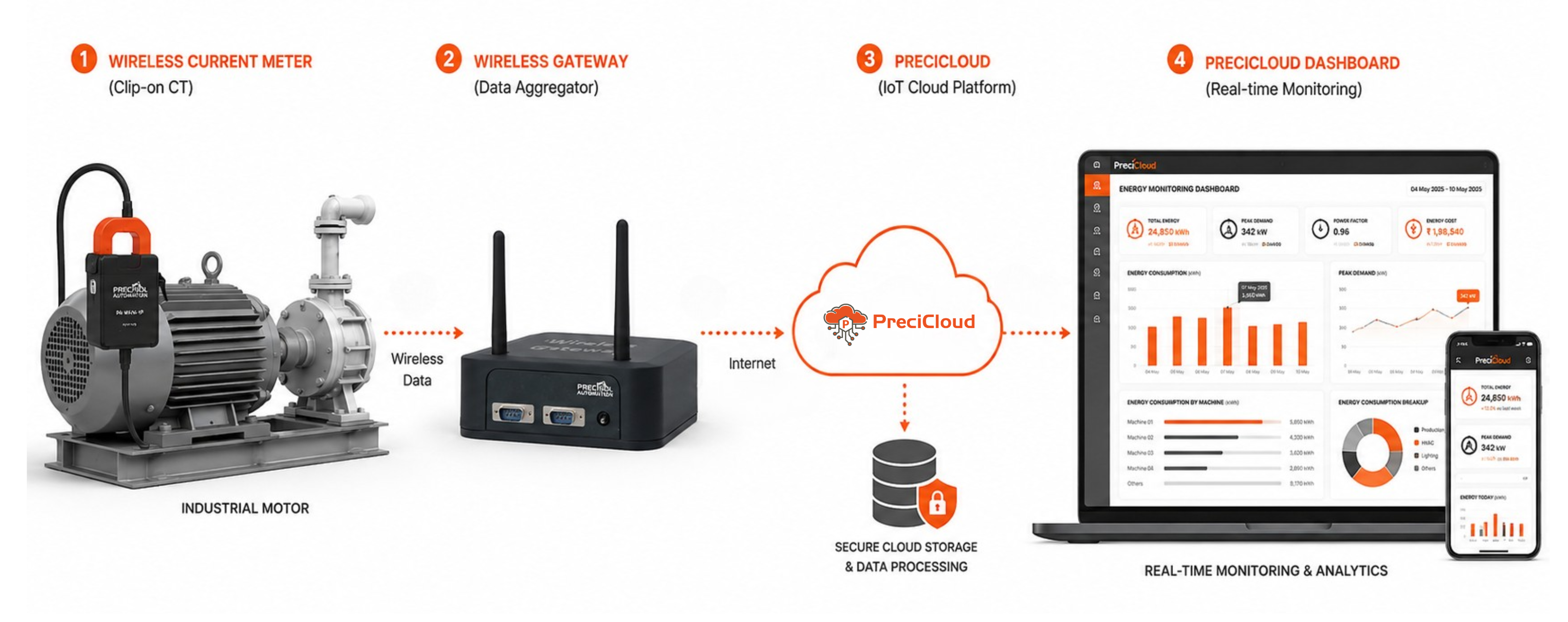
Smart energy metering with industrial IoT transforms energy management from a monthly utility-bill exercise into a continuous, real-time industrial energy monitoring discipline. A smart energy metering system deploys IoT power monitoring devices — wireless current meters, energy analysers — at machine, circuit, and sub-panel level across the facility, transmitting granular energy consumption tracking data to a cloud platform that makes waste visible and quantifiable. The fundamental insight that smart energy metering delivers is attribution: instead of knowing total site energy consumption from the utility bill, operations teams know exactly which machine, which shift, which production process, and which time period accounts for each kWh consumed. This granular visibility is the foundation of industrial energy reduction — you cannot manage what you cannot measure, and power meter IoT measurement at machine level is the minimum resolution needed to drive meaningful industrial energy monitoring improvement.
What Smart Energy Metering Reveals That Utility Bills Cannot
A facility's monthly utility bill shows total energy consumption and peak demand — two numbers that hide enormous detail. Smart energy metering exposes the patterns behind those numbers:
- Idle and Standby Energy Waste: IoT power monitoring at machine level reveals that machines in standby during production gaps, lunch breaks, and overnight periods consume significant energy. Energy consumption tracking typically shows that 10–30% of a machine's energy use occurs during non-productive periods — a direct cost reduction target that smart energy metering makes visible.
- Peak Demand Charges: Industrial energy monitoring of 15-minute demand intervals identifies which machines and processes drive peak demand charges. In many industrial tariffs, peak demand can represent 30–40% of the total electricity bill — smart energy metering reveals the demand peaks and enables scheduling changes that reduce peak demand without affecting production.
- Power Factor Penalties: Power meter IoT measurement of reactive power and power factor per circuit identifies inductance-heavy loads (large motors, welding machines, compressors) drawing reactive current that incurs power factor penalties. Industrial energy monitoring data guides targeted power factor correction capacitor installation.
- Machine Efficiency Degradation: Energy consumption tracking over time reveals when a machine begins consuming more energy for the same output — a sign of mechanical wear, misalignment, or lubrication degradation detectable through smart energy metering trend analysis.
Smart Energy Metering Implementation Tiers
| Tier | Smart Energy Metering Measurement Level | Industrial Energy Monitoring Insight |
|---|---|---|
| Tier 1 | Sub-panel / distribution board (whole area) | Area-level energy consumption tracking — identifies high-use zones |
| Tier 2 | Production line / machine group | IoT power monitoring by production unit — line efficiency comparison |
| Tier 3 | Individual machine / motor circuit | Machine-level smart energy metering — idle waste detection, condition monitoring |
| Tier 4 | Process step / component | Most granular industrial energy monitoring — specific energy per unit of output |
Deploy Smart Energy Metering with Precisol Automation
Precisol Automation's Wireless Current Meter provides non-invasive, clip-on IoT power monitoring without circuit interruption — enabling rapid smart energy metering deployment across machines and panels without shutdown or rewiring. The PreciCloud IoT Cloud Dashboard aggregates all power meter IoT data in a cloud industrial energy monitoring platform with machine-by-machine dashboards, energy consumption tracking reports, and peak demand visualisation.
See smart energy metering delivering measurable energy cost reduction in our carbon manufacturing plant case study, or explore how Precisol enables smart energy metering across diverse industrial facilities with wireless IoT power monitoring.
Frequently Asked Questions
What is smart energy metering in industrial facilities?
Smart energy metering uses IoT power monitoring devices to measure energy consumption at machine, circuit, and panel level in real time — transmitting data to a cloud platform for industrial energy monitoring, energy consumption tracking, and cost allocation. Smart energy metering replaces manual meter reading and utility-bill-only analysis with continuous, granular power meter IoT data.
How does IoT power monitoring reduce industrial energy costs?
IoT power monitoring makes consumption visible at machine level — identifying idle energy waste, peak demand drivers, power factor penalties, and efficiency degradation. Smart energy metering programs using granular energy consumption tracking and industrial energy monitoring typically achieve 10–20% energy cost reductions by enabling targeted interventions that utility-bill data alone cannot support.
What does a smart energy metering system measure?
Smart energy metering measures active power (kW), reactive power (kVAR), apparent power (kVA), power factor, per-phase current and voltage, cumulative energy (kWh), peak demand, and harmonics. IoT power monitoring platforms present all energy consumption tracking parameters in industrial energy monitoring dashboards with trending and automated reporting.