AMR Testing: CAN Bus Data Loggers for Autonomous Mobile Robot Validation
24 August 2026
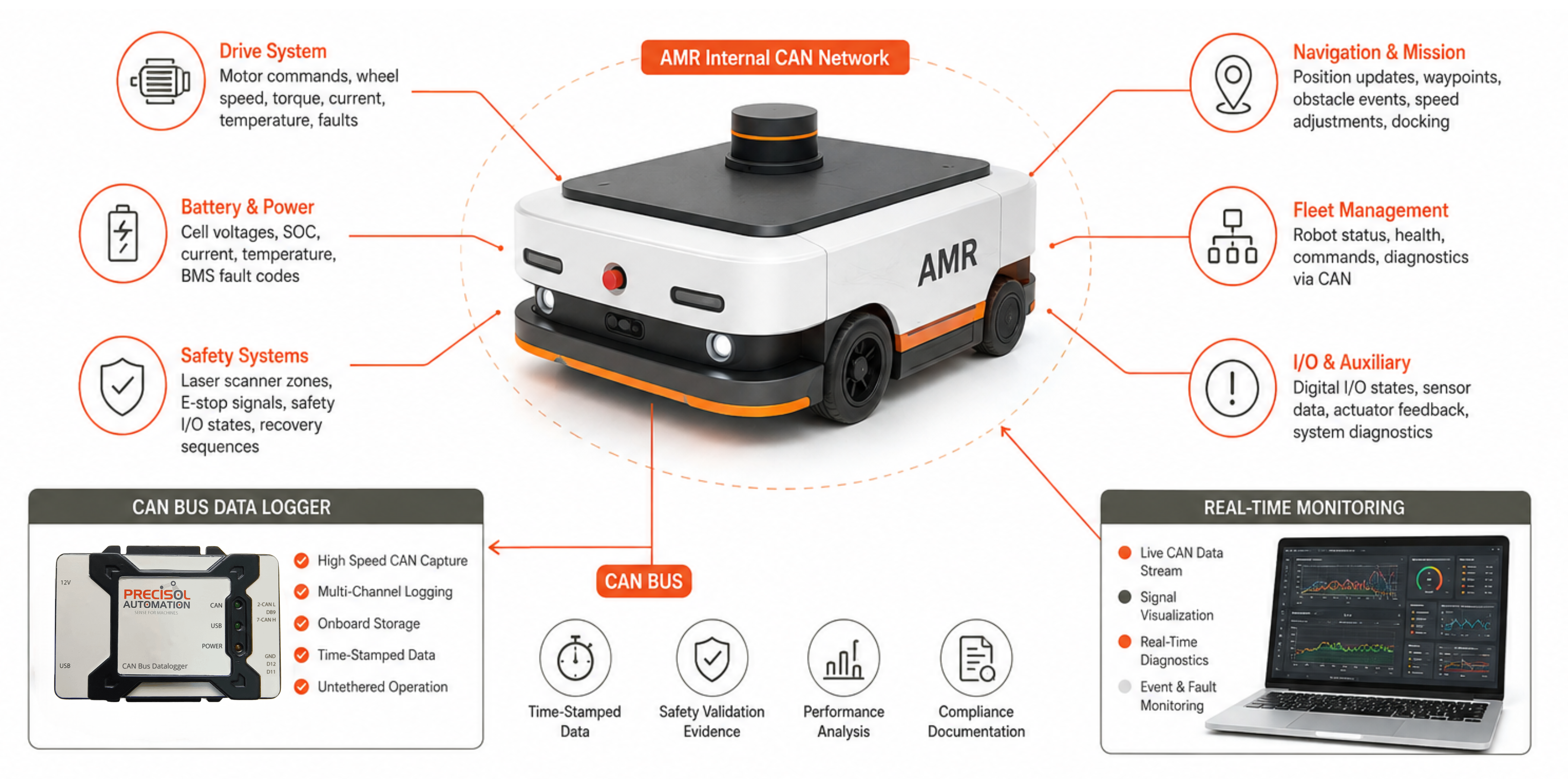
AMR testing with CAN bus data loggers provides the objective, time-stamped data record that autonomous mobile robot testing engineers need to validate navigation performance, safety systems, drive mechanics, and integration behaviour before deploying AMRs in shared human-robot workspaces. A CAN bus data logger connected to the AMR's internal CAN network captures all motor controller commands and feedback, battery management system data, safety laser scanner status, emergency stop signals, and fleet management communication — the complete internal state of the robot during every CAN bus robot testing scenario. This AMR CAN data logging record enables engineers to objectively measure navigation accuracy, verify safety response times against specification, identify control system defects, and build the robot safety validation documentation that facility operators and regulators require before AMR commissioning. As AMR deployments grow in automotive plants, pharmaceutical warehouses, and logistics centres, rigorous AMR testing with CAN data loggers is an essential step in confident, safe robot deployment.
What CAN Bus Robot Testing Captures in AMR Validation
The CAN bus in an autonomous mobile robot is the primary nervous system — connecting the robot's drive motor controllers, battery BMS, safety system controller, and I/O modules into a coordinated network. AMR CAN data logging during autonomous mobile robot testing captures the complete real-time picture of robot internal state:
- Drive System Data: CAN bus robot testing captures motor controller CAN messages — velocity commands, actual wheel speed feedback, motor torque, current draw, controller temperature, and drive system fault codes. This data validates drive control loop accuracy, wheel slip detection, and motor protection behaviour during AMR testing load and speed variation trials.
- Battery and Power Data: Battery management system CAN data captured by AMR CAN data logging includes cell voltages, pack SOC, charging current, temperature, and BMS fault codes — enabling validation of battery runtime under operational load, charging behaviour, and low-battery safe-stop sequences during autonomous mobile robot testing.
- Safety System Events: Safety laser scanner zone transitions, emergency stop activations (source and reason), safety I/O state changes, and recovery sequences are all transmitted on the AMR CAN bus and captured by the CAN bus robot testing data logger. Time-stamped robot safety validation records prove that safety systems responded within specification.
- Navigation and Mission Data: Position updates (from onboard localisation), waypoint commands, obstacle detection events, speed adjustments, and docking sequences — AMR CAN data logging correlates navigation CAN messages with actual position data for path tracking accuracy analysis.
AMR Testing Protocol: From Lab to Facility
| AMR Testing Stage | Autonomous Mobile Robot Testing Focus | CAN Bus Robot Testing Data Captured |
|---|---|---|
| Component Testing | Drive motor, BMS, safety scanner individual validation | AMR CAN data logging of individual subsystem CAN data streams |
| Integration Testing | Multi-subsystem CAN bus communication; E-stop propagation | Full CAN bus robot testing — all nodes simultaneously logged |
| Performance Testing | Navigation accuracy, path tracking, payload handling | AMR testing drive data + GPS/position correlation for accuracy analysis |
| Safety Validation | E-stop response time, safety zone function, speed compliance | Robot safety validation CAN records — timestamped safety events |
| Factory Acceptance Test (FAT) | Full autonomous mobile robot testing in simulated facility scenario | Complete AMR CAN data logging archive for commissioning documentation |
Robot Safety Validation Requirements for AMR Deployment
Robot safety validation for AMRs operating in human-occupied facilities follows ISO 3691-4 (industrial trucks — safety requirements for driverless trucks and their systems). The standard requires documented autonomous mobile robot testing of emergency stop performance (stopping distance from maximum speed must be within calculated personnel safety distance), safety sensor zone coverage, failure mode behaviour (safe state on communication loss, sensor failure, or power interruption), and maximum speed limits in personnel areas. AMR CAN data logging provides the objective evidence for each of these requirements — the time-stamped CAN bus robot testing records showing emergency stop signals, response times, and safe-state transitions form the core of the robot safety validation documentation file submitted for facility deployment approval.
Deploy AMR CAN Data Logging with Precisol Automation
Precisol Automation's CAN Data Logger provides compact, multi-channel AMR CAN data logging for autonomous mobile robot testing — capturing all internal CAN bus communication at high sample rates, with onboard storage for untethered AMR testing on the robot during navigation trials. The CAN to USB Adapter provides real-time CAN bus robot testing interface to a test laptop for live monitoring during robot safety validation tests.
See autonomous mobile robot testing with CAN data loggers in our AMR testing case study, or explore how Precisol enables industrial AMR field testing with CAN bus gateway tools for AMR CAN data logging and robot safety validation.
Frequently Asked Questions
What is AMR testing and what does it validate?
AMR testing systematically validates autonomous mobile robots before facility deployment — covering navigation accuracy, safety system response (E-stop, safety zones), drive performance, battery behaviour, and fleet management integration. AMR CAN data logging captures all internal CAN bus communication during autonomous mobile robot testing scenarios, providing objective time-stamped records for robot safety validation documentation.
Why is CAN bus used in autonomous mobile robots?
CAN bus provides reliable, noise-resistant multi-node communication between AMR motor controllers, BMS, safety scanners, and I/O modules — the same robustness that drives automotive and industrial automation adoption. CAN bus robot testing via a data logger captures all motor, battery, safety, and navigation CAN data during autonomous mobile robot testing, providing the complete robot internal state for AMR testing analysis and robot safety validation.
What AMR safety tests are required before facility deployment?
ISO 3691-4 requires documented AMR testing of emergency stop response and stopping distance, safety laser scanner zone function, failure mode safe-state behaviour, and maximum speed compliance. AMR CAN data logging records of CAN bus robot testing scenarios provide the objective time-stamped evidence for each robot safety validation requirement in the commissioning documentation file.