ECU Software Validation: Methods, Tools, and HIL Simulation Guide
21 August 2026
ECU software validation is the systematic, multi-stage process that automotive engineers use to verify that an Electronic Control Unit's software meets its functional requirements, safety specifications, and integration targets before the ECU reaches a production vehicle. Modern automotive development delivers ECUs running millions of lines of software code that control safety-critical systems — braking, steering, ADAS, powertrain — making thorough automotive software testing an engineering and regulatory necessity, not an optional quality activity. ECU validation tools span a hierarchy from early-stage model simulation through HIL simulation to vehicle-level validation, each stage progressively replacing simulated elements with real hardware. The ECU test bench and CAN bus tools that support this validation hierarchy — CAN analysers, data loggers, UDS diagnostic interfaces, and CAN simulators — are the laboratory infrastructure that makes ECU software validation efficient, reproducible, and traceable to ISO 26262 requirements.
The ECU Software Validation Hierarchy
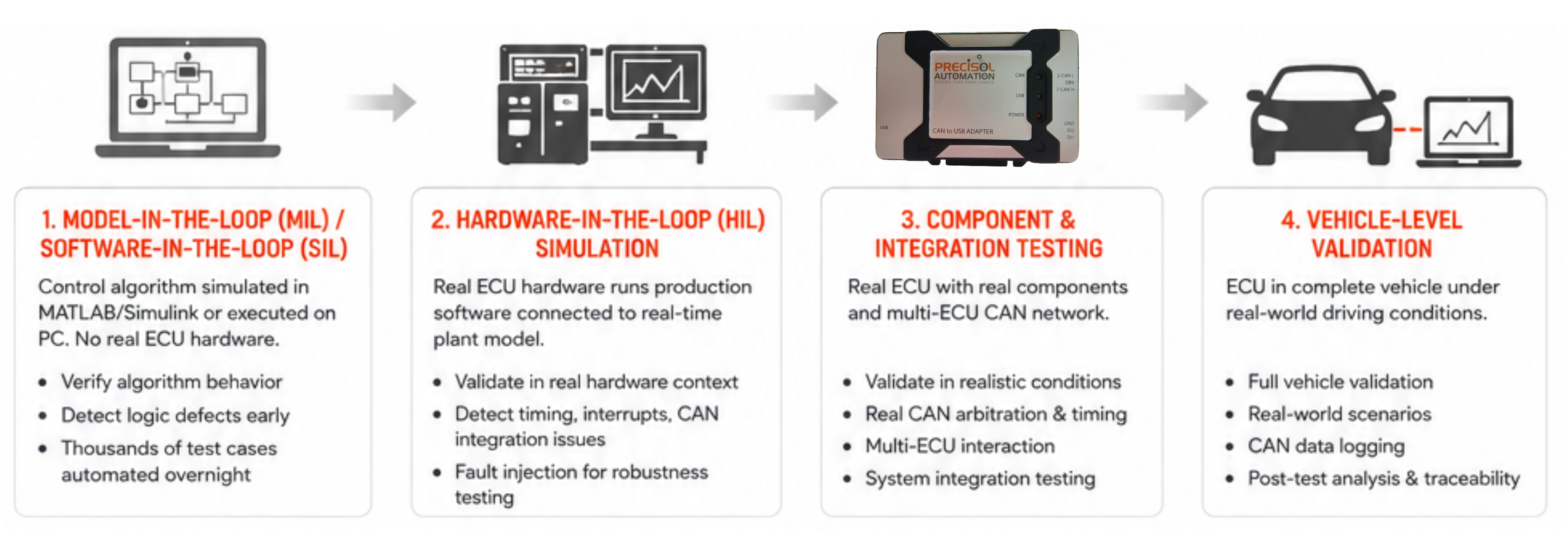
Effective ECU software validation follows a V-model progression: validation stages increase in hardware fidelity while decreasing in test setup cost, enabling defects to be detected at the lowest-cost stage. The hierarchy used in automotive software testing:
- Model-in-the-Loop (MIL) / Software-in-the-Loop (SIL): The earliest ECU software validation stages — the control algorithm is simulated in MATLAB/Simulink (MIL) or compiled to executable code running on a PC (SIL). No real ECU hardware is involved. These stages verify that the algorithm behaves correctly in simulation before hardware is involved — the most cost-effective stage for detecting logic defects. Automotive software testing at SIL stage can cover thousands of test cases automatically overnight.
- Hardware-in-the-Loop (HIL) Simulation: HIL simulation is the critical transition stage — the real ECU hardware runs production software, connected to an ECU test bench with a real-time plant model generating realistic sensor inputs, actuator loads, and CAN bus stimuli. HIL simulation validates the ECU software in its actual hardware context, uncovering timing errors, interrupt handling defects, and CAN bus integration issues that SIL testing cannot detect. ECU validation tools including fault injection (forcing sensor failures, power interruptions, CAN bus errors) enable comprehensive robustness testing at HIL stage.
- Component and Integration Testing: The real ECU connects to real hardware components on an ECU test bench — real actuators, real sensors, real CAN bus network with other ECUs. This automotive software testing stage validates ECU software in realistic integration conditions, including real CAN bus arbitration, real-world signal timing, and multi-ECU interaction.
- Vehicle-Level Validation: The final ECU software validation stage — the ECU in a complete vehicle. CAN bus data loggers capture full multi-channel vehicle CAN data during real-world driving cycles for post-test analysis and traceability.
ECU Validation Tools: CAN Bus Test Equipment
| ECU Validation Tool | Function in ECU Software Validation | Validation Stage |
|---|---|---|
| CAN to USB Adapter | ECU CAN bus to test PC interface; UDS diagnostics; log capture | ECU test bench, HIL simulation, integration testing |
| CAN Data Logger | High-speed multi-channel CAN capture; offline analysis | Automotive software testing at vehicle level; regression testing |
| CAN Bus Analyser | Real-time CAN frame decoding; timing and protocol compliance check | ECU test bench integration; CAN bus EOL test |
| HIL Simulator | Real-time plant model; sensor signal generation; fault injection | HIL simulation — core ECU software validation ECU validation tool |
| UDS Diagnostic Tool | ECU firmware flashing; DTC reading; read/write data by identifier | All ECU software validation stages requiring ECU diagnostic access |
ISO 26262 and ECU Software Validation Requirements
ISO 26262 (Functional Safety for Road Vehicles) defines rigorous ECU software validation requirements for safety-related ECUs. ASIL (Automotive Safety Integrity Level) classification — from ASIL A (least critical) to ASIL D (most safety-critical) — determines the depth of automotive software testing required. ASIL D ECUs controlling functions like braking or steering require: complete requirements traceability; formal software architecture verification; code coverage measurement (MC/DC coverage for ASIL C/D); HIL simulation with fault injection to validate safe-state transitions; and independent ECU software validation review. The ECU test bench and ECU validation tools used in ASIL validation must themselves be qualified — their reliability and accuracy must be documented to demonstrate that the validation evidence is trustworthy.
Deploy ECU Software Validation with Precisol Automation
Precisol Automation's CAN to USB Adapter provides the CAN bus interface for ECU test bench setups — supporting UDS diagnostics, CAN frame monitoring, and automated automotive software testing sequences. The CAN Data Logger captures complete multi-channel CAN bus sessions during HIL simulation and vehicle-level validation — providing the high-fidelity data capture that ECU software validation traceability requires.
See ECU software validation in practice in our automotive ECU software validation case study, or explore how Precisol enables ECU simulator and HIL simulation applications with CAN bus ECU validation tools.
Frequently Asked Questions
What is ECU software validation and why is it critical for automotive development?
ECU software validation verifies that an ECU's software meets functional, safety, and performance requirements before vehicle integration. It is critical because ECUs control safety-critical systems, ISO 26262 mandates systematic automotive software testing, and software defects reaching production cause costly recalls. ECU validation tools from SIL through HIL simulation to vehicle-level testing form the validation hierarchy.
What is HIL simulation and how does it differ from an ECU test bench?
HIL simulation connects the real ECU hardware to a real-time plant model, replacing the physical engine/vehicle with simulation. An ECU test bench is broader — it may use real hardware loads without a full real-time plant model. HIL simulation is a specific, structured ECU software validation stage with real-time computation; an ECU test bench may be used for simpler interface verification without the complete automotive software testing plant model.
What CAN bus tools are used in ECU software validation?
ECU software validation uses CAN to USB adapters (ECU test bench interface, UDS diagnostics), CAN data loggers (high-speed capture for vehicle-level automotive software testing), CAN bus analysers (real-time protocol compliance checking), HIL simulators (real-time plant model and fault injection), and UDS diagnostic tools (ECU flashing, DTC reading). A CAN to USB adapter is the most universal ECU validation tool across all validation stages.