Instrument Cluster Validation: HMI Testing Methods and Tools
25 August 2026
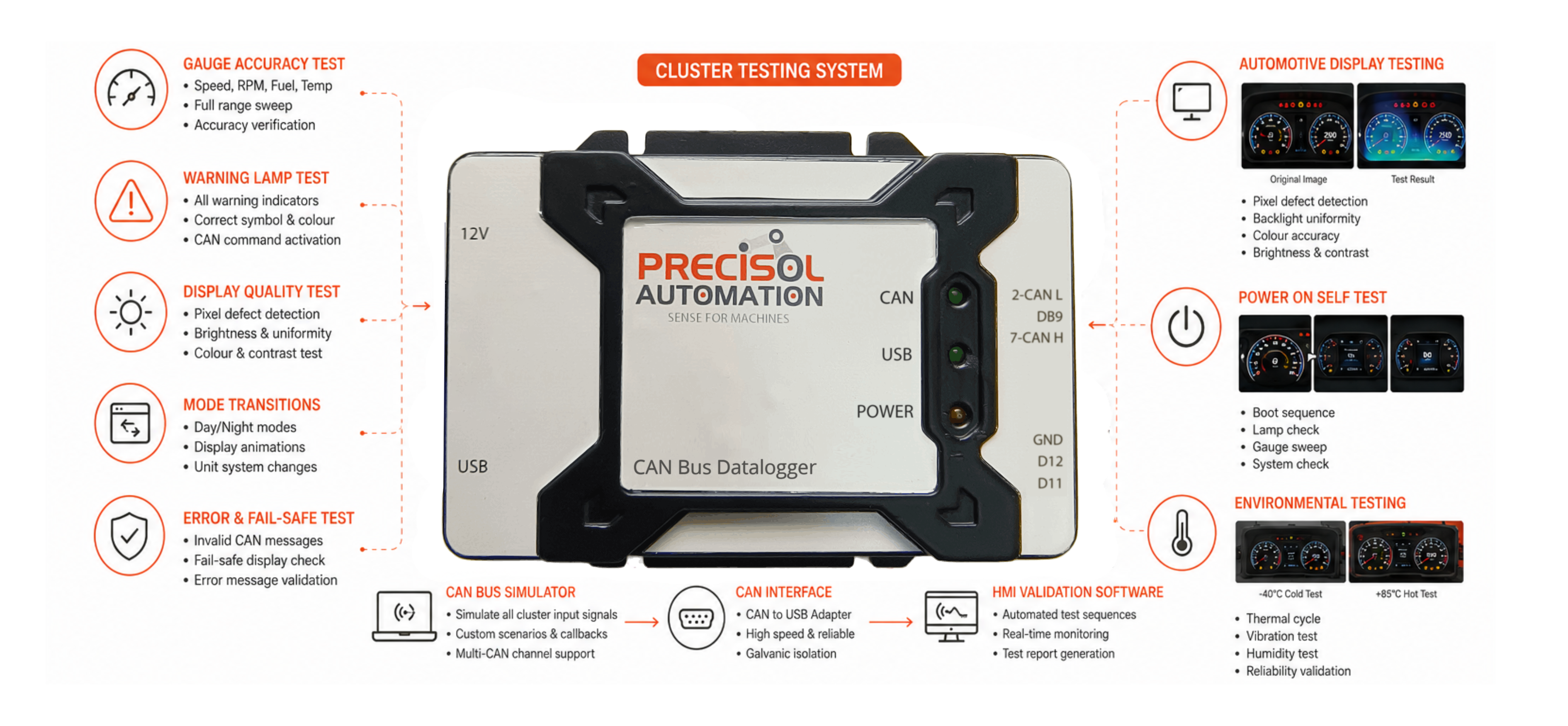
Instrument cluster validation is the systematic testing process that confirms an automotive dashboard display — digital TFT instrument panel, analog gauge cluster, or hybrid — correctly receives CAN bus data, accurately renders all gauges and warning indicators, meets display quality standards, and survives the full automotive environmental specification before entering production. A modern cluster testing system must exercise the instrument cluster across hundreds of test cases: all warning lamp activations, gauge deflection accuracy at multiple CAN bus input values, display mode transitions (day/night/backlight failure), error message rendering, power-on self-test sequences, and automotive display testing of pixel quality, colour accuracy, and animation smoothness. HMI validation testing of the instrument cluster is required at multiple development stages — from early hardware-in-the-loop bench testing through complete vehicle integration — and the instrument cluster design must satisfy both the functional requirements defined in the specification and the perceptual quality standards that automotive OEM visual quality teams apply. CAN bus data loggers and CAN to USB adapters are the key tools in instrument cluster validation — providing the interface between the test PC, the cluster testing system, and the cluster CAN bus network.
Instrument Cluster Validation: What a Cluster Testing System Verifies
A complete instrument cluster validation test campaign exercises every functional aspect of the cluster through its cluster testing system:
- CAN Bus Signal Reception and Display Accuracy: The cluster testing system sends CAN bus messages for vehicle speed, engine RPM, fuel level, coolant temperature, and other gauge inputs at a series of defined values across the full gauge range. HMI validation testing verifies that each gauge displays within the tolerance specified in the instrument cluster design (typically ±2% of full-scale deflection for analog gauges; pixel-accurate for digital gauges).
- Warning Lamp and Indicator Function: Every warning lamp (engine malfunction indicator, oil pressure, coolant temperature, battery charge, seat belt reminder, door ajar, traction control, ABS) must activate, display the correct symbol, and in many cases display in the specified colour — instrument cluster validation tests each lamp via CAN bus command and verifies correct display behaviour.
- Automotive Display Testing: The TFT display screen requires automotive display testing for pixel defects (stuck-on or stuck-off pixels), backlight uniformity (brightness variation across the screen), colour accuracy (colour gamut and white point), contrast ratio, and visibility at specified ambient light levels. Instrument cluster design for modern vehicles typically requires 1000 cd/m² peak brightness for daylight visibility.
- Instrument Cluster Design Mode Transitions: HMI validation testing covers all cluster display modes: normal driving mode, service mode, economy mode, tachometer range switching, unit system change (km/h vs mph), and failure mode displays. Transition animations and timing are part of instrument cluster validation.
CAN Bus Interface in Instrument Cluster Validation
| Validation Requirement | Cluster Testing System Approach | HMI Validation Testing Tool |
|---|---|---|
| CAN Signal Simulation | CAN bus simulator sends all cluster input messages | CAN to USB adapter + instrument cluster validation test PC |
| Gauge Accuracy Check | Sweep each gauge input over full range; compare display vs. CAN input | Vision system or manual check against cluster testing system values |
| Warning Lamp Activation | CAN command each lamp; verify correct activation and colour | Automated automotive display testing with image analysis |
| Error Handling | Send invalid CAN messages; confirm cluster fail-safe display response | CAN bus data logger records all messages during instrument cluster validation |
| Environmental Testing | Cluster testing system operates cluster in thermal chamber, on vibration table | HMI validation testing with automated CAN stimulus during environment tests |
Field Testing for Instrument Cluster Validation
Laboratory instrument cluster validation covers the structured test cases; field testing in a vehicle validates the cluster in realistic operating conditions. A CAN data logger or CAN to USB adapter connected to the vehicle CAN bus during instrumented field testing captures the full range of real vehicle CAN signals — including transient messages, simultaneous multi-ECU data, and realistic message timing — that a cluster testing system lab simulation may not fully replicate. Field-driven HMI validation testing may reveal display rendering issues at specific CAN bus load levels, vibration-induced display artefacts, or thermal performance differences at extreme ambient temperatures that only appear in real operating conditions. Automotive display testing in field conditions — direct sunlight readability, night-time backlight dimming, rain and condensation effects — validates the instrument cluster design against human factors requirements that laboratory tests cannot fully capture.
Deploy Instrument Cluster Validation with Precisol Automation
Precisol Automation's HMI Validation Systems provide the cluster testing system infrastructure for instrument cluster validation — CAN bus signal simulation, automated HMI validation testing sequences, and display quality testing tools for automotive display testing. The CAN Data Logger supports field-based instrument cluster validation by capturing complete vehicle CAN bus sessions for post-test analysis of cluster response to real-world signal conditions.
See instrument cluster validation and HMI validation testing in practice in our automotive instrument cluster field testing case study, or explore how Precisol supports automotive diagnostics with CAN bus interfaces for cluster testing system and automotive display testing applications.
Frequently Asked Questions
What is instrument cluster validation and what does it cover?
Instrument cluster validation verifies that an automotive dashboard display correctly handles all CAN bus data inputs, accurately renders gauges and warning lamps, meets automotive display testing quality standards, and survives the environmental specification. A cluster testing system exercises all functional, display quality, and HMI validation testing requirements — from gauge accuracy and warning lamp function to automotive display testing of pixel quality and backlight performance.
How does a cluster testing system simulate CAN bus signals for validation?
A cluster testing system uses a CAN bus simulator connected to the cluster harness to generate synthetic CAN messages — sending specific speed, RPM, fuel level, and warning lamp signals. HMI validation testing verifies that the cluster displays each value within specification and activates correct warning indicators. Automotive display testing with vision systems or manual inspection confirms the displayed values match the CAN bus stimuli from the cluster testing system.
What environmental tests are required in instrument cluster validation?
Instrument cluster validation environmental testing covers temperature range (−40°C to +85°C storage, −20°C to +70°C operating), thermal cycling, random vibration and shock profiles, humid heat cycling, and EMC/ESD testing to automotive standards. A cluster testing system must deliver CAN bus stimulus during environmental tests so HMI validation testing confirms instrument cluster design function across the full operating envelope.