Automatic Meter Reading (AMR) with IoT: Smart Meter Data Collection for Utilities
07 October 2026
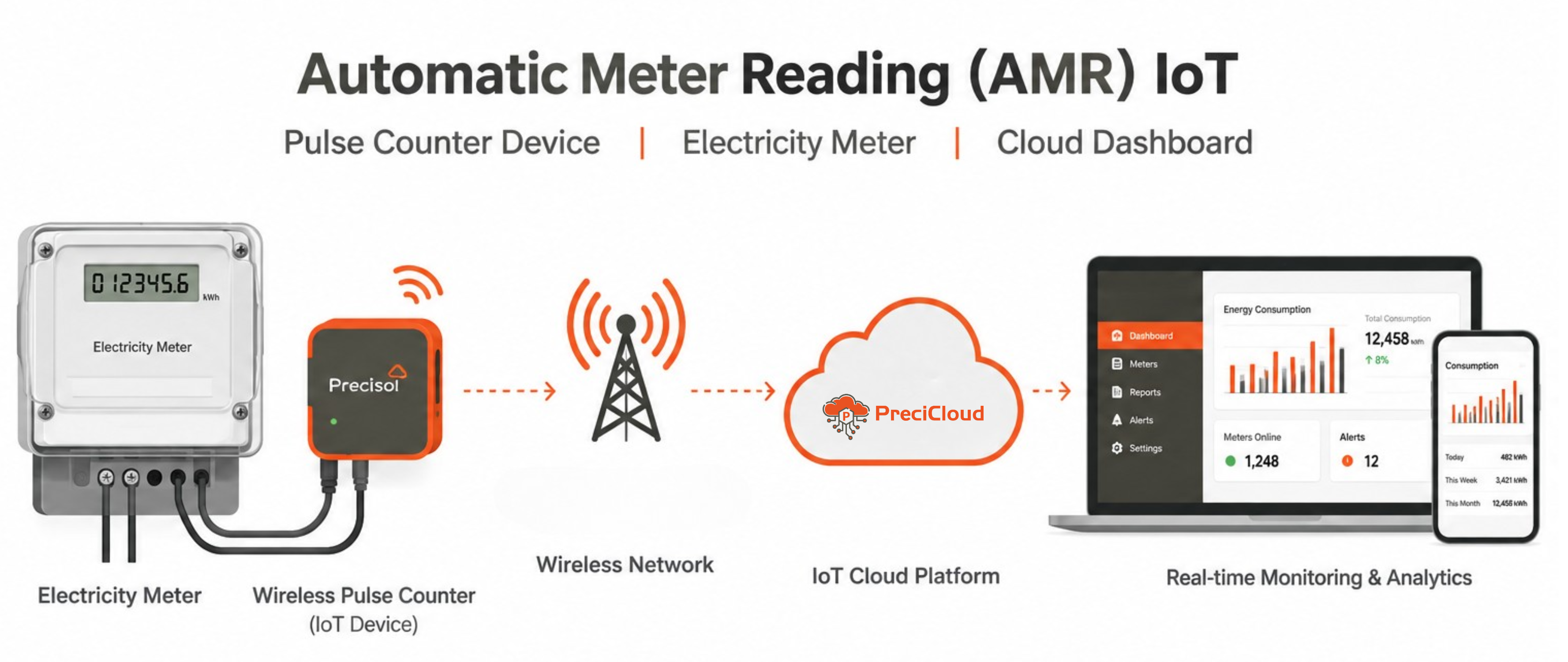
Automatic meter reading AMR IoT eliminates the operational inefficiency, billing inaccuracy, and customer service burden of manual meter reading — one of the most persistent legacy processes in electricity, water, and gas utility operations. Every utility in India and globally maintains large field metering teams whose primary task is visiting millions of customer premises to manually record meter consumption — a process that is expensive (Rs. 15–50 per meter read in India depending on location), error-prone (transcription errors cause billing disputes), unable to detect leaks or theft between reads, and increasingly difficult as access issues (locked premises, aggressive animals, inaccessible meter locations) prevent successful reads on schedule. Automatic meter reading AMR IoT using pulse counter IoT meter devices connected to existing meters transforms this by transmitting daily or hourly consumption readings to a central smart meter data collection platform — no meter reader required, no premises access needed, no transcription errors, and reads available at configurable frequency rather than monthly. Utility IoT meter reading via LoRaWAN (for dense urban deployments), NB-IoT (for wide-area deployments with existing cellular network), or Wi-Fi (for industrial campus sub-metering) connects thousands of meters to the cloud platform through a single gateway, reducing the per-read cost to Rs. 0.5–3 per meter per month at scale. The transition from AMR to AMI advanced metering infrastructure adds real-time demand data, two-way communication, and remote disconnect capability — enabling time-of-use pricing, demand response, and non-revenue energy programmes that AMR alone cannot support.
Automatic Meter Reading AMR IoT: Technology Options
- Pulse Counter IoT Meter (Legacy Meter Retrofit): The most cost-effective automatic meter reading AMR IoT approach — connects to the existing meter's S0 pulse output terminal and counts consumption pulses, transmitting totals to the cloud platform. Pulse counter IoT meter devices are battery-powered (3–10 year battery life depending on transmission interval), non-intrusive (no modification to the meter or supply), and work with any brand of electricity, water, or gas meter with pulse output. Suitable for both domestic and commercial meters.
- Optical Interface AMR (Any Meter): For meters without pulse output, optical reader adapters clip over the meter's LED pulse indicator (optical port) and read electronically — adding utility IoT meter reading capability without any electrical connection to the meter. Used in smart meter data collection retrofits for domestic tariff meters, prepayment meters, and industrial meters lacking wired pulse terminals.
- Modbus/DLMS Protocol (Smart Meter Interface): Modern digital electricity meters expose consumption registers via RS485 Modbus or DLMS/COSEM protocol. Automatic meter reading AMR IoT gateways with Modbus master capability collect interval energy data (15-minute or hourly kWh), demand data (kW peak per interval), power factor, and phase-by-phase data from smart meters — providing the interval data foundation for AMI advanced metering infrastructure analytics and time-of-use billing.
- LoRaWAN Network for Utility IoT Meter Reading: LoRaWAN (Long Range Wide Area Network) is the preferred utility IoT meter reading communication for large-scale AMR deployments — a single LoRa gateway covers 2–15 km radius and connects thousands of pulse counter IoT meter devices simultaneously. LoRaWAN's low power consumption (enabling 5–10 year meter device battery life) and sub-GHz penetration through buildings and utility meter enclosures make it the leading network technology for automatic meter reading AMR IoT in India's utility sector.
Automatic Meter Reading AMR IoT: Application Coverage
| Application | AMR IoT Technology | Smart Meter Data Collection Benefit |
|---|---|---|
| Utility Distribution (Electricity) | Pulse counter IoT meter or Modbus smart meter; LoRaWAN or NB-IoT | Eliminate manual reads; daily billing; non-revenue energy detection |
| Water Utility (Residential/Commercial) | Pulse counter IoT meter (1L or 10L pulse); LoRaWAN | Leak detection between reads; hourly consumption profiles; theft alert |
| Industrial Campus Sub-Metering | Modbus energy meters; Wi-Fi or wired Ethernet AMR IoT gateway | Utility IoT meter reading for cost allocation; department energy billing |
| AMI Advanced Metering Infrastructure | DLMS/COSEM smart meter; mesh or cellular two-way network | Time-of-use pricing; demand response; remote disconnect; outage detection |
| Gas Distribution | Pulse counter IoT meter on gas diaphragm meter; NB-IoT | Automatic meter reading AMR IoT daily reads; pressure event alerting |
Deploy Automatic Meter Reading AMR IoT with Precisol Automation
Precisol Automation's Wireless Pulse Counter provides the battery-powered pulse counter IoT meter device for retrofit automatic meter reading AMR IoT on existing electricity, water, and gas meters — transmitting pulse count data via LoRa or NB-IoT to the cloud platform. The PreciCloud IoT Cloud Dashboard provides the smart meter data collection platform with consumption dashboards, billing data export, interval data analysis, and leak/theft detection alerts for utility IoT meter reading deployments.
See IoT sensor data aggregation and cloud reporting in our IT-OT bridge for process automation case study, or explore automatic meter reading using wireless pulse counter for full AMR IoT deployment guidance using Precisol's wireless pulse counter and cloud platform.
Frequently Asked Questions
What is automatic meter reading AMR IoT and how does it work?
Automatic meter reading AMR IoT uses pulse counter IoT meter devices or optical/Modbus adapters attached to existing utility meters to collect consumption data and transmit via LoRaWAN, NB-IoT, or cellular to a smart meter data collection cloud platform — replacing manual meter readers. Utility IoT meter reading platforms aggregate thousands of meter readings for billing, consumption analysis, and non-revenue energy detection. Per-read cost falls from Rs. 15–50 (manual) to Rs. 0.5–3 at IoT scale.
What is the difference between AMR and AMI (Advanced Metering Infrastructure)?
Automatic meter reading AMR IoT collects consumption totals at defined intervals (daily/monthly), replacing manual reads but providing no real-time data or two-way communication. AMI advanced metering infrastructure adds 15-minute interval data, two-way communication (remote connect/disconnect, demand response commands), outage detection, and tampering alerts. AMI smart meter data collection enables time-of-use pricing and demand response; AMR IoT uses simpler pulse counter IoT meter technology at lower cost per connection for basic billing automation.
How does pulse counter IoT meter reading work for legacy meters?
Pulse counter IoT meter reading connects to an existing meter's S0 pulse output terminal — counting contact closures (1 pulse = 0.1 kWh or 1 litre, depending on meter type) and transmitting consumption totals to the smart meter data collection platform at configured intervals. Battery-powered (3–10 year life), non-intrusive, and compatible with any brand of electricity, water, or gas meter with pulse output. For meters without pulse outputs, optical interface adapters add automatic meter reading AMR IoT capability without electrical connection.