Edge Computing vs Cloud IoT: Choosing the Right IIoT Architecture
08 October 2026
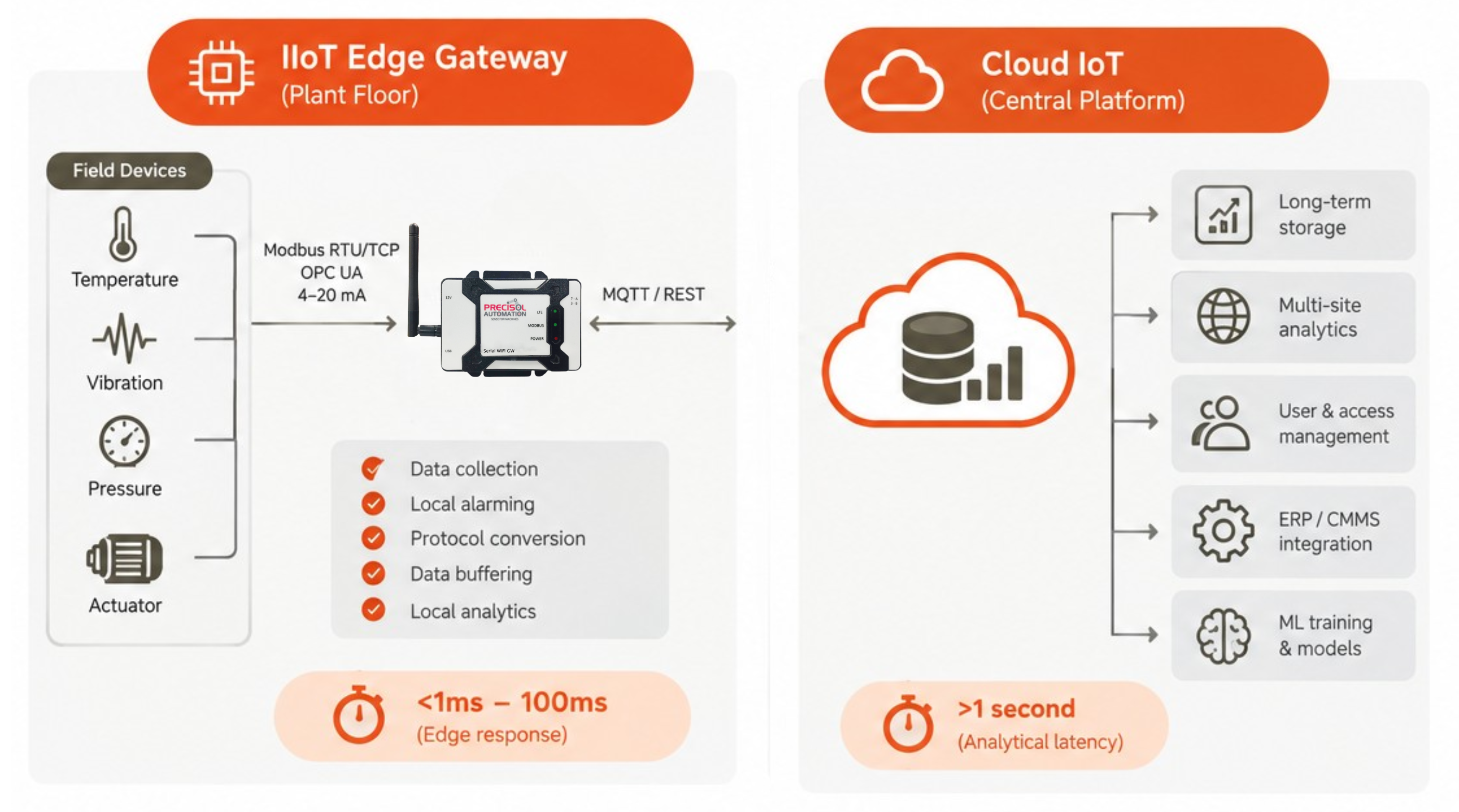
Edge computing vs cloud IoT is one of the most practically important architecture decisions in Industrial IoT deployments — determining where data processing occurs, how the system behaves during connectivity loss, how much bandwidth is consumed, and whether real-time safety and control requirements can be met. The choice is rarely absolute: most production-grade IIoT edge computing deployments use a hybrid architecture that exploits both layers — edge processing for real-time local response, control, and data reduction; cloud for multi-site aggregation, long-term analytics, and management. Understanding when to process at the edge versus the cloud, and how fog computing industrial IoT architectures distribute processing across both, is essential for engineers designing IIoT systems that must be both operationally reliable and analytically capable. Pure cloud IoT — streaming all raw sensor data to the cloud for all processing — is architecturally simple but fails in real industrial environments: internet connectivity gaps cause data loss and alarm management failures; latency of 50–200ms or more makes real-time machine safety response impossible; and bandwidth costs for high-frequency vibration or video data become prohibitive at scale. IIoT edge computing via an edge gateway industrial IoT device addresses these limitations by moving appropriate processing to the plant floor — but requires more capable local hardware and introduces local management complexity. The practical answer for most industrial facilities is the layered approach: local PLCs and safety systems handle microsecond-level real-time control; IIoT edge computing gateways handle millisecond-level data processing, alarm management, and local historian buffering; cloud platforms handle multi-site analytics, long-term storage, and management dashboards. The cloud vs edge latency constraint is the primary driver for where each function must sit in this architecture.
Edge Computing vs Cloud IoT: Architecture Layers
- IIoT Edge Computing Layer (Plant Floor): The edge gateway industrial IoT device at the sensor/actuator level handles data collection from field devices (Modbus RTU, OPC UA, 4–20 mA analogue), local alarming at configured thresholds (independent of cloud connectivity), protocol conversion to MQTT or REST, data buffering for connectivity gaps, and local analytics (moving average, FFT for vibration, rule-based anomaly detection). Edge computing layer response time: <1ms to <100ms. Functions that must remain at this layer: safety interlocks, real-time machine control, alarm response that cannot tolerate cloud round-trip latency.
- Fog Computing Industrial IoT Layer (Regional/Site Server): Fog computing industrial IoT describes a middle tier between field-level edge gateways and the central cloud — a site-level or regional server that aggregates data from multiple edge gateways at the same facility, runs more sophisticated analytics (machine learning model inference, multi-sensor correlation), provides a local historian, and manages local HMI serving without cloud dependency. Fog computing is particularly valuable for large facilities (chemical plants, automotive plants) where dozens of edge gateways generate volumes of data that are most efficiently analysed at the site level before cloud transmission.
- Cloud IoT Layer (Central Platform): The cloud layer handles what edge and fog cannot efficiently provide: unlimited long-term storage, multi-site data aggregation and comparison, user and access management, integration with enterprise systems (ERP, CMMS), and the compute-intensive machine learning training that edge inference models are built from. Edge computing vs cloud IoT architecture assigns to the cloud layer any function that benefits from global visibility, requires historical comparison across months or years, or needs enterprise system integration — while keeping real-time response and local resilience at the edge.
Edge Computing vs Cloud IoT: Architecture Decision Guide
| Requirement | IIoT Edge Computing | Cloud IoT |
|---|---|---|
| Latency Requirement | <10ms real-time control — cloud vs edge latency makes cloud impossible | >1 second acceptable — cloud analytical latency is fine |
| Connectivity | Unreliable/intermittent internet — edge gateway industrial IoT operates standalone | Reliable high-bandwidth connection available |
| Data Volume | Very high frequency (vibration FFT, video) — edge processing reduces bandwidth | Low to medium frequency — sensor data volume manageable via cloud |
| Analytics Scope | Single machine, single site — local context sufficient | Multi-site benchmarking, fleet analytics, long-term trend comparison |
| Fog Computing Industrial IoT | Both — site-level server aggregates edge; cloud receives site summaries | |
Deploy IIoT Edge Computing with Precisol Automation
Precisol Automation's Serial IIoT Gateway provides the edge gateway industrial IoT function — collecting field device data via Modbus RTU/TCP, running local alarming and protocol conversion, buffering data for connectivity gaps, and transmitting to cloud platforms via MQTT. The PreciCloud IoT Cloud Dashboard provides the cloud layer for multi-site aggregation, long-term analytics, and management — completing the edge computing vs cloud IoT architecture from field device to enterprise visibility.
See IIoT edge computing and cloud integration in practice in our IT-OT bridge for process automation case study, or explore smart energy metering as an example of fog computing industrial IoT that processes sub-meter data at the gateway before transmitting summaries to the cloud energy management platform.
Frequently Asked Questions
What is the difference between edge computing and cloud IoT in industrial applications?
Edge computing vs cloud IoT differs in where processing occurs: cloud IoT sends all data to remote servers for central processing; IIoT edge computing processes data locally at an edge gateway industrial IoT device for real-time response, local alarming, and bandwidth reduction. Cloud IoT provides scalability and multi-site management but introduces cloud vs edge latency (50–200ms) and requires reliable connectivity. IIoT edge computing ensures local operation during outages and sub-millisecond response for safety-critical functions.
When should industrial IoT use edge computing vs cloud processing?
Choose IIoT edge computing when real-time control or safety response is required (cloud vs edge latency too high), connectivity is unreliable (edge gateway industrial IoT operates standalone), or data volumes are very high (vibration FFT — process locally, send summaries). Choose cloud IoT for multi-site analytics, long-term historical storage, and enterprise integration where latency >1 second is acceptable. Fog computing industrial IoT uses both — edge for real-time local response, cloud for global analytics.
What is an edge gateway industrial IoT and what does it do?
An edge gateway industrial IoT device collects data from field instruments via Modbus, OPC UA, or analogue inputs, runs local alarming and analytics (independent of cloud), converts protocols to MQTT/REST for cloud transmission, and buffers data during connectivity gaps. IIoT edge computing gateway specification ranges from simple protocol converters to powerful Linux-based edge servers running Python ML models locally — the cloud vs edge latency requirement and local analytics complexity determine the required hardware capability.