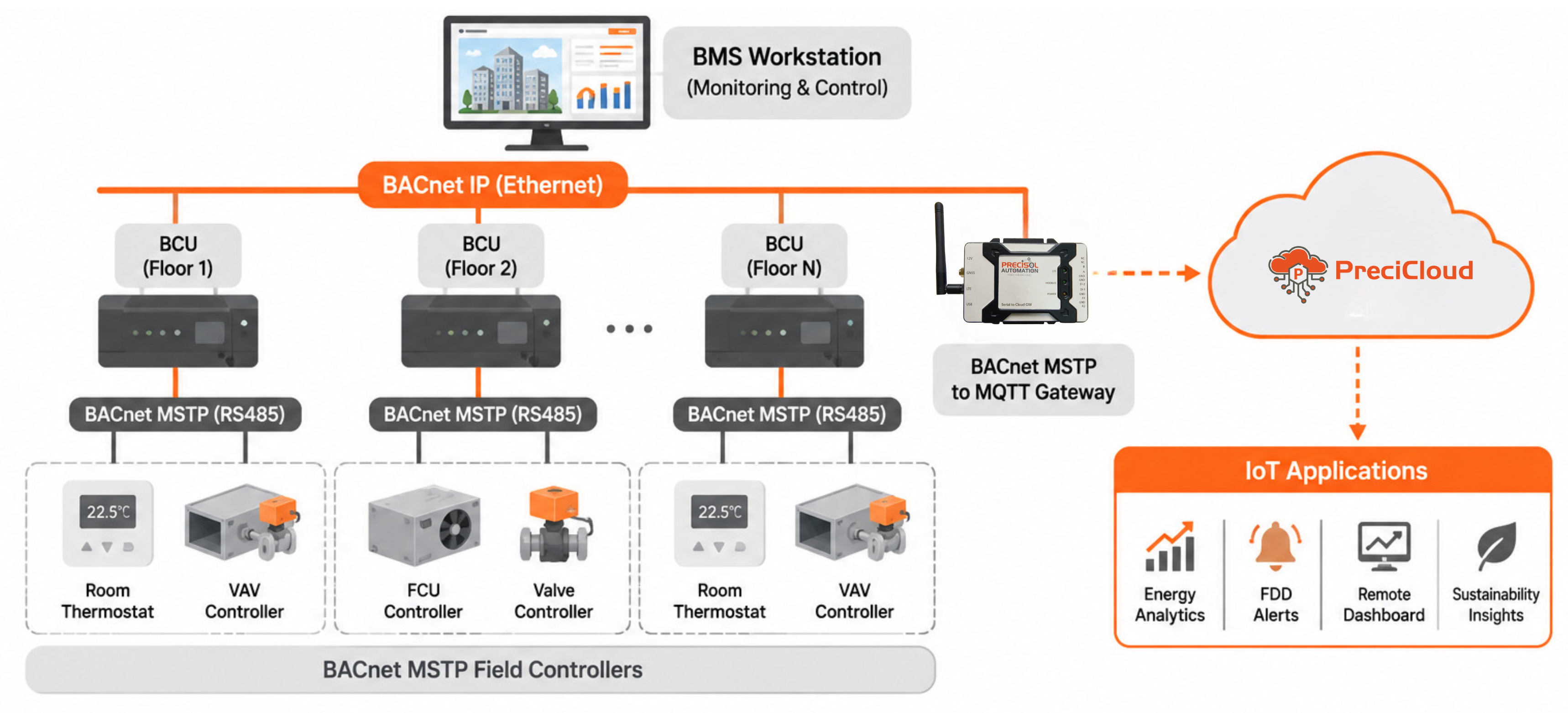
BACnet protocol building automation is the dominant open standard for integrating building automation systems — HVAC, lighting, access control, fire safety, and energy management — from different manufacturers into a unified Building Management System (BMS) that provides centralised monitoring, control, and energy optimisation. Published as ASHRAE Standard 135 and adopted as ISO 16484-5, BACnet has been mandatory in US federal buildings since the 1990s and is now the de-facto standard for commercial building automation globally, with hundreds of millions of BACnet-compatible devices installed in offices, hospitals, airports, and industrial facilities worldwide. The combination of an open data model (every data point is a BACnet object with standardised properties), a rich service set (read, write, subscribe to change-of-value, discover devices), and multiple physical layer options (BACnet IP vs BACnet MSTP) has made BACnet the enabler of multi-vendor building automation — where the chiller controller from Trane, the AHU controller from Siemens, and the room thermostat from Honeywell all communicate to the same BMS workstation via a common BACnet network. Modern BACnet IoT gateway integration extends this multi-vendor interoperability to the cloud: BACnet MSTP to MQTT gateways translate BACnet object data into cloud-native MQTT JSON messages, enabling energy management platforms, remote monitoring dashboards, and fault detection and diagnostics (FDD) services to access live building automation data without the BMS client software that traditionally required on-site or VPN access to the building controller network. This guide covers the BACnet protocol building automation object model, the BACnet IP vs BACnet MSTP comparison, BACnet HVAC controller IoT data points, and the BACnet MSTP to MQTT cloud integration architecture.
BACnet Protocol Building Automation: Key Concepts
- BACnet Object Model — Standardised Data Points: Every sensor, actuator, setpoint, and calculated value in a BACnet building automation system is a BACnet object — an Analog Input (AI) for temperature, pressure, or humidity sensors; Analog Output (AO) for valve positions, fan speed commands, damper positions; Binary Input (BI) for on/off status points (fan running, valve open/closed); Binary Output (BO) for equipment start/stop commands; and Analog Value (AV) or Binary Value (BV) for setpoints and calculated values. Each object has a Present Value property that holds the current value, a Priority Array for command priority resolution, and Object Name and Description properties for identification. BACnet HVAC controller IoT objects in an AHU controller typically include: supply air temperature AI, return air temperature AI, supply fan status BI, outside air damper AO, cooling coil valve AO, and zone setpoint AV — all readable by any BACnet client on the network.
- BACnet IP vs BACnet MSTP — Network Architecture: BACnet IP vs BACnet MSTP reflects the building automation network hierarchy: BACnet/IP connects floor-level building controllers (BCUs), BMS workstations, and remote sites on the Ethernet backbone; BACnet MS/TP connects field-level devices (room thermostats, VAV controllers, FCU controllers) via RS485 2-wire to the floor BCU, which acts as a BACnet MS/TP-to-IP router. A typical 10-storey office building has: 1 BMS workstation on BACnet/IP LAN; 10 BCUs (one per floor) on BACnet/IP; each BCU connecting 20–50 BACnet MS/TP field controllers via RS485; and the whole network visible to the BMS via BACnet/IP discovery. BACnet IoT gateway integration can attach at either layer: to the BACnet/IP backbone for access to all building data, or to a specific BACnet MS/TP segment for a subset of field devices.
- BACnet MSTP to MQTT — Cloud Integration Gateway: BACnet MSTP to MQTT gateways enable cloud energy management platforms to access BACnet field device data without the BMS: the gateway connects to the BACnet MS/TP RS485 bus (or BACnet/IP Ethernet), uses BACnet Who-Is to discover devices, reads configured AI/BI/AO Present Values at a poll interval, and publishes each value as an MQTT JSON message with a structured topic path encoding the device instance and object identifier. BACnet IoT gateway integration outputs to MQTT brokers connect to InfluxDB, Grafana, or cloud energy management platforms (EcoStruxure, Siemens Desigo CC cloud, custom platforms) for energy analytics dashboards that supplement or replace traditional BMS reporting.
- BACnet HVAC Controller IoT — Remote Monitoring Use Cases: BACnet HVAC controller IoT cloud monitoring via MQTT enables: facility energy dashboards showing AHU supply air temperature, outdoor air fraction, chiller kW, and energy intensity KPIs; fault detection and diagnostics (FDD) algorithms running in the cloud to detect AHU simultaneous heating and cooling, stuck dampers, or low delta-T syndrome; remote setpoint adjustment via cloud-to-BACnet WriteProperty commands through the gateway; and building portfolio benchmarking comparing energy intensity across multiple sites using a common BACnet protocol building automation cloud data pipeline.
BACnet Protocol Building Automation: IP vs MSTP Comparison
| Criteria | BACnet IP | BACnet MSTP |
|---|---|---|
| Physical layer | 100BASE-TX Ethernet (UDP port 47808) | EIA-485 RS485 two-wire |
| Data rate | 100–1000 Mbit/s | 9600–115200 baud (76800 baud typical) |
| Node count | Thousands (IP network) | Up to 127 per RS485 segment |
| Typical layer | BMS workstation, BCU, floor controller | Room thermostat, VAV, FCU — BACnet HVAC controller IoT |
| BACnet MSTP to MQTT | Gateway connects via BACnet/IP client | Gateway RS485 port connects as BACnet MS/TP master |
BACnet Protocol Building Automation with Precisol Automation
Precisol Automation's Serial IIoT Gateway supports RS485 serial connectivity applicable to BACnet MSTP to MQTT field-level integration — connecting to BACnet MS/TP networks via the RS485 port and implementing BACnet IoT gateway integration to extract HVAC controller object values for MQTT cloud publication. The PreciCloud IoT Cloud Dashboard receives BACnet HVAC controller IoT data streams for energy monitoring, HVAC performance dashboards, and facility manager remote access.
See IT-OT integration patterns in our IT-OT bridge for process automation case study, or explore remote monitoring for Modbus PLCs for the RS485 gateway integration pattern applicable to BACnet protocol building automation MS/TP network cloud connectivity.
Frequently Asked Questions
What is BACnet protocol and how is it used in building automation?
BACnet protocol building automation (ASHRAE 135 / ISO 16484-5) is the open standard for multi-vendor building system integration — representing every HVAC, lighting, and access control data point as a BACnet object (Analog Input, Binary Output, etc.) with standardised Present Value and description properties. BACnet HVAC controller IoT devices (AHU controllers, VAV boxes, room thermostats) expose their setpoints, sensors, and actuator states as BACnet objects readable by any BACnet client on BACnet IP or BACnet MSTP networks — enabling the Building Management System to integrate devices from any BACnet-certified manufacturer.
What is the difference between BACnet IP and BACnet MSTP?
BACnet IP vs BACnet MSTP: BACnet/IP runs on standard Ethernet (UDP port 47808) at 100–1000 Mbit/s for BMS workstations, building controllers, and inter-building connections. BACnet MS/TP runs on RS485 two-wire serial at 9600–115200 baud for field-level BACnet HVAC controller IoT devices (room thermostats, VAV controllers) — lower cost wiring to each terminal device. Floor-level BCUs route between BACnet MS/TP field device segments and the BACnet/IP backbone. BACnet MSTP to MQTT gateways connect to the RS485 MS/TP bus as a master node to extract field device data for cloud integration.
How does BACnet IoT gateway integration enable cloud monitoring of building systems?
BACnet IoT gateway integration acts as a BACnet client (MS/TP or IP) on the building automation network — using Who-Is discovery to find devices, then polling configured Analog Input, Binary Input, and Analog Value Present Values at 30-second to 5-minute intervals. BACnet MSTP to MQTT conversion publishes each polled value as structured MQTT JSON to a cloud platform for energy dashboards, FDD analytics, and remote monitoring. Facility managers access HVAC performance, energy intensity KPIs, and fault alerts from any device without BMS VPN — eliminating the need for on-site BMS client software access for routine performance monitoring.