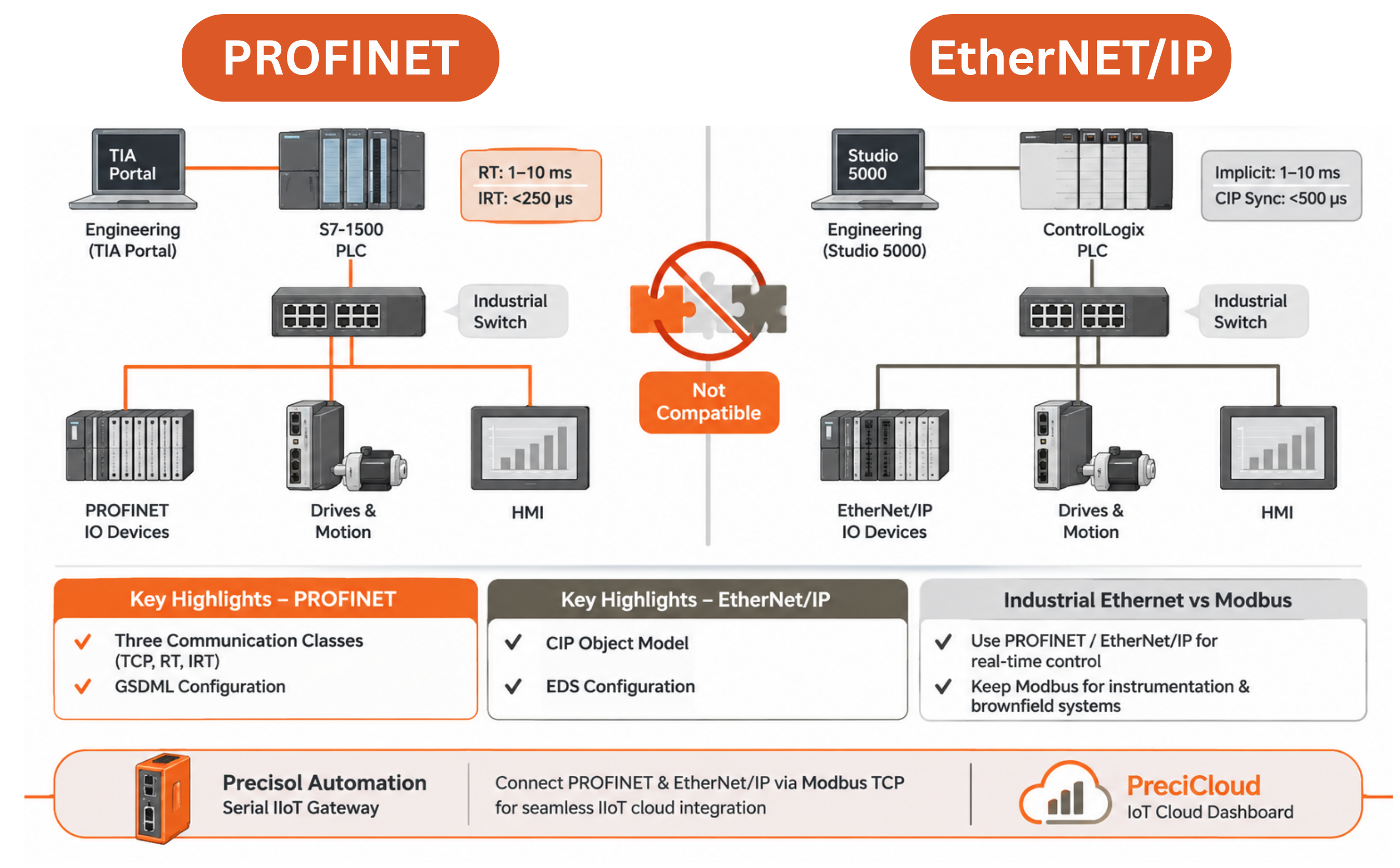
The PROFINET vs EtherNet/IP industrial Ethernet protocol comparison is one of the most common architectural decisions in industrial automation — defining which PLC vendor ecosystem, device library, and engineering toolchain a plant will commit to for new machine builds and production line automation. Both PROFINET and EtherNet/IP are real-time industrial Ethernet protocols that run on standard Ethernet hardware (100BASE-TX Cat 5e cables, standard managed switches), both are backed by major industry organisations (PROFIBUS & PROFINET International for PROFINET; ODVA for EtherNet/IP), and both have mature device ecosystems with hundreds of compatible IO devices, drives, sensors, and HMI systems. Yet they are not compatible with each other — a PROFINET IO device cannot participate directly in an EtherNet/IP network, and a ControlLogix EtherNet/IP scanner cannot configure a PROFINET IO device. The choice between PROFINET Siemens IIoT and EtherNet/IP Allen Bradley IIoT is therefore a long-term commitment that follows the PLC platform selection rather than being independently optimisable. Understanding the industrial Ethernet protocol comparison between PROFINET and EtherNet/IP — their performance characteristics, communication models, engineering tool integration, and IIoT connectivity options — helps engineers make informed decisions when specifying new automation platforms and when evaluating brownfield integration options where both protocols may coexist. The comparison also includes industrial Ethernet vs Modbus — the still-prevalent serial protocol that remains the dominant field protocol for process instrumentation and the primary IIoT gateway integration interface in brownfield installations — to help engineers understand when industrial Ethernet adds value over Modbus and when Modbus remains the appropriate choice.
PROFINET vs EtherNet/IP: Protocol Architecture Comparison
- PROFINET Siemens IIoT — Communication Classes: PROFINET Siemens IIoT (IEC 61158, IEC 61784) provides three communication performance tiers: PROFINET TCP/IP (non-real-time, standard Ethernet TCP stack, for IT data and parameter configuration); PROFINET RT (Real-Time, 100BASE-TX, 1–10 ms cycle, deterministic within switch latency tolerance — suitable for most IO applications); and PROFINET IRT (Isochronous Real-Time, requires managed switches with PROFINET IRT forwarding, <250 μs cycle time, <1 μs jitter — for servo motion applications requiring multi-axis synchronisation). PROFINET Siemens IIoT IO devices are described by GSDML files (XML) imported into TIA Portal; the engineering tool configures the IO update rates, alarm channels, and diagnostics through the GSDML-derived device properties GUI.
- EtherNet/IP Allen Bradley IIoT — CIP Object Model: EtherNet/IP Allen Bradley IIoT (ODVA specification, IEC 61784) implements the Common Industrial Protocol (CIP) over standard Ethernet TCP/UDP: Implicit Messaging (UDP-based, real-time cyclic I/O data, producer-consumer model) achieves 1–10 ms IO update rates for most applications; CIP Sync (IEEE 1588 PTP hardware timestamping in ODVA-compliant switches) achieves <500 μs synchronisation for EtherNet/IP motion applications. EDS files (Electronic Data Sheet, ODVA format — similar to CANopen EDS in concept, different syntax) describe each device's attributes for RSLogix 5000/Studio 5000 automatic device configuration. EtherNet/IP Allen Bradley IIoT supports up to 500 connections per ControlLogix controller — substantially more than PROFINET's device count per controller for large machine systems.
- Industrial Ethernet Protocol Comparison — Selection Decision: The industrial Ethernet protocol comparison for new projects resolves simply by PLC vendor: Siemens PLC → PROFINET; Allen-Bradley PLC → EtherNet/IP; Beckhoff TwinCAT → EtherCAT (different from both, even higher performance for motion); other PLCs (Mitsubishi, Omron, Schneider) typically support both via protocol modules. For brownfield IIoT integration where Modbus devices exist alongside a PROFINET or EtherNet/IP machine network, a protocol gateway or IIoT gateway with both Modbus master and PROFINET/EtherNet/IP interfaces bridges the protocols — enabling the IIoT platform to access data from both the Modbus instruments and the PLC IO devices through the same cloud channel.
- Industrial Ethernet vs Modbus — When Each Fits: Industrial Ethernet vs Modbus selection: use PROFINET or EtherNet/IP for new machine automation where real-time IO performance, device diagnostics, and integrated engineering tool support (TIA Portal, Studio 5000) are required. Use Modbus TCP for: IIoT integration to cloud from any PLC or instrument (Modbus TCP is universally supported and directly readable by IIoT gateways without protocol conversion); process instrumentation (transmitters, energy meters, drives — the vast majority of industrial instruments support Modbus RTU as standard); and brownfield systems where changing field devices from Modbus to industrial Ethernet is not justified by the performance requirement.
PROFINET vs EtherNet/IP: Industrial Ethernet Protocol Comparison
| Criteria | PROFINET Siemens IIoT | EtherNet/IP Allen Bradley IIoT |
|---|---|---|
| Standard body | PROFIBUS & PROFINET International (PI) | ODVA |
| Best with PLC | Siemens S7-300/400/1500 | Rockwell ControlLogix / CompactLogix |
| Real-time cycle | RT: 1–10 ms; IRT: <250 μs | Implicit: 1–10 ms; CIP Sync: <500 μs |
| Device description | GSDML file (XML) — CANopen EDS equivalent | EDS file (ODVA format) |
| IIoT integration | OPC UA server on S7-1500; PROFINET to OPC UA gateway | CIP to OPC UA gateway; REST API via Ignition OPC UA |
| Industrial Ethernet vs Modbus | Performance: PROFINET >> Modbus; install base: Modbus >>> PROFINET globally | Same: EtherNet/IP >> Modbus in performance; Modbus dominant in instrumentation |
PROFINET vs EtherNet/IP with Precisol Automation
Precisol Automation's Serial IIoT Gateway integrates with PROFINET Siemens IIoT and EtherNet/IP Allen Bradley IIoT systems via the Modbus TCP interface that all modern S7 and ControlLogix PLCs expose in parallel — reading PLC data area values via Modbus TCP and publishing to cloud via MQTT TLS, providing IIoT cloud visibility without modifying the PLC PROFINET or EtherNet/IP configuration. The PreciCloud IoT Cloud Dashboard receives this data for production monitoring and energy KPI dashboards across mixed industrial Ethernet protocol comparison plant environments.
See multi-protocol IT-OT integration in our IT-OT bridge for process automation case study, or explore remote monitoring for Modbus PLCs for the IIoT gateway Modbus TCP integration applicable to industrial Ethernet vs Modbus brownfield IIoT deployments.
Frequently Asked Questions
What is the difference between PROFINET and EtherNet/IP?
PROFINET vs EtherNet/IP: both are industrial Ethernet protocols on standard 100BASE-TX hardware, but PROFINET Siemens IIoT (PI standard) dominates European Siemens PLC systems while EtherNet/IP Allen Bradley IIoT (ODVA/CIP standard) dominates North American Rockwell PLC systems. PROFINET offers RT (1–10 ms) and IRT (<250 μs jitter) communication classes; EtherNet/IP offers Implicit Messaging (1–10 ms) and CIP Sync (<500 μs) for motion. Both use device description files (GSDML for PROFINET, EDS for EtherNet/IP) for auto-configuration in their respective engineering tools (TIA Portal, Studio 5000).
How does PROFINET Siemens IIoT integration work for industrial automation?
PROFINET Siemens IIoT integrates IO devices via GSDML files imported into TIA Portal — the tool auto-configures cyclic IO update rates (1–10 ms RT or <250 μs IRT) and alarm channels from the GSDML device description. The S7-1500 PLC's OPC UA server provides the IIoT cloud integration path — IIoT gateways read PLC tags via OPC UA and publish via MQTT to cloud dashboards without modifying the PROFINET configuration. PROFINET IRT with managed IRT-capable switches enables synchronised multi-axis motion control with <1 μs cycle-to-cycle jitter.
How does industrial Ethernet compare to Modbus for IIoT integration?
Industrial Ethernet vs Modbus: PROFINET and EtherNet/IP provide superior real-time performance (1–250 μs cycles vs 5–100 ms Modbus RTU), device diagnostics, and engineering tool integration — essential for new machine automation. Modbus RTU/TCP remains dominant for process instrumentation (energy meters, transmitters, drives) due to universal device support, simplicity, and direct IIoT gateway integration without protocol conversion. For brownfield IIoT deployments, Modbus TCP is the pragmatic integration path to cloud dashboards; for new greenfield automation lines, PROFINET (Siemens) or EtherNet/IP (Rockwell) is the appropriate industrial Ethernet choice.