How a CAN Bus Gateway Enables Protocol Bridging in Mixed Networks
03 July 2026
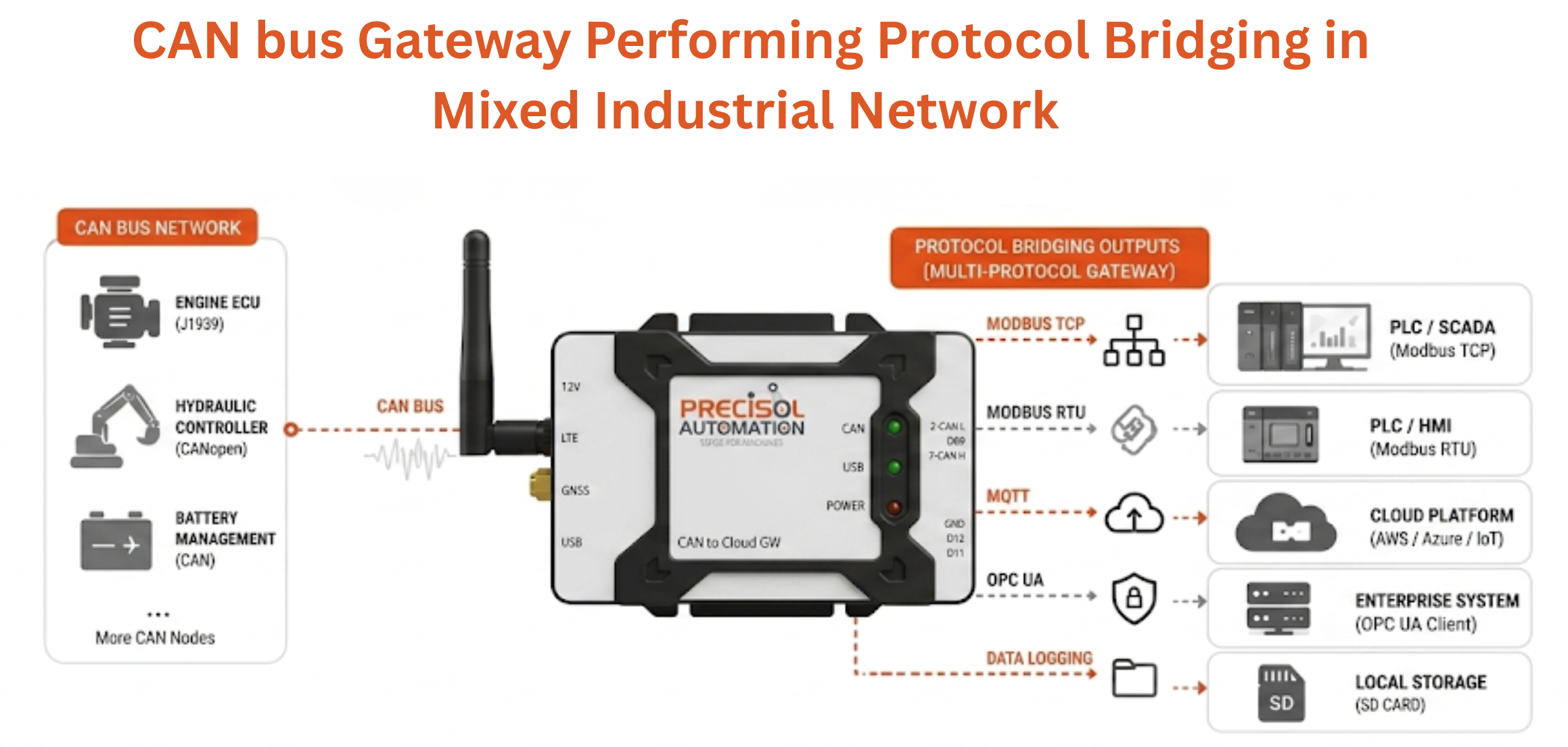
A CAN bus gateway is a hardware device that performs protocol bridging between a Controller Area Network and other communication protocols — enabling OT network integration across the incompatible systems that characterise real-world industrial and automotive environments. Whether you need CAN to Modbus conversion to connect a vehicle engine to a factory PLC, or a multi-protocol gateway that forwards J1939 data to an MQTT broker for cloud analytics, a CAN bus gateway eliminates the need for custom firmware development and provides a configurable, reliable translation layer between otherwise incompatible protocol worlds.
Why Protocol Bridging Is Necessary
Industrial and automotive networks were never designed with interoperability in mind. Vehicle ECUs communicate over CAN bus using J1939 or CANopen. Factory PLCs communicate over Modbus RTU or Modbus TCP. Cloud platforms receive data via MQTT or REST APIs. When a diesel generator's CAN bus network needs to report its runtime parameters to a plant SCADA system running Modbus, or when a mining vehicle's J1939 engine data must flow to a cloud fleet management dashboard, no native connectivity exists. Protocol bridging via a CAN bus gateway closes this gap — it reads CAN messages, decodes them into physical values, and re-transmits those values in the target protocol without custom software on either end.
OT network integration has become a strategic priority for industrial operators pursuing Industry 4.0 and predictive maintenance goals. The CAN bus gateway is a key enabler of this OT network integration, allowing legacy CAN-based machines to contribute data to modern analytics platforms without replacing or modifying the machine itself.
How a CAN Bus Gateway Performs Protocol Bridging
A CAN bus gateway operates in several functional stages:
- CAN Frame Reception: The CAN bus gateway listens to the CAN bus and captures all frames (or a filtered subset by message ID). It timestamps each frame for accurate data association and logging.
- Signal Decoding: Using a DBC file (for standard CAN) or J1939 PGN/SPN configuration, the CAN bus gateway decodes raw CAN bytes into physical signal values — engine RPM, coolant temperature, oil pressure — applying scaling factors, offsets, and unit conversions specified in the configuration.
- Protocol Bridging Output: The decoded signal values are mapped to the target protocol format. For CAN to Modbus conversion, each signal is mapped to a Modbus register address, so a Modbus master PLC can poll the CAN bus gateway like any other Modbus slave device. For MQTT protocol bridging, signals are packaged into JSON payloads and published to configured topics on an MQTT broker.
- Bidirectional Protocol Bridging: An advanced CAN bus gateway also supports reverse translation — receiving Modbus write commands or MQTT subscribed messages and injecting the corresponding CAN frames onto the bus. This enables remote actuation as well as monitoring through the same multi-protocol gateway.
CAN to Modbus Conversion: The Most Common Use Case
CAN to Modbus conversion is the most widely deployed CAN bus gateway application in industrial environments. Scenarios include:
| Source | CAN Bus Gateway Role | Target |
|---|---|---|
| Generator J1939 ECU | CAN to Modbus conversion of engine parameters | Building management system (Modbus TCP) |
| Mobile hydraulic machine | Protocol bridging of J1939 pressure and flow data | Factory SCADA (Modbus RTU) |
| Forklift CAN network | CAN to Modbus conversion of battery SoC and speed | Warehouse management system (Modbus) |
| Compressor CANopen network | Multi-protocol gateway to MQTT cloud | Cloud IoT platform (AWS, Azure) |
Multi-Protocol Gateway: Beyond CAN to Modbus
A modern CAN bus gateway is a multi-protocol gateway capable of simultaneous protocol bridging across several target interfaces. A single multi-protocol gateway device might expose CAN data as Modbus TCP registers on its Ethernet port, publish selected signals to an MQTT broker over Wi-Fi or cellular, and log all raw CAN frames to an SD card simultaneously. This multi-protocol gateway capability is essential for OT network integration projects where different consumers — PLCs, SCADA, cloud, mobile dashboards — all need access to the same CAN bus data in their native protocol format.
OT network integration through a multi-protocol gateway also simplifies the IT security boundary. Instead of giving the SCADA system direct CAN bus access, the CAN bus gateway presents a clean Modbus or OPC UA interface with only the signals the SCADA operator needs — reducing the attack surface while enabling full OT network integration.
Deploy CAN Bus Protocol Bridging with Precisol Automation
Precisol Automation's CAN Bus Gateway is a purpose-built multi-protocol gateway supporting CAN to Modbus conversion, MQTT publishing, and OPC UA — configurable without firmware development through an intuitive web interface. It handles J1939, CANopen, and standard CAN bus protocol bridging equally, making it the right OT network integration tool for industrial, agricultural, marine, and fleet applications. Pair it with the Modbus RTU to TCP Converter for end-to-end serial-to-cloud protocol bridging in complex mixed-protocol plants.
See CAN bus gateway OT network integration in practice in our IT-OT bridge case study, or explore how Precisol hardware enables industrial AMR testing through seamless CAN bus gateway connectivity.
Frequently Asked Questions
What does a CAN bus gateway do?
A CAN bus gateway performs protocol bridging between CAN bus and other protocols such as Modbus, MQTT, or OPC UA. It reads CAN messages, decodes them using DBC or J1939 PGN configuration, and re-transmits the signal values in the target protocol — enabling OT network integration across incompatible systems.
When do you need CAN to Modbus conversion?
CAN to Modbus conversion is needed when CAN bus data from a vehicle or machine must be read by a Modbus PLC or SCADA system. A CAN bus gateway handles this protocol bridging transparently, mapping CAN signals to Modbus registers for seamless OT network integration.
What is the difference between a CAN bus gateway and a CAN bus bridge?
A CAN bus bridge connects two CAN segments and forwards frames between them. A CAN bus gateway performs full protocol bridging — translating CAN to Modbus, MQTT, OPC UA, or other protocols. The CAN bus gateway is a more intelligent multi-protocol gateway with complete OT network integration capability.