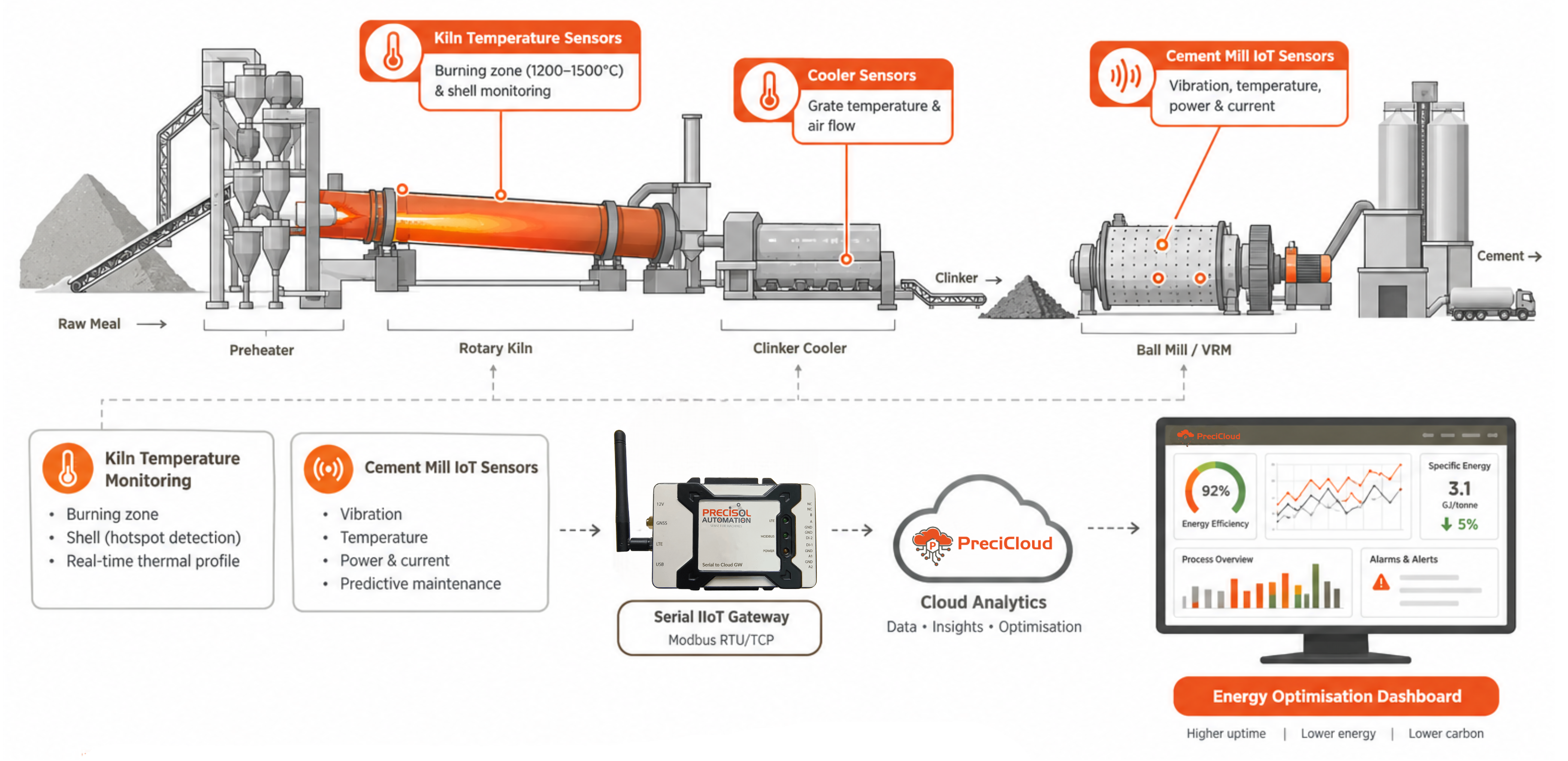
Cement plant monitoring IoT addresses one of the most energy-intensive manufacturing processes in the world — cement production consumes approximately 3 GJ/tonne of clinker in thermal energy and 90–130 kWh/tonne of cement in electrical energy, making it responsible for around 7% of global CO₂ emissions. For a plant producing 1 million tonnes per annum (MTPA), a 5% improvement in specific energy consumption saves approximately 150,000 GJ of thermal energy and 45–65 GWh of electrical energy annually — translating to millions of dollars in fuel and electricity cost savings and significant emissions reduction. The two dominant energy users in a cement plant — the rotary kiln (thermal) and the grinding mills (electrical) — are also the highest-maintenance assets, where unplanned downtime from refractory failure, main bearing damage, or gearbox failure costs $50,000–$200,000 per day in lost clinker and cement production. Cement kiln temperature monitoring using scanning pyrometers, radiation thermometers, and thermocouple arrays gives operators and control systems the thermal profile data needed to optimise fuel consumption, protect refractory, and detect hotspot formation before it causes kiln shell damage. Cement mill IoT sensor networks on ball mills and VRMs provide vibration, temperature, and power consumption data for predictive maintenance and rotary kiln process control optimisation. Together, cement plant monitoring IoT combining kiln thermal management, mill condition monitoring, and cement plant energy optimisation IoT analytics delivers both operational reliability and the continuous energy efficiency improvement that cement producers need to meet carbon reduction targets and energy cost pressures.
Cement Plant Monitoring IoT: Key Process Areas
- Cement Kiln Temperature Monitoring — Burning Zone and Shell: Cement kiln temperature monitoring in the burning zone uses non-contact radiation pyrometers mounted through access ports in the kiln shell to measure material and flame temperatures (1200–1500°C) in real time. Burning zone temperature is the primary setpoint for fuel feed control — kiln underburn (temperature below 1350°C) produces under-calcined clinker with poor strength; overburn (above 1500°C) increases NOₓ emissions and refractory wear. Shell scanning infrared pyrometers rotate with the kiln or scan the stationary shell from a fixed mounting, detecting hotspots (>380°C rise) that indicate brick damage before shell deformation occurs. Cement plant monitoring IoT platforms display the full shell temperature map updated every kiln rotation, with alarm setpoints for hotspot location and magnitude to trigger scheduled inspection windows.
- Rotary Kiln Process Control — IIoT Data Integration: Rotary kiln process control requires integration of multiple cement kiln temperature monitoring points, kiln feed rate, fuel rate, kiln drive torque, and back-end gas analysis (O₂, CO, NOₓ) into a unified control strategy. Cement plant monitoring IoT gateways connected to the DCS or PLC via Modbus provide these measurements to advanced process control (APC) systems that run model predictive control (MPC) algorithms for kiln optimisation — maintaining burning zone temperature within ±15°C of target while minimising fuel rate and NOₓ emissions simultaneously. IIoT cloud analytics supplement DCS-based control with long-term trend analysis and ML-based fault prediction.
- Cement Mill IoT Sensor Network: Cement mill IoT sensor installations on ball mills (20–30 MW drive motors) cover main bearing vibration (ISO 10816 Class IV: alert 4.5 mm/s, trip 7.1 mm/s), gearbox vibration and oil temperature, mill body vibration for fill level estimation, and drive motor current. Wireless cement mill IoT sensor nodes on hard-to-reach locations (mill shell, gearbox housing) transmit via 900 MHz ISM radio to a gateway at the mill control panel. Temperature and vibration data cloud analytics detect bearing defect frequencies 4–8 weeks before failure, enabling scheduled ball mill main bearing replacement during a planned kiln shutdown rather than an emergency stoppage.
- Cement Plant Energy Optimisation IoT — Analytics Layer: Cement plant energy optimisation IoT analytics aggregate cement kiln temperature monitoring, mill power, fuel feed rate, raw mix chemistry, and clinker quality data to calculate specific energy consumption (GJ/tonne clinker and kWh/tonne cement) continuously. KPI dashboards show energy efficiency trends, specific heat comparisons against best-practice benchmarks, and the contribution of each process variable to energy losses. ML models trained on plant historical data recommend optimal setpoints for kiln speed, coal rate, and mill separator speed that minimise energy consumption while maintaining quality — delivering 2–5% specific energy reduction that compounds into significant annual fuel and electricity cost savings.
Cement Plant Monitoring IoT: Key Parameters
| Process Area | Cement Plant Monitoring IoT Parameter | Energy / Reliability Impact |
|---|---|---|
| Rotary Kiln Burning Zone | Cement kiln temperature monitoring (1200–1500°C) | ±1% fuel consumption, clinker quality — rotary kiln process control |
| Kiln Shell | Shell scanning pyrometer (hotspot detection) | Prevents shell deformation, emergency refractory repair avoidance |
| Ball Mill / VRM | Cement mill IoT sensor (vibration, temp, power) | Bearing predictive maintenance; 5–10% specific energy via load optimisation |
| Clinker Cooler | Grate temperature, cooler air flow | Cement plant energy optimisation IoT — heat recovery 2–4% fuel savings |
Cement Plant Monitoring IoT with Precisol Automation
Precisol Automation's Serial IIoT Gateway integrates with plant DCS and standalone PLCs via Modbus RTU/TCP, collecting cement kiln temperature monitoring data, mill sensor readings, and energy meter values for cloud analytics. The Wireless Vibration and Temperature Sensor provides cement mill IoT sensor capability for ball mill bearing monitoring — wireless, battery-powered, and deployable without plant shutdown.
See industrial process monitoring in practice in our predictive maintenance in carbon manufacturing plant case study, or explore remote temperature monitoring for industrial process for the cement kiln temperature monitoring and rotary kiln process control IoT data collection configuration.
Frequently Asked Questions
How is IoT used for cement kiln temperature monitoring?
Cement kiln temperature monitoring uses radiation pyrometers in the burning zone (1200–1500°C) for fuel control and clinker quality, shell scanning pyrometers detecting hotspots (>380°C rise) from refractory brick damage, and thermocouples in preheater cyclones and clinker cooler. All data flows via Modbus to the DCS for rotary kiln process control and to IIoT gateways for cloud-based cement plant monitoring IoT analytics. Shell hotspot detection prevents kiln shell deformation and forced outage for emergency refractory repair.
What cement mill IoT sensors are used for ball mill and vertical roller mill monitoring?
Cement mill IoT sensor packages include: vibration sensors on main bearing housings (ISO 10816 velocity RMS monitoring for bearing condition and fill level); temperature sensors on bearings, motor windings, and gearbox oil; drive motor current transducers for load monitoring; and separator differential pressure. Wireless cement mill IoT sensor nodes transmit via 900 MHz ISM radio to IIoT gateways. Cloud FFT analysis detects bearing defect frequencies 4–8 weeks ahead of failure for scheduled maintenance planning.
How does IoT help with cement plant energy optimisation?
Cement plant energy optimisation IoT aggregates cement kiln temperature monitoring, mill power, fuel feed, and clinker quality data to calculate specific energy KPIs continuously. ML models recommend optimal setpoints for fuel rate, kiln speed, and mill load — achieving 2–5% specific energy reduction compounding to significant annual savings on a MTPA plant. Real-time cement kiln temperature monitoring tightens burning zone temperature control to ±10°C, reducing fuel over-consumption while maintaining clinker quality. Rotary kiln process control with dense IoT data eliminates the energy waste of manual operator setpoint adjustment.