Mining equipment monitoring IoT has become one of the highest-ROI applications of industrial IoT in the resources sector — where a single unplanned crusher or conveyor failure at a high-throughput mine site can cost $50,000–$500,000 per day in lost production, with repair lead times for major components like crusher mantles, gearboxes, and drive motors measured in weeks. Traditional time-based maintenance (monthly inspections, quarterly oil changes, annual overhauls) catches some failures but misses the bearing defects, misalignment, and lubrication degradation that develop unpredictably between scheduled maintenance intervals. Mining predictive maintenance IIoT systems replace the calendar-based maintenance schedule with condition-based maintenance triggered by actual equipment health data — vibration spectra showing bearing defect frequencies, temperature trends indicating lubrication breakdown, and motor current signatures revealing mechanical load changes — so maintenance is performed exactly when needed, not before (wasting resources) or after (suffering unplanned breakdown). The most critical assets targeted by mining equipment monitoring IoT in the mineral processing plant are: primary, secondary, and tertiary crushers; ball mills and SAG mills; long-distance belt conveyors; slurry pumps; and air compressors — all of which are single-failure-point assets where breakdown stops the entire production flow. This guide covers the sensors, crusher conveyor monitoring architectures, wireless communication approaches for underground equipment IoT, and the mining vibration monitoring sensor technologies that enable effective mining predictive maintenance IIoT.
Mining Equipment Monitoring IoT: Critical Asset Coverage
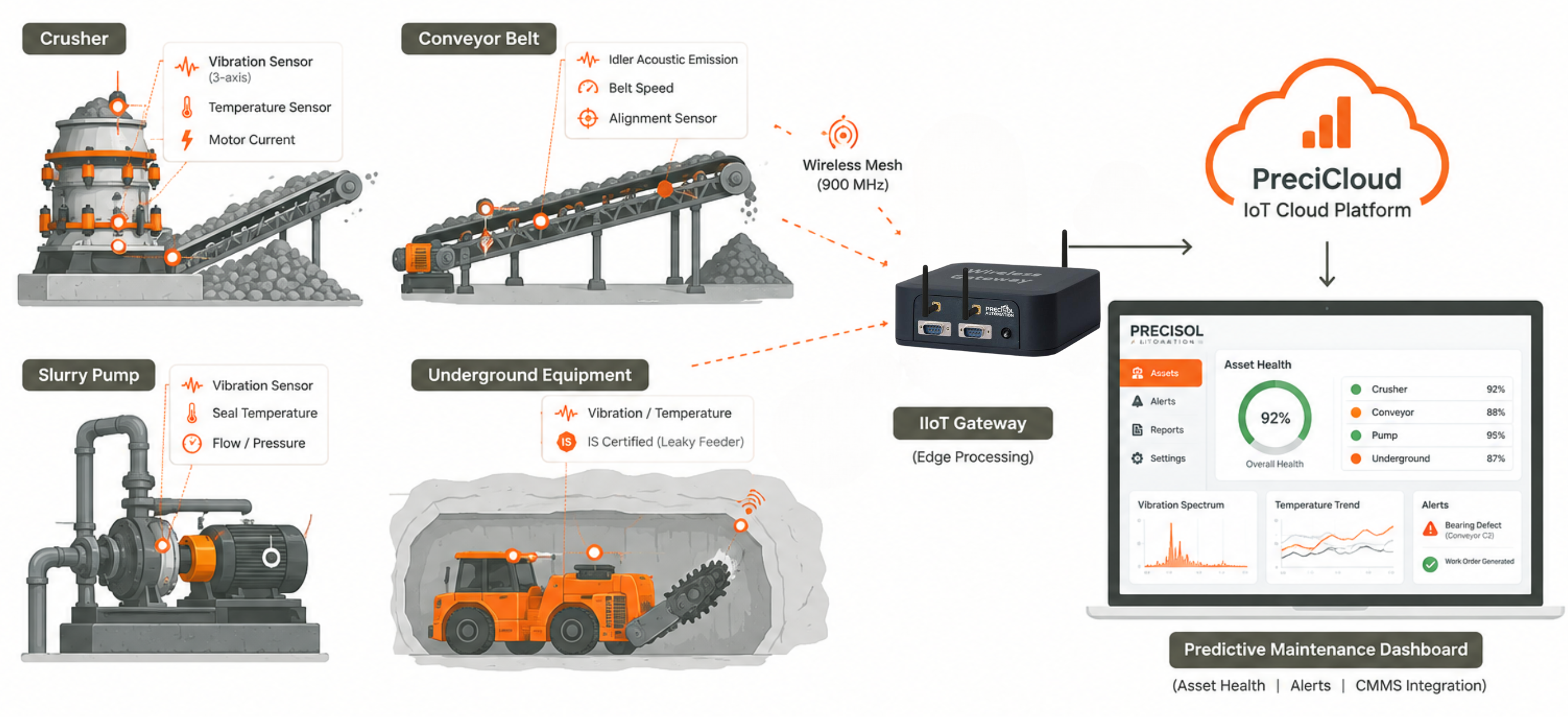
- Crusher Monitoring — Primary and Secondary: Crusher conveyor monitoring begins with the crusher as the highest-value equipment in the plant. For cone crushers, mining vibration monitoring sensor arrays on each of the five to eight main shaft and eccentric bearing housings monitor vibration velocity (ISO 10816) and high-frequency acceleration for BPFO/BPFI bearing defect frequency detection. Temperature sensors monitor lubrication oil temperature (inlet and outlet) and crusher shaft temperature. Current monitoring on the drive motor detects liner wear — as the crushing liner wears, motor current pattern changes. Mining equipment monitoring IoT cloud platforms use FFT spectral analysis on 10-second vibration snapshots collected every 15–30 minutes to track bearing defect frequency amplitude trends over weeks, allowing a bearing replacement to be scheduled 2–4 weeks before catastrophic failure.
- Conveyor Belt Monitoring — Long Distance Coverage: Belt conveyors in mines can run 5–20 km from pit to plant, with hundreds of idler rollers, multiple transfer stations, and drive systems that each require crusher conveyor monitoring. Mining equipment monitoring IoT for conveyors prioritises: drive motor and reducer vibration and temperature at head and tail pulleys; idler roller condition monitoring using acoustic emission sensors detecting the high-frequency signature of a seized idler before it burns through the belt (seized idlers are the leading cause of belt fires in coal mines); belt speed monitoring to detect belt slip on the drive pulley; and belt alignment sensors to detect tracking issues. Wireless mining vibration monitoring sensor nodes on idler frames transmit using 900 MHz mesh radio — a gateway every 500–1000 m along the conveyor collects data and relays to the control room via fibre or Ethernet backhaul.
- Underground Equipment IoT — Communication Architecture: Underground equipment IoT for continuous miners, loaders, and underground crushers uses leaky feeder radiating cable installed along tunnel walls to provide radio coverage throughout the mine workings. Mining equipment monitoring IoT nodes on underground equipment use IS (intrinsically safe) certified wireless transmitters operating in the leaky feeder network's RF zone to push vibration and temperature data to a shaft-top gateway, which relays to the surface cloud platform via fibre or cellular. Underground equipment that travels with the mining face (shuttle cars, bolters) requires wireless connectivity that tracks the equipment as it moves, making mesh radio and leaky feeder the preferred underground equipment IoT infrastructure approaches.
- Mining Predictive Maintenance IIoT Platform: The mining predictive maintenance IIoT cloud platform aggregates all sensor data from crushers, conveyors, pumps, and mills into asset health dashboards showing current health scores, trending alarms, and maintenance recommendations. Integration with the mine's CMMS (Maximo, SAP PM) automatically generates work orders when health score thresholds are breached — closing the loop between mining equipment monitoring IoT condition detection and the maintenance planning and execution workflow.
Mining Equipment Monitoring IoT: Sensor Summary
| Equipment | Mining Vibration Monitoring Sensor / Parameter | Mining Predictive Maintenance IIoT Target Failure Mode |
|---|---|---|
| Cone/Jaw Crusher | Tri-axial vibration (bearing BPFO/BPFI), temperature, motor current | Bearing fatigue, liner wear, lubrication failure |
| Belt Conveyor | Drive vibration, idler acoustic emission, belt speed, alignment | Seized idlers, belt slip, drive reducer failure |
| Slurry Pump | Vibration (impeller cavitation signature), seal temperature, flow/pressure | Impeller wear, seal failure, cavitation damage |
| Underground Equipment IoT | IS-certified wireless vibration/temp (leaky feeder comms) | Haulage motor bearing, tramming drive gearbox |
Mining Equipment Monitoring IoT with Precisol Automation
Precisol Automation's Wireless Vibration and Temperature Sensor provides the mining vibration monitoring sensor hardware for crusher and conveyor bearing monitoring — wireless mesh connectivity, battery-powered, IP67 rated, with direct Modbus output to IIoT gateways. The PreciCloud IoT Cloud Dashboard provides the mining predictive maintenance IIoT visualisation layer — asset health trends, vibration spectra, temperature history, and alert management for maintenance teams.
See vibration-based predictive maintenance in practice in our predictive maintenance in carbon manufacturing plant case study predictive maintenance for rotating machinery for the complete mining equipment monitoring IoT sensor and gateway configuration.
Frequently Asked Questions
How does IoT predictive maintenance work for mining equipment?
Mining predictive maintenance IIoT monitors vibration, temperature, and motor current on crushers, conveyors, and pumps continuously. FFT spectral analysis on vibration data identifies bearing defect frequencies (BPFO, BPFI) weeks before failure. Mining vibration monitoring sensor arrays on each bearing housing transmit to IIoT gateways, which send data to cloud platforms for ML anomaly detection. Condition-based maintenance replaces time-based schedules, reducing unplanned downtime by 30–50% and cutting maintenance costs in mining equipment monitoring IoT deployments.
What IoT sensors are used for crusher and conveyor monitoring in mining?
Crusher conveyor monitoring uses: tri-axial vibration sensors (piezoelectric, 10 Hz–10 kHz) on bearing housings for FFT analysis; PT100 temperature sensors on motors and gearboxes; acoustic emission sensors on conveyor idlers detecting seizure signatures; belt speed proximity sensors; and motor current transducers. Mining vibration monitoring sensor nodes communicate via 900 MHz mesh radio (surface) or leaky feeder (underground equipment IoT) to gateways with cellular or fibre backhaul to the mining predictive maintenance IIoT cloud platform.
What are the challenges of deploying IoT monitoring in underground mining environments?
Underground equipment IoT faces: radio penetration limitations (Wi-Fi and cellular don't work through rock — leaky feeder or mesh radio required); ATEX/IECEx intrinsic safety certification for methane zones; limited mains power for mobile equipment (battery-powered nodes needed); IP67/68 enclosures for dust and water; and armoured cable protection. Despite these challenges, mining equipment monitoring IoT in underground mines delivers strong ROI — a scheduled bearing replacement avoiding 3–5 days unplanned downtime saves 40–60x the sensor and maintenance cost.