Steel plant temperature monitoring IoT is central to process control, quality assurance, and equipment protection in steelmaking — a process where molten steel at 1550–1650°C passes through multiple transformation stages (melting, secondary metallurgy, continuous casting, reheating, and hot rolling) each with precise temperature requirements that determine the mechanical properties and surface quality of the finished product. Temperature measurement in steel plants is technically challenging: process temperatures in EAF and BOF steelmaking exceed the range of standard industrial thermocouples; the furnace environment is highly aggressive with exposure to molten metal splash, oxygen, CO gas, and high-intensity thermal radiation; and measurements must be available in real time to control processes that run to tight metallurgical time constraints. Steel furnace IoT monitoring addresses these challenges with a combination of disposable immersion thermocouples for direct melt temperature reading, optical and radiation pyrometers for non-contact continuous monitoring, and ladle temperature sensor steel systems that track heat loss from furnace tap through casting. On the downstream rolling side, rolling mill process monitoring with IoT adds equipment condition data for mill bearing predictive maintenance and strip quality parameter monitoring that DCS automation systems alone don't capture. Combining steel plant temperature monitoring IoT from melting through rolling into a unified cloud platform enables the steel plant predictive maintenance and process optimisation analytics that are transforming steel plant operations from reactive to data-driven.
Steel Plant Temperature Monitoring IoT: Process Stage Coverage
- EAF/BOF Steel Furnace IoT Monitoring — Melt Temperature Control: Steel furnace IoT monitoring in the EAF and BOF uses immersion thermocouples (Type S, disposable platinum tip) plunged into the bath via a thermocouple lance for tap temperature measurement (1560–1650°C). Non-contact optical pyrometers through furnace portholes provide continuous bath temperature trend during the heat for power-on/power-off control. Steel plant temperature monitoring IoT connects thermocouple digitisers and pyrometer outputs via Modbus RTU to the process control system and simultaneously to cloud analytics — enabling tap-to-tap time optimisation, heat balance modelling, and electrode energy consumption tracking. EAF furnace shell temperature monitoring using IR cameras or fixed pyrometers on the shell panels detects hot panel areas indicating cooling water flow problems before panel failure.
- Ladle Temperature Sensor Steel — Secondary Metallurgy and Casting: Ladle temperature sensor steel monitoring tracks heat in the ladle from EAF/BOF tap through ladle furnace treatment to continuous caster tundish. Ladle preheating burner temperature control uses thermocouples in the preheating stand to ensure ladle lining temperature (900–1100°C) before tapping — preventing cold ladle thermal shock to refractory and excessive steel temperature loss. At the ladle furnace, immersion thermocouples and tundish radiation pyrometers provide the continuous casting superheat control data. Steel plant temperature monitoring IoT ladle tracking systems log every temperature measurement with ladle ID, heat number, and timestamp for traceability and yield optimisation.
- Rolling Mill Process Monitoring — Equipment and Quality: Rolling mill process monitoring IoT adds equipment condition monitoring (bearing vibration and temperature on work rolls, backup rolls, and pinion stands) and strip quality measurement (thickness, width, temperature profile) to the existing rolling automation data. Steel plant predictive maintenance for rolling mills focuses on: work roll bearing temperature trending (alert: >70°C rise from baseline, trip: >90°C above ambient); mill pinion gear vibration (sideband analysis for tooth damage); and hydraulic servo valve health monitoring for AGC response consistency. Strip temperature distribution from run-out table IR line scanners links to final strip mechanical property measurement for process quality traceability.
- Steel Plant Predictive Maintenance — Integrated Analytics: Steel plant predictive maintenance IoT platforms aggregate furnace, ladle, and rolling mill data into asset health dashboards covering refractory lining condition prediction (thermal camera kiln shell analysis correlating with campaign life models), mill bearing health scores, and process equipment reliability KPIs. CMMS integration auto-generates work orders from steel plant temperature monitoring IoT alerts — ensuring maintenance windows align with planned production shutdowns.
Steel Plant Temperature Monitoring IoT: Sensor Types
| Process Area | Steel Plant Temperature Monitoring IoT Sensor | Temperature Range / Protocol |
|---|---|---|
| EAF/BOF Bath | Disposable immersion thermocouple (Type S/B) + optical pyrometer | 1400–1700°C — steel furnace IoT monitoring |
| Ladle / Tundish | Ladle temperature sensor steel (radiation pyrometer, immersion TC) | 1500–1650°C — superheat control for casting |
| Reheat Furnace | Zone thermocouples (Type K/S) + slab exit pyrometer | 900–1300°C — rolling mill process monitoring |
| Rolling Mill Bearings | PT100 temperature + vibration sensor (ISO 10816) | 0–200°C — steel plant predictive maintenance |
Steel Plant Temperature Monitoring IoT with Precisol Automation
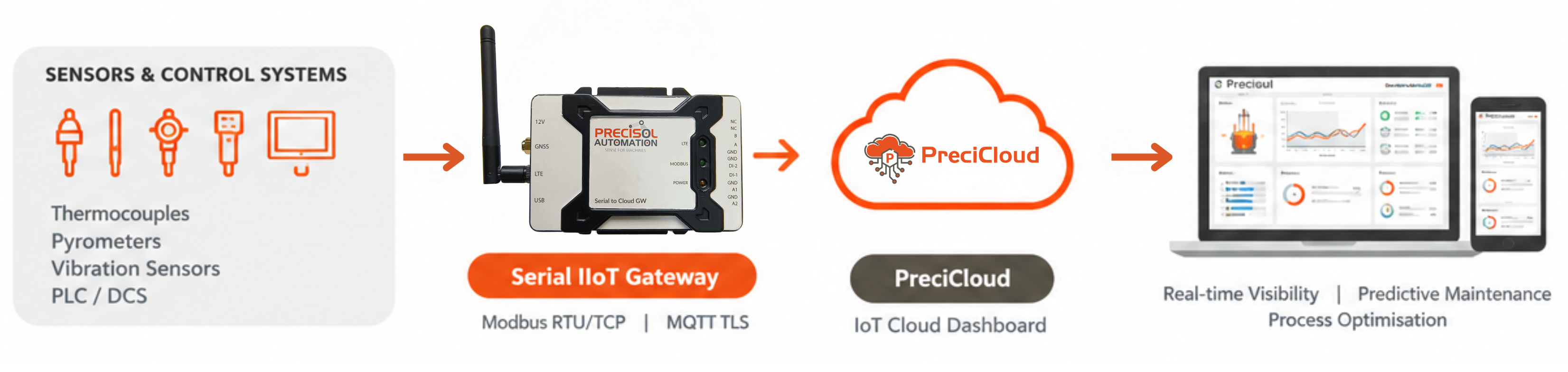
Precisol Automation's Serial IIoT Gateway interfaces with furnace thermocouple digitisers, pyrometer transmitters, and PLC via Modbus RTU/TCP — collecting steel plant temperature monitoring IoT data from across the steelmaking process and publishing to cloud dashboards via MQTT TLS for remote process visibility and analytics. The PreciCloud IoT Cloud Dashboard consolidates steel furnace IoT monitoring, ladle temperature sensor steel data, and rolling mill process monitoring into unified plant performance and predictive maintenance views.
See industrial temperature monitoring in practice in our IT-OT bridge for process automation case study, or explore remote temperature monitoring for industrial process for the steel plant temperature monitoring IoT IIoT gateway configuration pattern.
Frequently Asked Questions
How is IoT used for steel furnace temperature monitoring?
Steel furnace IoT monitoring uses disposable immersion thermocouples (Type S/B, 1400–1700°C) for tap temperature measurement and optical pyrometers through sight ports for continuous bath monitoring in EAF and BOF furnaces. Thermocouple digitisers connect via Modbus to the process control system and IIoT gateways for cloud analytics. Steel plant temperature monitoring IoT tracks tap temperature accuracy, heat balance, electrode energy consumption, and refractory shell hot spots from IR camera scans — enabling process control optimisation and early refractory damage detection.
What is ladle temperature monitoring and why is it critical in steelmaking?
Ladle temperature sensor steel monitoring tracks molten steel temperature from furnace tap through secondary metallurgy to continuous casting. Tundish superheat (temperature above liquidus, typically 20–40°C) must be controlled within ±10°C to prevent breakouts, control solidification structure, and achieve grade specification. Steel plant temperature monitoring IoT ladle tracking logs temperature at each stage by ladle ID and heat number, enabling temperature loss modelling and LF heating optimisation to eliminate temperature shortfalls at the caster that cause quality rejects or emergency casting speed reductions.
How does IoT improve rolling mill process monitoring in steel plants?
Rolling mill process monitoring IoT adds bearing vibration and temperature sensors on work rolls, backup rolls, and pinion stands for steel plant predictive maintenance — detecting bearing defect frequencies before catastrophic failure causes roll breakage and production cobble. Reheat furnace temperature monitoring with steel plant temperature monitoring IoT ensures uniform slab heating to ±20°C for consistent rolling force and strip properties. Run-out table IR line scanners provide temperature distribution maps for cooling uniformity analysis, linking strip temperature to final mechanical properties for quality traceability.