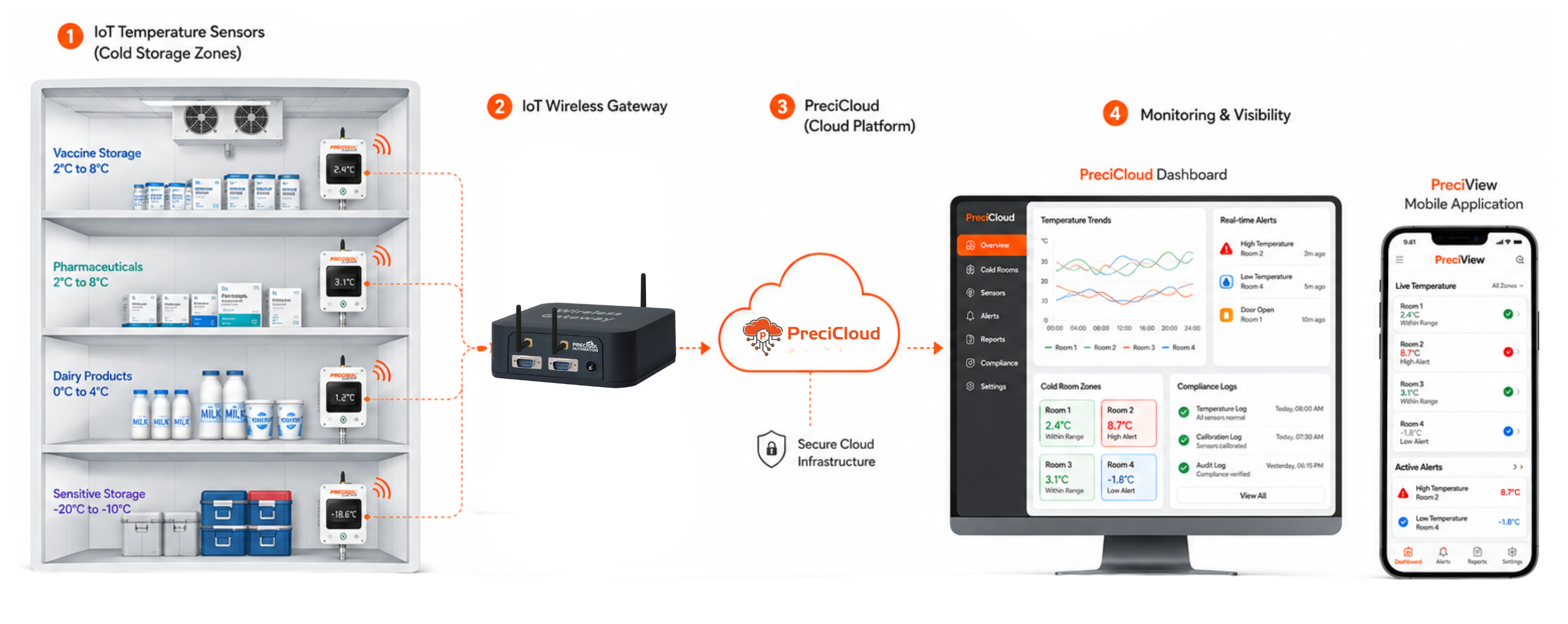
Cold chain monitoring with IoT temperature sensors provides continuous, automated tracking of temperature conditions throughout the storage and distribution of temperature-sensitive products — pharmaceuticals, vaccines, food and dairy products, chemicals, and biological materials. Cold chain monitoring is not optional for these products: a single temperature excursion can render a batch of vaccines ineffective, cause food spoilage, or trigger regulatory non-compliance that results in product recall. IoT temperature monitoring replaces the reactive, manual approach of periodic temperature data logger checks with proactive, real-time cold chain monitoring — alerting teams within minutes of a refrigeration failure, before product damage becomes irreversible. Cold storage IoT systems also generate the automatic, time-stamped temperature records that regulatory bodies now require as evidence of cold chain monitoring compliance.
From Temperature Data Loggers to Cold Storage IoT
Traditional cold chain monitoring relied on standalone temperature data loggers — devices that record temperature at configured intervals and store the data internally. The temperature data logger approach has two fundamental limitations: it cannot alert in real time when temperature deviates (the excursion is only discovered when the logger is downloaded), and it requires manual retrieval and data transfer to generate compliance records. Cold storage IoT systems overcome both limitations. Wireless IoT temperature sensors transmit readings continuously to a cloud cold chain monitoring platform. When temperature deviates from the set range, the IoT temperature monitoring system sends an immediate alert via SMS, email, or push notification — giving the operations team time to respond (transfer product to backup storage, repair the refrigeration unit) before product is damaged. The cloud platform stores all cold chain monitoring records with timestamps, sensor IDs, and alert histories — ready for regulatory audit without any data retrieval effort.
Critical Applications for Cold Chain Monitoring
| Sector | Cold Chain Monitoring Requirement | IoT Temperature Monitoring Parameter |
|---|---|---|
| Vaccines and Biologics | +2°C to +8°C continuous cold storage IoT monitoring | Temperature, door open detection, power failure alert |
| Pharmaceutical Warehouse | 15–25°C ambient; controlled cool room cold chain monitoring | IoT temperature monitoring + humidity (for hygroscopic drugs) |
| Food and Dairy | 0–4°C refrigeration; −18°C to −22°C frozen cold chain monitoring | Multi-zone cold storage IoT with individual refrigeration monitoring |
| Chemical Raw Materials | Varies by material — cold chain monitoring of flash point risk temperature ranges | IoT temperature monitoring with configurable alert bands per zone |
| Transport and Logistics | Reefer container cold chain monitoring in transit | GPS + IoT temperature monitoring — location and temperature data logger replacement |
Refrigeration Monitoring: Detecting Equipment Failure Early
Refrigeration monitoring via cold storage IoT detects refrigeration unit failures before they cause product loss. The typical failure sequence in an unmonitored cold room: compressor fails overnight → temperature rises gradually → product discovered damaged at morning inspection. With IoT temperature monitoring, the alert fires within minutes of the temperature beginning to rise — triggering a response call while product can still be saved. Cold chain monitoring systems can also track refrigeration efficiency over time: a compressor that previously held temperature at −20°C now struggles at −18°C before its alarm threshold — this trend in refrigeration monitoring data indicates developing compressor degradation, enabling planned maintenance before failure.
Advanced cold chain monitoring platforms also monitor door open events (via magnetic contact sensors), compressor run time (via current monitoring), and ambient temperature around the refrigeration unit — building a complete picture of cold storage IoT performance that goes beyond simple temperature data logger replacement.
Deploy Cold Chain Monitoring with Precisol Automation
Precisol Automation's Wireless Temperature Sensor provides accurate, battery-powered IoT temperature monitoring without any wiring — clipping to storage racks, cold room walls, or reefer container interiors for immediate cold chain monitoring coverage. The Wireless Gateway aggregates readings from multiple wireless temperature sensors and transmits them to a cloud cold storage IoT platform with real-time alerting and automated cold chain monitoring report generation.
See cold chain monitoring protecting product quality in our precision cold chain monitoring case study, or explore how Precisol supports vaccine storage monitoring using temperature sensors with compliant cold chain monitoring records.
Frequently Asked Questions
What is cold chain monitoring and why is it important?
Cold chain monitoring is continuous temperature tracking during storage and transport of temperature-sensitive products. IoT temperature monitoring replaces temperature data logger manual checks with real-time cold chain monitoring alerts — detecting refrigeration failures within minutes, before vaccines, food, or pharmaceuticals are damaged. Cold storage IoT records also satisfy regulatory compliance requirements.
How does IoT temperature monitoring improve on traditional temperature data loggers?
Temperature data loggers store data internally and require manual retrieval — excursions are discovered hours later. IoT temperature monitoring transmits readings continuously, alerting immediately when cold chain monitoring limits are exceeded. Cold storage IoT platforms store tamper-evident records automatically, eliminating manual reporting while detecting refrigeration monitoring failures before product damage occurs.
What regulations require cold chain monitoring records?
Cold chain monitoring records are required by WHO vaccine guidelines, FDA 21 CFR Part 11, EU GMP Annex 11, FSMA/HACCP, and ASHRAE transport standards. IoT temperature monitoring systems generate time-stamped, audit-ready cold storage IoT records that satisfy all major cold chain monitoring regulatory frameworks without manual data logger retrieval.