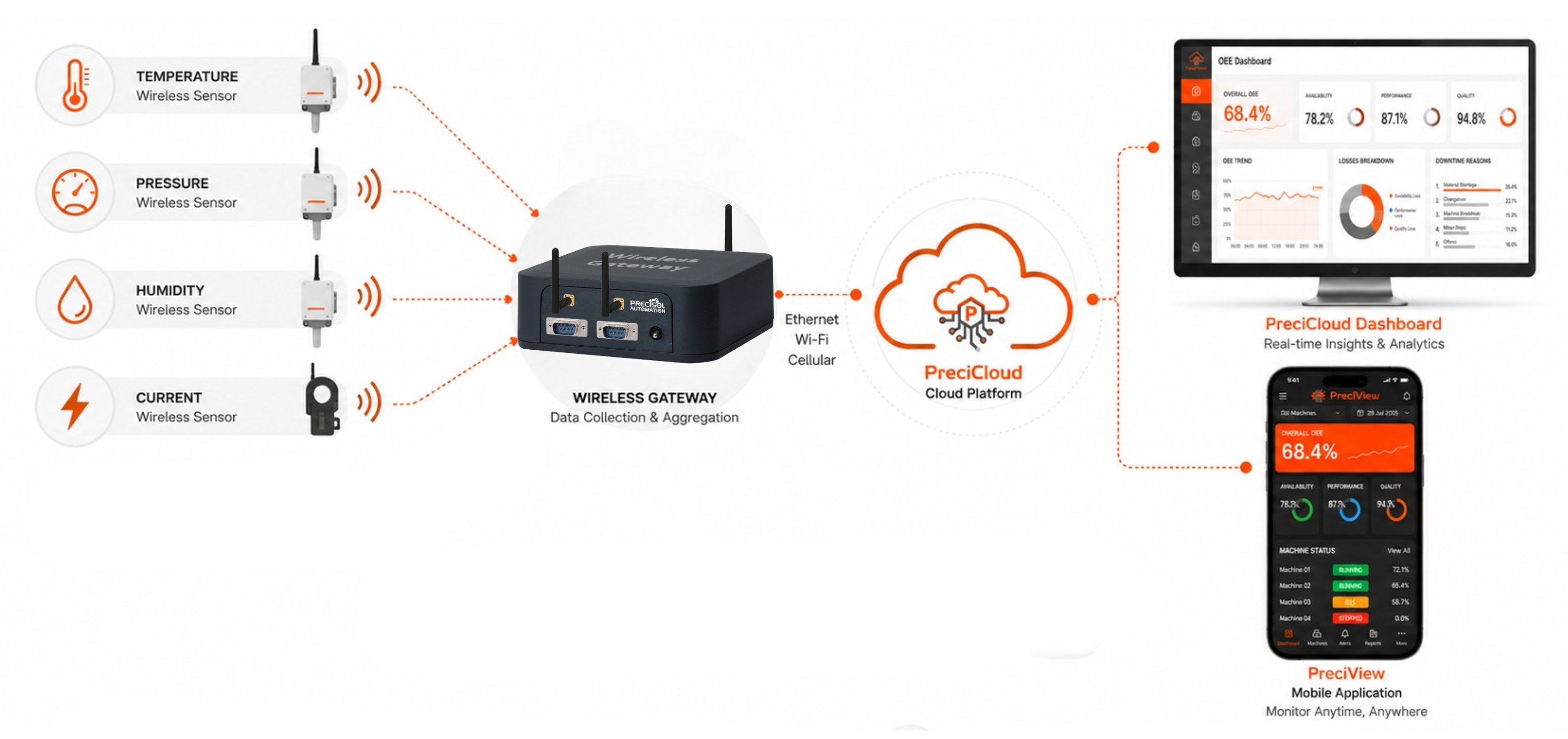
An industrial wireless sensor network (IWSN) is a distributed system of battery-powered or energy-harvesting wireless IoT sensors that collect environmental, process, and equipment condition data across a facility or field site — transmitting readings wirelessly to a gateway and onward to a cloud monitoring platform, without any signal cable runs. The industrial wireless sensor network architecture transforms how plants instrument their assets: instead of running RS485 or 4–20 mA wiring to every sensor point, wireless IoT sensors are installed directly at the measurement point and communicate over a wireless sensor protocol suited to the environment and data requirements. From LoRa industrial sensor deployments covering kilometres of open field, to Zigbee industrial IoT mesh networks threading through complex plant structures, the right wireless sensor protocol makes the difference between a reliable industrial wireless sensor network and a frustrating connectivity headache.
Industrial Wireless Sensor Network Architecture
A complete industrial wireless sensor network consists of three layers working together:
- Sensor Nodes: Wireless IoT sensors at each measurement point. Each node integrates a sensor element, a microcontroller for data processing and protocol handling, a radio transceiver for the chosen wireless sensor protocol, and a power source (battery, solar, or vibration energy harvesting). Node design determines measurement accuracy, battery life, and wireless sensor protocol support.
- Gateway: The gateway receives transmissions from all wireless IoT sensors in its coverage area, aggregates the data, and forwards it to the cloud via Ethernet, Wi-Fi, or cellular. The gateway is the bridge between the industrial wireless sensor network radio domain and the IP network. For LoRa industrial sensor deployments, one gateway can cover an entire plant; Zigbee industrial IoT gateways cover shorter ranges but support mesh topologies that extend coverage through multi-hop routing.
- Cloud Platform: The cloud platform receives industrial wireless sensor network data from one or more gateways, stores historical measurements, runs alerting rules, and presents the data in dashboards and reports. The cloud platform is where the wireless IoT sensors' raw data becomes actionable intelligence.
Wireless Sensor Protocol Comparison for Industrial Deployments
| Wireless Sensor Protocol | Range | Battery Life | Data Rate | Best Industrial Wireless Sensor Network Use Case |
|---|---|---|---|---|
| LoRa / LoRaWAN | 1–15 km (outdoor) | 5–10 years | 0.25–50 kbps | LoRa industrial sensor for large sites, pipelines, agriculture |
| Zigbee | 10–100 m per hop; mesh extends range | 2–5 years | 250 kbps | Zigbee industrial IoT in dense, complex plant structures |
| Wi-Fi (802.11) | 30–100 m indoors | Months (active radio) | Mbps | High-frequency wireless IoT sensors where infrastructure exists |
| Cellular (4G LTE) | Unlimited (network coverage) | 1–3 years (NB-IoT) | kbps–Mbps | Remote sites, mobile assets — no local wireless sensor protocol infrastructure needed |
| ISM Band (433/868/915 MHz) | 100–500 m | 2–5 years | 1–100 kbps | Proprietary industrial wireless sensor network deployments |
Real-World Industrial Wireless Sensor Network Use Cases
The industrial wireless sensor network architecture is proven across diverse industrial sectors. LoRa industrial sensor deployments are common in agriculture (soil moisture, weather monitoring across fields), water utilities (pipeline pressure monitoring across long distribution networks), and large manufacturing sites where cable installation is cost-prohibitive. Zigbee industrial IoT mesh networks are deployed in pharmaceutical cleanrooms (temperature and humidity grid monitoring), food processing plants (multi-point cold chain monitoring), and complex refinery structures where signal propagation paths are tortuous. Wi-Fi-based wireless IoT sensors are used in connected factories where IT-managed Wi-Fi infrastructure already exists. Cellular-based wireless IoT sensors are the only viable choice for remote assets — pump stations, pipeline valves, weather monitoring — where no local wireless sensor protocol infrastructure can be deployed economically.
Deploy an Industrial Wireless Sensor Network with Precisol Automation
Precisol Automation's Wireless Sensors and Gateways range provides a complete industrial wireless sensor network solution — purpose-built wireless IoT sensors for temperature, pressure, humidity, current, and level monitoring, paired with a compatible Wireless Gateway that aggregates sensor data and delivers it to the cloud. The wireless sensor protocol is optimised for industrial environments — penetrating metal structures, operating across noisy RF environments, and maintaining connectivity in the presence of industrial EMI.
See a wireless IoT sensor network in action for pipeline integrity monitoring in our industrial pipeline monitoring case study, or explore how Precisol enables greenhouse irrigation monitoring with a LoRa industrial sensor and wireless gateway solution.
Frequently Asked Questions
What is an industrial wireless sensor network?
An industrial wireless sensor network is a system of wireless IoT sensors that collect process and equipment data at field points and transmit it wirelessly via a chosen wireless sensor protocol to a gateway and cloud platform — eliminating cable runs and enabling rapid deployment across large industrial sites.
What wireless sensor protocol is best for industrial environments?
LoRa industrial sensor deployments suit long-range, low-power applications; Zigbee industrial IoT suits short-range mesh networks; cellular suits remote sites without local infrastructure. Match the wireless sensor protocol to your site's range, data rate, battery life, and existing infrastructure — no single wireless sensor protocol wins in all industrial wireless sensor network scenarios.
How is an industrial wireless sensor network different from a wired sensor system?
An industrial wireless sensor network eliminates cable runs — wireless IoT sensors self-power and communicate without wiring. This makes deployment faster and cheaper, especially across large areas. Wired systems offer lower latency and higher determinism for time-critical measurements; the industrial wireless sensor network wins on deployment flexibility and cost for monitoring applications.