Diesel Generator Remote Monitoring with IoT: Fuel, Load, and Health Tracking
16 September 2026
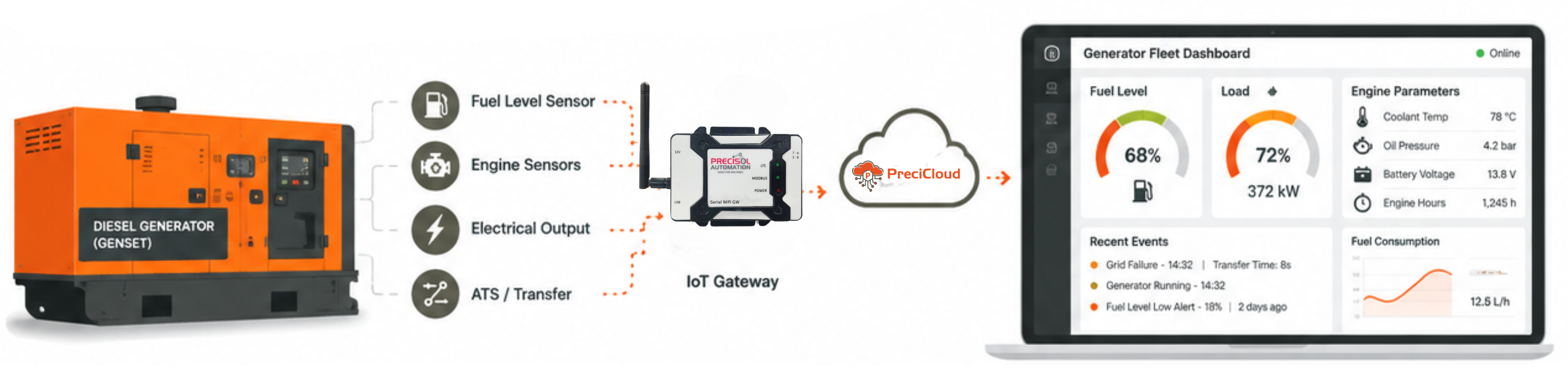
Diesel generator remote monitoring with IoT gives facilities managers, data centre operators, healthcare administrators, and industrial plant engineers real-time visibility of backup power assets that sit dormant for months — then must start and perform flawlessly during a grid power failure at exactly the moment the pressure is greatest. The fundamental problem with DG sets is their operational profile: they run during load tests and actual outages, spending 95%+ of their life in standby — making condition degradation invisible between manual inspection visits. DG set IoT monitoring transforms this by creating a continuous window into the generator's health: coolant temperature trends, oil pressure history, battery cranking voltage, and engine hour accumulation are tracked regardless of whether the generator is running or on standby. Generator fuel monitoring IoT adds another critical dimension — fuel level tracking that detects theft, identifies refuelling schedule requirements, and quantifies fuel consumption rate per runtime hour for operational cost reporting. For facilities with multiple distributed generators across sites — telecom towers, remote industrial plants, rural healthcare facilities — diesel generator remote monitoring via cellular IoT gateways provides a central dashboard view of all assets without requiring site visits. Genset predictive maintenance from continuous IoT data eliminates the scenario where a generator fails during its first start in months precisely because an undetected fault developed in the idle period between the last test run and the actual outage.
Critical DG Set IoT Monitoring Parameters
- Generator Fuel Monitoring IoT: Tank fuel level via continuous sensor (not just a low-level float switch) provides three essential data streams: refuelling cycle tracking (when to dispatch a fuel delivery); theft detection (unexplained level drops via generator fuel monitoring IoT anomaly alerts); and runtime fuel consumption (litres per hour at measured load — enabling fuel efficiency benchmarking and capacity planning for extended power outage duration).
- Engine Health Parameters: Diesel generator remote monitoring logs oil pressure, coolant temperature, exhaust temperature, and battery voltage history for every start and run event. Trending these parameters across weeks and months (via DG set IoT monitoring) reveals slow degradation — cooling system fouling, oil degradation, battery ageing — before it reaches the threshold for a fault alarm or start failure during an actual grid outage.
- Electrical Output Monitoring: Voltage, frequency, current, and active power output during each test run and actual outage operation provide the electrical performance baseline for the generator. Diesel generator remote monitoring platforms flag voltage unbalance, frequency droop under load, or output below rated power — indicating alternator or governor issues requiring genset predictive maintenance attention before next deployment.
- ATS and Transfer Monitoring: Automatic Transfer Switch status logging in DG set IoT monitoring records every grid power failure event, transfer time (seconds from grid loss to generator stable output), and retransfer to grid — providing the data for SLA compliance reporting and identification of slow-transfer ATS contacts requiring cleaning or replacement.
Diesel Generator Remote Monitoring: Fleet Use Cases
| Application | DG Set IoT Monitoring Priority | Generator Fuel Monitoring IoT Need |
|---|---|---|
| Telecom Tower Sites | Remote start, battery voltage, ATS transfer monitoring | High — fuel theft a major operational cost; remote refuelling scheduling |
| Data Centre Backup | Load bank test data, transfer time, coolant temperature | Medium — large tanks, but consumption during extended outage critical |
| Hospital / Healthcare | ATS reliability, battery cranking health, service hour tracking | Medium — compliance-driven; fuel level for extended outage planning |
| Industrial Plant | Load percentage, power quality output, genset predictive maintenance | Low to medium — on-site refuelling typically accessible |
| Remote / Off-Grid Sites | Diesel generator remote monitoring all parameters via cellular IoT | High — inaccessible sites; early fuel warning prevents operational loss |
Deploy Diesel Generator Remote Monitoring with Precisol Automation
Precisol Automation's Serial IIoT Gateway connects to generator controllers (DSE, ComAp, Cummins DCAN) via Modbus RTU, providing DG set IoT monitoring data for engine parameters, electrical output, and ATS status over cellular or Ethernet to cloud platforms. The CAN Telematics Gateway enables diesel generator remote monitoring for generators with CAN bus controllers — providing generator fuel monitoring IoT and genset predictive maintenance data via 4G LTE to the cloud dashboard for remote fleet management.
See remote site IoT monitoring in our IT-OT bridge for process automation case study, or explore remote generator monitoring using Precisol's Serial IIoT Gateway for DG set IoT monitoring deployment at distributed sites.
Frequently Asked Questions
What does diesel generator remote monitoring with IoT measure?
Diesel generator remote monitoring IoT measures fuel level (generator fuel monitoring IoT for theft detection and refuelling), engine parameters (oil pressure, coolant temperature, RPM, battery voltage, engine hours), electrical output (voltage, current, kW, kVAr, frequency), load percentage, ATS status, and alarm events. DG set IoT monitoring connects to generator controllers via Modbus RTU or CAN bus — capturing all available parameters in one integration for centralised fleet management.
How does generator fuel monitoring IoT detect fuel theft?
Generator fuel monitoring IoT correlates fuel level, runtime, and expected consumption rate continuously. Legitimate consumption produces a slow decline matching litres-per-hour at measured load. Theft produces a step-change level drop disproportionate to runtime, or a drop while the generator is stopped (zero consumption expected). Diesel generator remote monitoring platforms alert on instantaneous level drops exceeding maximum legitimate consumption rates — enabling security response before theft completes.
What is genset predictive maintenance and how does IoT enable it?
Genset predictive maintenance uses diesel generator remote monitoring data trends to detect faults developing during idle standby — before they cause failure during actual power outages. DG set IoT monitoring trends coolant temperature (cooling degradation), oil pressure at stable RPM (pump/filter wear), battery cranking voltage (battery capacity loss), and exhaust temperature (combustion issues) — triggering maintenance alerts weeks before parameters reach fault alarm thresholds, enabling scheduled service rather than emergency response.