Solar Inverter Monitoring with IoT: PV System Performance and Fault Detection
15 September 2026
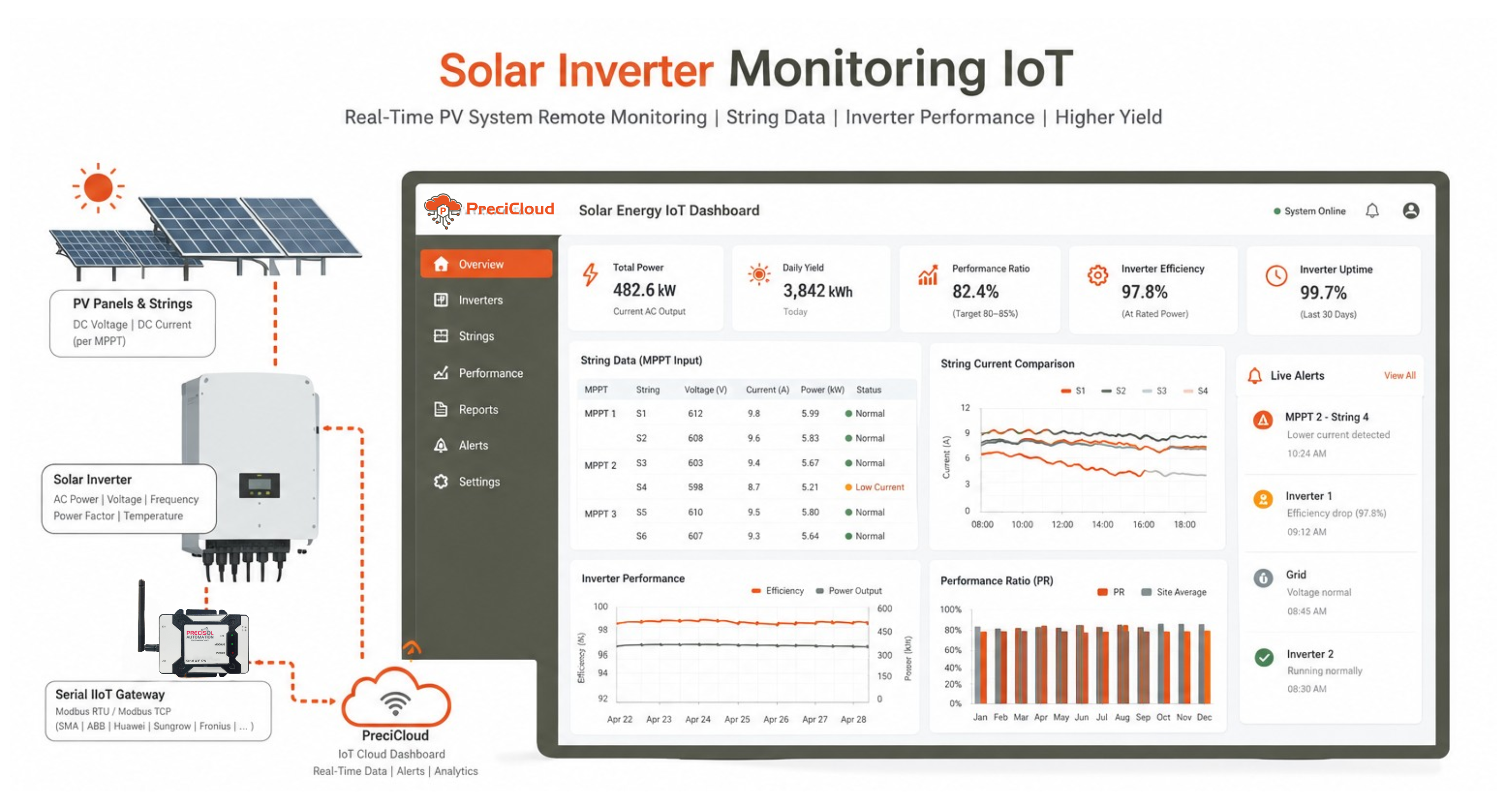
Solar inverter monitoring IoT provides the real-time performance visibility that industrial rooftop, commercial ground-mount, and utility-scale solar PV systems need to maximise energy yield, detect faults quickly, and demonstrate system performance against contractual obligations. Industrial PV systems represent a major capital investment with an expected 25-year productive life — and energy yield losses from inverter underperformance, string faults, soiling, and shading accumulate silently across that asset life unless continuous PV system remote monitoring is in place to flag them. Without solar inverter monitoring IoT, operators only discover underperformance when monthly energy generation falls noticeably below expectations — by which point weeks or months of yield loss have already occurred and cannot be recovered. A solar energy IoT dashboard with real-time string data, inverter efficiency trends, and irradiance-normalised performance ratio tracking changes this: faults are detected within minutes of occurrence, inverter fault detection alerts trigger immediate O&M response, and solar panel performance tracking data continuously validates that the PV asset is delivering its contracted energy yield. For industrial facilities with on-site solar generation, solar inverter monitoring IoT also enables integration of solar yield forecasting with facility energy demand management — optimising the consumption of self-generated solar energy and managing grid import/export intelligently.
What Solar Inverter Monitoring IoT Measures
- MPPT Tracker Input (String Monitoring): Each MPPT tracker in a solar inverter receives one or more strings of PV panels. Solar inverter monitoring IoT reads DC input voltage and current per MPPT tracker — comparing string currents at the same irradiance level to identify underperforming strings from soiling, module failure, partial shading, or bypass diode failure. Solar panel performance tracking at tracker level is the primary early-warning mechanism for PV system energy losses.
- AC Output and Grid Injection: PV system remote monitoring logs AC power output per phase, voltage, frequency, and power factor for each inverter. Inverter output below rated power at peak irradiance — captured by solar inverter monitoring IoT — indicates temperature derating, MPPT tracking error, or internal inverter fault requiring inverter fault detection investigation.
- Inverter Efficiency Trending: Conversion efficiency (AC output ÷ DC input, expressed as %) should be stable over the inverter's life at 96–99% at partial load. Solar inverter monitoring IoT efficiency trending detects gradual degradation in inverter electronics — capacitor ageing, IGBT gate driver degradation — before efficiency loss accumulates to significant yield impact.
- Performance Ratio (PR) Calculation: The solar energy IoT dashboard calculates Performance Ratio — actual yield divided by theoretical yield at measured irradiance — normalising energy output for weather conditions. PR trending reveals PV system degradation independent of seasonality, enabling solar panel performance tracking comparison across months, years, and system sections.
Solar Inverter Monitoring IoT: Key Metrics and Benchmarks
| Metric | PV System Remote Monitoring Data Source | Performance Benchmark |
|---|---|---|
| Performance Ratio (PR) | Solar energy IoT dashboard — irradiance-normalised yield | 80–85% PR; >5% below site average triggers alert |
| String Current Balance | Solar inverter monitoring IoT — MPPT input current per tracker | <5% current mismatch between strings at same irradiance |
| Inverter Efficiency | DC input vs. AC output from solar panel performance tracking | >97% at rated power; declining trend triggers inverter fault detection |
| Specific Yield (kWh/kWp/day) | PV system remote monitoring daily energy total | Site-specific; compared against irradiance-expected baseline |
| Inverter Uptime | Solar inverter monitoring IoT fault event log | >99.5% uptime target; grid fault vs. equipment fault classification |
Deploy Solar Inverter Monitoring IoT with Precisol Automation
Precisol Automation's Serial IIoT Gateway connects to solar inverters via Modbus RTU or Modbus TCP — compatible with SMA, ABB, Huawei, Sungrow, Fronius, and most commercial inverter brands — for PV system remote monitoring data collection. The PreciCloud IoT Cloud Dashboard hosts the solar energy IoT dashboard with real-time MPPT data, solar panel performance tracking trend charts, PR calculation, and inverter fault detection alerting.
See IIoT energy monitoring integration in our IT-OT bridge for process automation case study, or explore how Precisol's smart energy metering platform integrates solar inverter monitoring IoT with facility consumption data for comprehensive energy management.
Frequently Asked Questions
Why is solar inverter monitoring IoT important for industrial PV systems?
Solar inverter monitoring IoT detects inverter faults, underperforming strings, and efficiency degradation that silently reduce energy yield — losses that only appear in monthly bills without continuous PV system remote monitoring. A solar energy IoT dashboard compares actual yield against irradiance-corrected expectations, identifying underperformance from soiling, shading, module degradation, or inverter derating within minutes rather than weeks.
What data does PV system remote monitoring collect from solar inverters?
PV system remote monitoring collects DC input (string voltage, current, MPPT power per tracker), AC output (power, voltage, frequency, power factor), inverter efficiency, heat sink temperature, fault and event codes, and energy yield totals. Solar inverter monitoring IoT gateways connect via Modbus RTU/TCP to SMA, ABB, Huawei, Sungrow, Fronius, and most inverter brands, forwarding data to solar energy IoT dashboards for solar panel performance tracking analysis.
How does solar panel performance tracking detect underperforming strings?
Solar panel performance tracking compares each string's current output against irradiance-normalised expected output — at the same irradiance, soiled or degraded strings produce less current than healthy strings. Solar inverter monitoring IoT platforms calculate performance ratio (PR) per MPPT tracker and flag trackers whose PR falls more than a defined percentage below site average. String-level inverter fault detection identifies individual module failures within strings for targeted O&M response.