UPS Battery Monitoring with IoT: Predict Failures Before Power Outages
17 September 2026
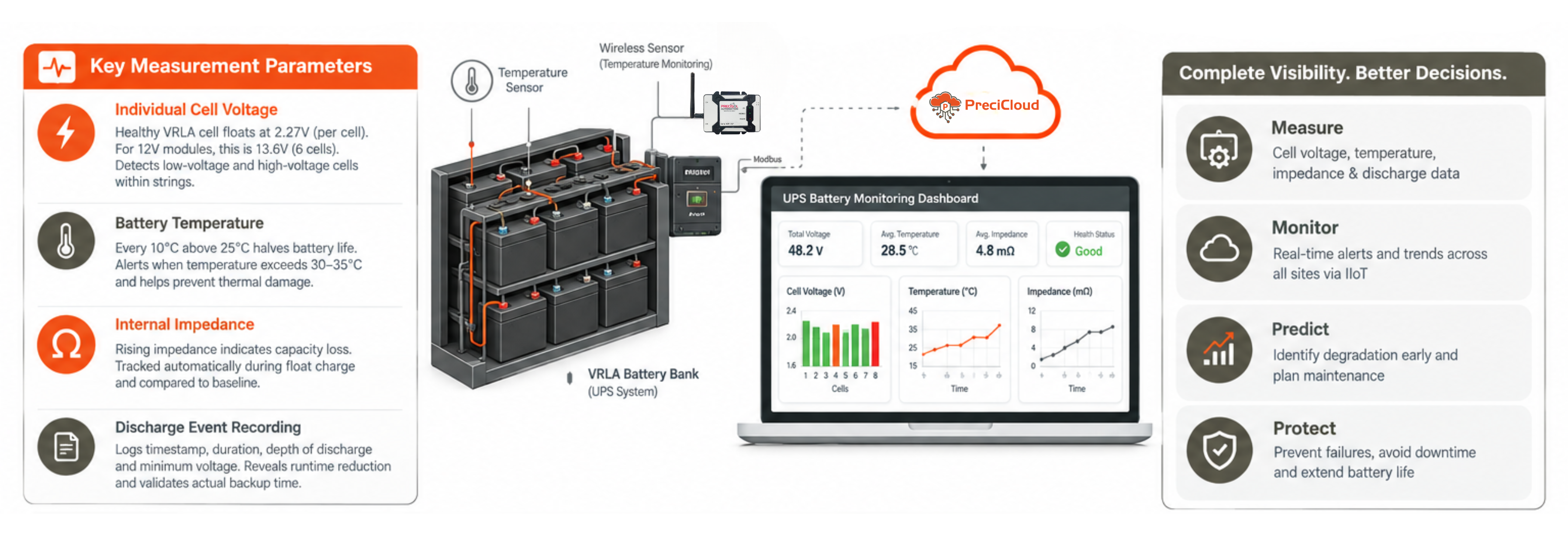
UPS battery monitoring IoT is the critical missing layer in most industrial and commercial uninterruptible power supply strategies — because the UPS hardware is typically well-maintained and reliable, but the batteries supporting it degrade silently, losing capacity without triggering any alarm until the moment the grid fails and the UPS is called upon to deliver backup power it no longer has. VRLA (Valve-Regulated Lead Acid) batteries — the standard in most industrial UPS systems — lose capacity gradually through sulfation, electrolyte dry-out, and internal plate degradation over a 3–5 year nominal service life, but individual cells can fail much sooner if exposed to elevated temperatures, deep discharges, or manufacturing defects. Without UPS battery monitoring IoT, the only way to detect degraded capacity is a scheduled load bank discharge test — an intrusive, time-consuming procedure performed annually at best, which means a battery that degrades rapidly can fail at any point in the 11-month gap between tests. Battery health monitoring industrial IoT systems measure cell or string voltage, temperature, and internal impedance continuously — providing early warning of capacity loss before it reaches the point of UPS failure. UPS remote monitoring across multiple sites via IIoT connectivity gives facilities management teams a central view of all UPS battery systems, enabling UPS predictive maintenance planning that schedules battery string replacement during planned windows rather than scrambling after a failed power outage response.
UPS Battery Monitoring IoT: Key Measurement Parameters
- Individual Cell Voltage: A healthy VRLA cell floats at 2.27V (per cell, for most 12V VRLA modules this is 13.6V at 6-cell level). UPS battery monitoring IoT systems that measure per-cell or per-module voltage detect low-voltage cells (indicating sulfation or internal short) and high-voltage cells (indicating dry-out or overcharge) within strings — string-level voltage measurement alone misses individual weak cells that pull down string performance.
- Battery Temperature (VRLA Battery IoT): Temperature is the most critical VRLA battery degradation accelerant — every 10°C above the rated 25°C halves the expected battery service life. VRLA battery IoT monitoring places temperature sensors on battery strings or modules, alerting when temperature exceeds 30–35°C thresholds and enabling investigation of cooling system inadequacy, thermal runaway conditions, or excessive charging current before damage accumulates.
- Internal Impedance Monitoring: Internal impedance measurement is the most predictive battery health monitoring industrial parameter — rising impedance indicates capacity loss that correlates with the battery's ability to deliver current under load. UPS battery monitoring IoT systems measure impedance automatically during float charge and track each cell or module's impedance relative to its commissioning baseline, flagging deviation beyond threshold for UPS predictive maintenance replacement scheduling.
- Discharge Event Recording: UPS remote monitoring logs every discharge event with timestamp, duration, depth of discharge (percentage of rated capacity used), and minimum voltage reached under load — building a discharge history that reveals battery runtime reduction over service life and validates actual runtime against rated backup time.
UPS Battery Monitoring IoT: Failure Mode Detection Reference
| Battery Failure Mode | UPS Battery Monitoring IoT Detection Method | Action Trigger |
|---|---|---|
| Sulfation (capacity loss) | Impedance rise >25% above baseline; reduced voltage under load | Battery health monitoring industrial alert → schedule replacement |
| Electrolyte Dry-Out | High float voltage; high temperature; high impedance in affected cells | UPS remote monitoring alert → immediate inspection |
| Thermal Runaway Risk | VRLA battery IoT temperature sensor → rapid temperature rise | Critical alert → immediate load transfer and UPS predictive maintenance inspection |
| Internal Short (cell) | Low individual cell voltage below 2.0V in float | UPS battery monitoring IoT cell fault alarm → string isolation |
| Capacity Below Rated Runtime | Discharge event log → calculated runtime vs. rated runtime | UPS remote monitoring runtime shortfall report → string replacement |
Deploy UPS Battery Monitoring IoT with Precisol Automation
Precisol Automation's Wireless Sensors provide temperature monitoring nodes for UPS battery room and rack environment monitoring — detecting the thermal conditions that accelerate VRLA battery IoT degradation. The PreciCloud IoT Cloud Dashboard aggregates UPS battery monitoring IoT data from Modbus-connected battery monitoring units across all sites into centralised UPS remote monitoring dashboards with impedance trend charts, temperature alerts, and UPS predictive maintenance scheduling reports.
See wireless sensor environmental monitoring in our warehouse temperature monitoring case study, or explore UPS battery room temperature monitoring for details on deploying battery health monitoring industrial IoT in critical power environments.
Frequently Asked Questions
Why is UPS battery monitoring IoT critical for industrial facilities?
UPS battery monitoring IoT is critical because VRLA batteries degrade silently — losing capacity without triggering alarms until they fail during an actual power outage. Battery health monitoring industrial IoT systems detect weak cells, elevated temperature (primary VRLA aging accelerant), and impedance increases that indicate capacity loss — enabling UPS predictive maintenance replacement before failure. Annual load tests miss rapid degradation; continuous UPS remote monitoring provides year-round visibility.
What parameters does UPS battery monitoring IoT measure?
UPS battery monitoring IoT measures individual cell/module voltage, string total voltage, battery temperature (via VRLA battery IoT sensors), internal impedance or conductance, float and discharge current, discharge event depth and duration, and UPS operating mode. Battery health monitoring industrial platforms track impedance and temperature trends across all cells — detecting sulfation, dry-out, and thermal runaway risk before they cause UPS failure under load.
How does IoT battery impedance monitoring predict UPS battery failure?
Internal impedance rises as VRLA capacity degrades — a cell at 25% above baseline impedance has lost ~20–30% capacity; at 50% above baseline it has lost 40–60% and needs replacement. UPS battery monitoring IoT measures impedance automatically during float charge, comparing each cell against its commissioning baseline. Battery health monitoring industrial algorithms flag threshold deviations for UPS predictive maintenance scheduling — enabling planned battery string replacement before power outage failures.