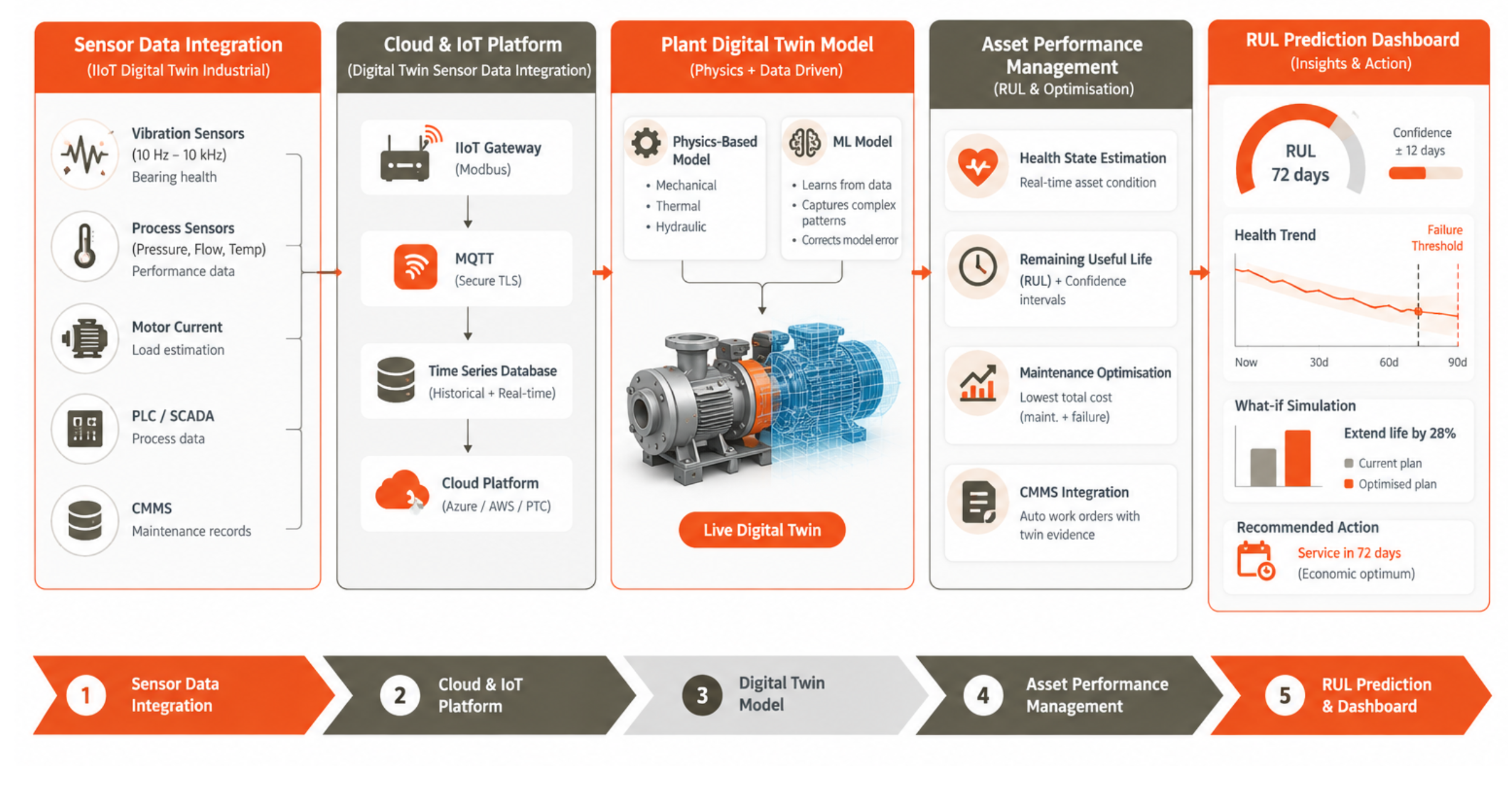
Digital twin predictive maintenance represents the convergence of physics-based engineering models, machine learning, and IIoT sensor data into a unified framework for industrial asset management that goes beyond what either pure data-driven monitoring or traditional engineering simulation can achieve independently. The concept of a plant digital twin IoT — a continuously updated virtual representation of physical equipment that mirrors its actual operating state and predicts its future condition — has been technically feasible for decades in theory, but the IIoT sensor infrastructure needed to continuously feed these models with real-world asset data was prohibitively expensive until the commodity wireless sensor, cloud compute, and scalable time series database technologies of the past decade made digital twin sensor data integration economically accessible. The result is a new generation of industrial asset management: IIoT digital twin industrial platforms that integrate Modbus sensor readings from field gateways, vibration signatures from wireless sensors, process data from PLCs, and maintenance records from CMMS into live digital twin models that calculate current asset health, estimate remaining useful life (RUL), and recommend the economically optimal maintenance intervention time — all in real time, continuously updated as the asset operates. Digital twin asset performance management distinguishes this from conventional SCADA-based monitoring: SCADA tells you what the pump is doing now; the digital twin tells you what will happen to the pump over the next 90 days under different operating scenarios, and when the economic optimum time to service it is. This guide explains what a digital twin predictive maintenance system is, how digital twin sensor data integration works in practice, and how digital twin asset performance management differs from conventional SCADA and threshold-based condition monitoring approaches.
Digital Twin Predictive Maintenance: Architecture Components
- IIoT Digital Twin Industrial — Sensor Data Foundation: The IIoT digital twin industrial model is only as accurate as the sensor data it receives — sparse, noisy, or delayed data produces unreliable health state estimates. Digital twin sensor data integration requires: high-fidelity vibration sensors on all bearings (tri-axial, 10 Hz–10 kHz) for mechanical condition monitoring; process sensors (pressure, flow, temperature) for performance model updating; and motor current for load estimation. All data streams must reach the digital twin model with known latency and quality metadata (sensor calibration status, last maintenance date) so the model can weight inputs appropriately and flag unreliable readings. IIoT gateway → MQTT → time series database → twin model API is the standard digital twin sensor data integration pipeline, with the database providing the historical depth needed for degradation trend modelling.
- Plant Digital Twin IoT — Model Types: A plant digital twin IoT model combines two complementary approaches for maximum digital twin predictive maintenance accuracy: physics-based models (differential equation models of the asset's mechanical, thermal, and hydraulic behaviour — deterministic, interpretable, require engineering knowledge to build) and data-driven ML models (statistical models learned from historical sensor data — flexible, capture complex empirical relationships, but require data and can miss novel failure modes). Hybrid models use physics-based models as the primary structure and ML models to correct for the difference between physics prediction and actual sensor measurement — capturing both the engineering understanding of how the asset should behave and the empirical reality of how it actually behaves.
- Digital Twin Asset Performance Management — RUL and Optimisation: Digital twin asset performance management calculates Remaining Useful Life (RUL) by propagating the current health state estimate forward through the degradation model to the failure threshold, quantifying uncertainty with confidence intervals. Maintenance optimisation computes the cost-minimising trigger time: the point where the sum of expected maintenance cost at time t and expected failure cost × P(failure before time t) is minimised — moving the maintenance decision from threshold-crossing to economic optimisation. Digital twin predictive maintenance platforms integrate with CMMS to automatically create work orders at the optimal trigger time, with supporting evidence from the digital twin model (health trend, RUL estimate, failure mode diagnosis) attached for the maintenance planner.
- Digital Twin Sensor Data Integration — Cloud Platforms: Cloud-native IIoT digital twin industrial platforms include Azure Digital Twins (DTDL schema-based twin models, integrates with Azure IoT Hub and Azure Time Series Insights), AWS IoT TwinMaker (3D spatial twin models with IIoT sensor binding), and PTC ThingWorx (industrial IoT APM with REST API sensor integration). All support MQTT-based sensor ingestion from IIoT gateways and provide APIs for twin model query and alert subscription — enabling digital twin asset performance management dashboards in Grafana or custom web applications built on the platform APIs.
Digital Twin Predictive Maintenance vs SCADA: Capability Comparison
| Capability | SCADA / Condition Monitoring | Digital Twin Predictive Maintenance IIoT |
|---|---|---|
| Current asset state | Real-time sensor values and alarms | Physics-informed health state estimate — IIoT digital twin industrial |
| Failure prediction | None (threshold alarm when threshold crossed) | Remaining Useful Life with confidence intervals |
| What-if simulation | Not available | Simulate impact of operating changes on asset life — plant digital twin IoT |
| Maintenance timing | Threshold-triggered or time-based | Economic optimisation of maintenance trigger — digital twin asset performance management |
| Fleet benchmarking | Manual comparison only | Automated cross-site performance comparison — digital twin sensor data integration |
Digital Twin Predictive Maintenance IIoT with Precisol Automation
Precisol Automation's Serial IIoT Gateway provides the digital twin sensor data integration pipeline foundation — collecting Modbus sensor data from field assets and publishing via MQTT TLS to cloud platforms where IIoT digital twin industrial models run. The PreciCloud IoT Cloud Dashboard provides the data layer and API integration points for digital twin predictive maintenance model connectivity, with configurable time series storage matching twin model update requirements.
See sensor-to-cloud data integration for predictive maintenance in our predictive maintenance in carbon manufacturing plant case study, or explore predictive maintenance for rotating machinery for the IIoT sensor and gateway configuration powering plant digital twin IoT health state models.
Frequently Asked Questions
What is a digital twin for predictive maintenance in industrial plants?
A digital twin predictive maintenance system is a continuously updated virtual model of a physical asset (pump, motor, compressor) combining physics-based and ML models, fed by IIoT sensor data integration from field sensors via MQTT to cloud platforms. Unlike dashboards showing current values, the IIoT digital twin industrial model calculates current health state, projects remaining useful life (RUL) with confidence intervals, simulates what-if scenarios, and recommends economically optimal maintenance timing — going beyond SCADA's current-state monitoring to predictive and prescriptive asset management.
How does digital twin sensor data integration work in IIoT systems?
Digital twin sensor data integration pipeline: IIoT sensors (vibration, temperature, pressure, current) → IIoT gateway (Modbus polling) → MQTT TLS to cloud → time series database → twin model API. The model receives real-time updates and queries historical trends to update asset health state using Kalman filters. Contextual data (operating mode from PLC, maintenance history from CMMS, ambient conditions) is also integrated to distinguish degradation from operating condition changes. Plant digital twin IoT platforms (Azure Digital Twins, AWS IoT TwinMaker) provide the managed infrastructure for digital twin sensor data integration at scale.
What is digital twin asset performance management and how is it different from SCADA?
Digital twin asset performance management extends SCADA (current-state monitoring and control) with predictive and prescriptive capabilities: RUL prediction (how long until failure), what-if simulation (impact of operating setpoint changes on asset life), economic maintenance optimisation (cost-minimising maintenance trigger time), and fleet benchmarking across sites. SCADA alarms when a threshold is crossed; digital twin predictive maintenance triggers maintenance at the economic optimum — before failure risk is unacceptable but not prematurely — integrating with CMMS to schedule the intervention with supporting model evidence.