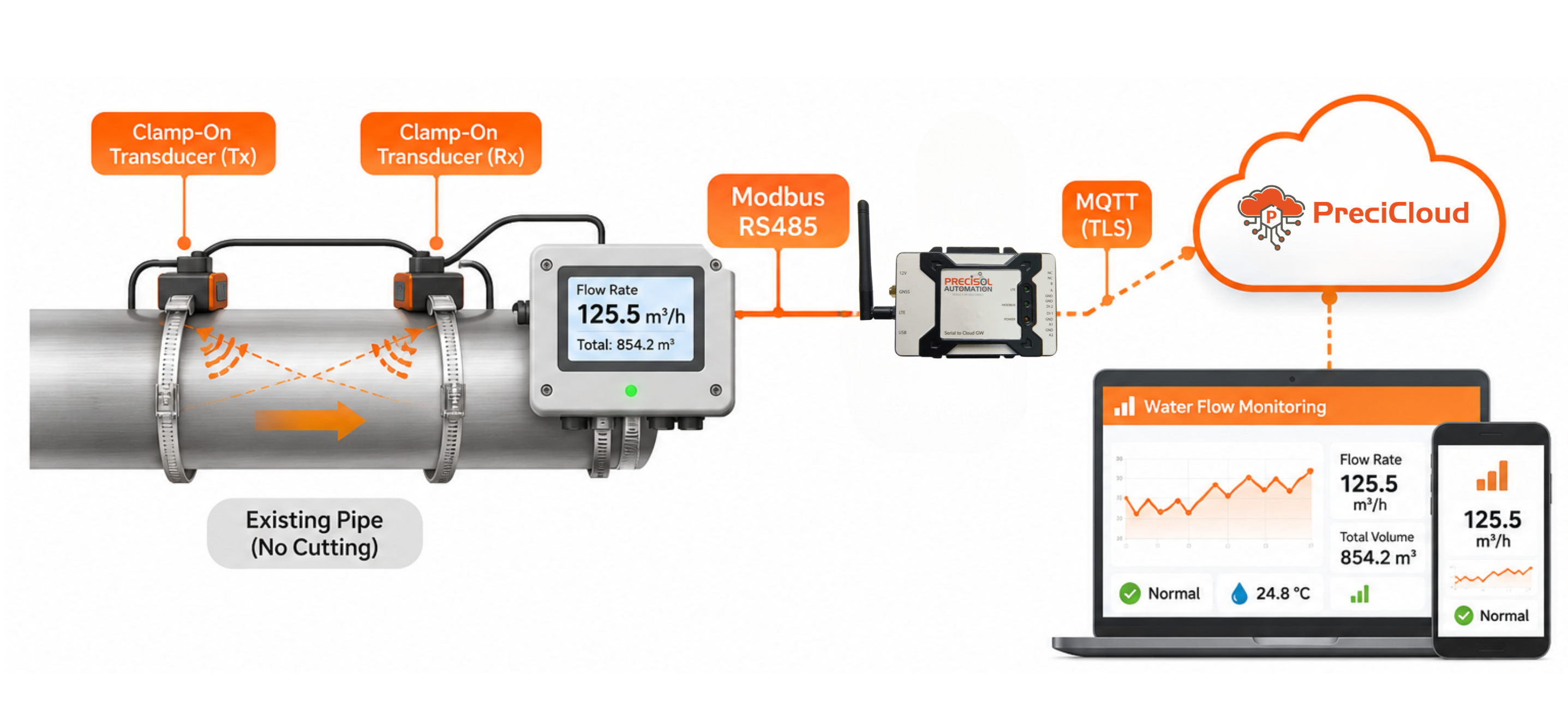
Ultrasonic flow meter IoT integration has become one of the fastest-growing applications of IIoT in process industries — combining the significant installation advantage of clamp-on flow meter IoT technology (no pipe cutting, no process shutdown, no wetted parts) with IoT connectivity that turns a previously isolated field instrument into a live data source for remote monitoring, leak detection, water balance analysis, and billing verification. The traditional barrier to retrofitting flow measurement on existing plant infrastructure was the cost and operational risk of shutdown, pipe modification, and flange installation required for inline meters — a project that could cost $5,000–$50,000 per measurement point depending on pipe size, material, and process. A clamp-on flow meter IoT system eliminates this barrier: transducers clamp to the outside of the existing pipe, the transmitter is configured with pipe dimensions and fluid properties, and ultrasonic flow meter Modbus output provides immediate data connectivity via IIoT gateway to cloud dashboard — all without any process disruption. The result has been widespread deployment in applications where flow data was previously unavailable or measured only by occasional portable metering surveys: cooling water distribution monitoring, HVAC chilled water balance, water utility distribution loss monitoring, effluent discharge monitoring for environmental compliance, and process utility (steam, compressed air, cooling water) consumption monitoring for water flow monitoring IoT energy management programmes. This guide covers the operating principle of transit-time clamp-on flow meter IoT systems, the advantages and limitations of non-intrusive flow measurement industrial, the ultrasonic flow meter Modbus output connection to IIoT gateways, and the complete remote monitoring integration architecture.
Ultrasonic Flow Meter IoT: Non-Intrusive Technology Overview
- Transit-Time Measurement Principle: Transit-time clamp-on flow meter IoT systems use two transducer pairs mounted on the pipe exterior at a calculated spacing. Each transducer alternately acts as transmitter and receiver, sending 1–5 MHz ultrasonic pulses diagonally through the pipe wall and fluid. The transit time difference between downstream and upstream pulses (typically 10–100 nanoseconds for a 100 mm pipe at 1 m/s flow) is proportional to flow velocity. Ultrasonic flow meter IoT transmitters calculate volumetric flow from velocity × pipe cross-section area and totalise volume via pulse counting. Signal quality is monitored — a quality below 50% (due to pipe scale, air entrainment, or poor coupling) triggers a diagnostic alarm and the flow reading is held or forced to zero.
- Clamp-On Flow Meter IoT — Installation Guidelines: Non-intrusive flow measurement industrial accuracy depends on proper installation: minimum 10× pipe diameter of straight pipe upstream of the transducers (20× preferred after elbows, valves, or pumps); both transducers on the same horizontal plane for vertical pipes (avoiding entrained air pockets); acoustic coupling compound between transducer face and pipe exterior; and correct transducer spacing calculated from pipe data (OD, WT, material) and fluid acoustic velocity. The clamp-on flow meter IoT transmitter's wizard guides transducer placement calculation. For water flow monitoring IoT on steel pipes, scaling (calcium carbonate deposits) can attenuate the signal — external pipe surface cleaning at the transducer mount point restores signal quality.
- Ultrasonic Flow Meter Modbus — IIoT Integration: Most modern ultrasonic flow meter Modbus transmitters provide RS485 Modbus RTU with registers for: instantaneous volumetric flow rate (engineering units); flow velocity (m/s); accumulated total volume (forward and reverse); signal quality indicator; alarm and status bits; and pipe temperature (from an optional PT100 input for heat metering). Ultrasonic flow meter IoT gateways poll these registers at 30–60 second intervals and publish to MQTT for cloud dashboard integration. For heat metering (energy = flow × ΔT), the gateway can calculate thermal energy from flow meter Modbus data combined with supply/return temperature sensor readings.
- Water Flow Monitoring IoT — Key Applications: Water flow monitoring IoT applications for ultrasonic flow meter IoT: cooling water distribution balance (verify flow to each production machine matches design); chilled water energy metering (BTU calculation for HVAC cost allocation); effluent discharge monitoring (environmental compliance with continuous flow logging); municipal water distribution loss detection (mass balance on district meter area vs. consumer meters); and process water consumption monitoring for ISO 50001 water intensity KPIs.
Clamp-On Flow Meter IoT vs Inline Flow Meters
| Criteria | Clamp-On Ultrasonic Flow Meter IoT | Inline Flow Meter (Electromagnetic/Coriolis) |
|---|---|---|
| Installation | No pipe cutting — clamp on outside | Pipe cutting, flanges, process shutdown required |
| Accuracy | ±1–2% of reading (clean liquids, good install) | ±0.2–0.5% of reading (Coriolis) |
| Non-intrusive flow measurement industrial | Yes — zero wetted parts, zero pressure drop | No — wetted parts subject to corrosion and fouling |
| Ultrasonic flow meter Modbus | RS485 Modbus RTU / 4–20 mA / pulse | 4–20 mA / HART / PROFIBUS / Modbus |
| Cost (retrofit) | Low — no civil or piping work | High — piping modification, labour, downtime |
Ultrasonic Flow Meter IoT with Precisol Automation
Precisol Automation's Serial IIoT Gateway connects to ultrasonic flow meter Modbus RS485 output via the gateway's built-in Modbus RTU master port — polling flow rate, totaliser, and signal quality registers and publishing to the water flow monitoring IoT cloud dashboard via MQTT TLS. The PreciCloud IoT Cloud Dashboard displays real-time and historical flow trends, daily volume totals, and configurable flow alarms for clamp-on flow meter IoT remote monitoring deployments.
See process utility monitoring in our IT-OT bridge for process automation case study, or explore water quality monitoring using serial IIoT gateway for the ultrasonic flow meter IoT Modbus integration pattern applied to water utility monitoring.
Frequently Asked Questions
What is a clamp-on ultrasonic flow meter and how does it work for IoT monitoring?
A clamp-on flow meter IoT ultrasonic system measures liquid flow by clamping transducers to the outside of the pipe and measuring the transit-time difference between ultrasonic pulses travelling downstream vs. upstream — proportional to flow velocity. No pipe cutting or process shutdown needed. Ultrasonic flow meter Modbus RS485 output connects to an IIoT gateway for water flow monitoring IoT cloud dashboards showing real-time flow rate, daily totals, and trend history. Signal quality monitoring detects coupling or scaling issues and flags unreliable readings automatically.
What are the advantages of non-intrusive flow measurement for industrial applications?
Non-intrusive flow measurement industrial clamp-on ultrasonic advantages: zero downtime installation (clamp on operating pipe); no pressure drop (transducers outside the pipe); no wetted parts (no corrosion or fouling from aggressive fluids); retrofit on any accessible straight pipe without piping modification. Accuracy ±1–2% for clean liquids with proper installation (10× pipe diameter straight run, good coupling). Limitations: reduced accuracy with air bubbles, heavy scale, or suspended solids; requires clean liquid for transit-time measurement (Doppler variant for slurries/aerated flow).
How do you integrate an ultrasonic flow meter with IoT for remote water flow monitoring?
Ultrasonic flow meter IoT integration: programme transmitter with pipe OD, wall thickness, material, and fluid type → connect RS485 Modbus RTU to IIoT gateway → configure gateway to poll flow rate, totaliser, velocity, and signal quality registers at 30–60 second intervals → IIoT gateway publishes MQTT JSON to cloud → water flow monitoring IoT dashboard shows live flow, daily totals, and trend history. Configure alarms for below-minimum flow (pump fault), above-maximum flow (pipe burst), and signal quality drop (scaling or transducer issues). Full installation to live dashboard in 2–4 hours without pipe cutting.