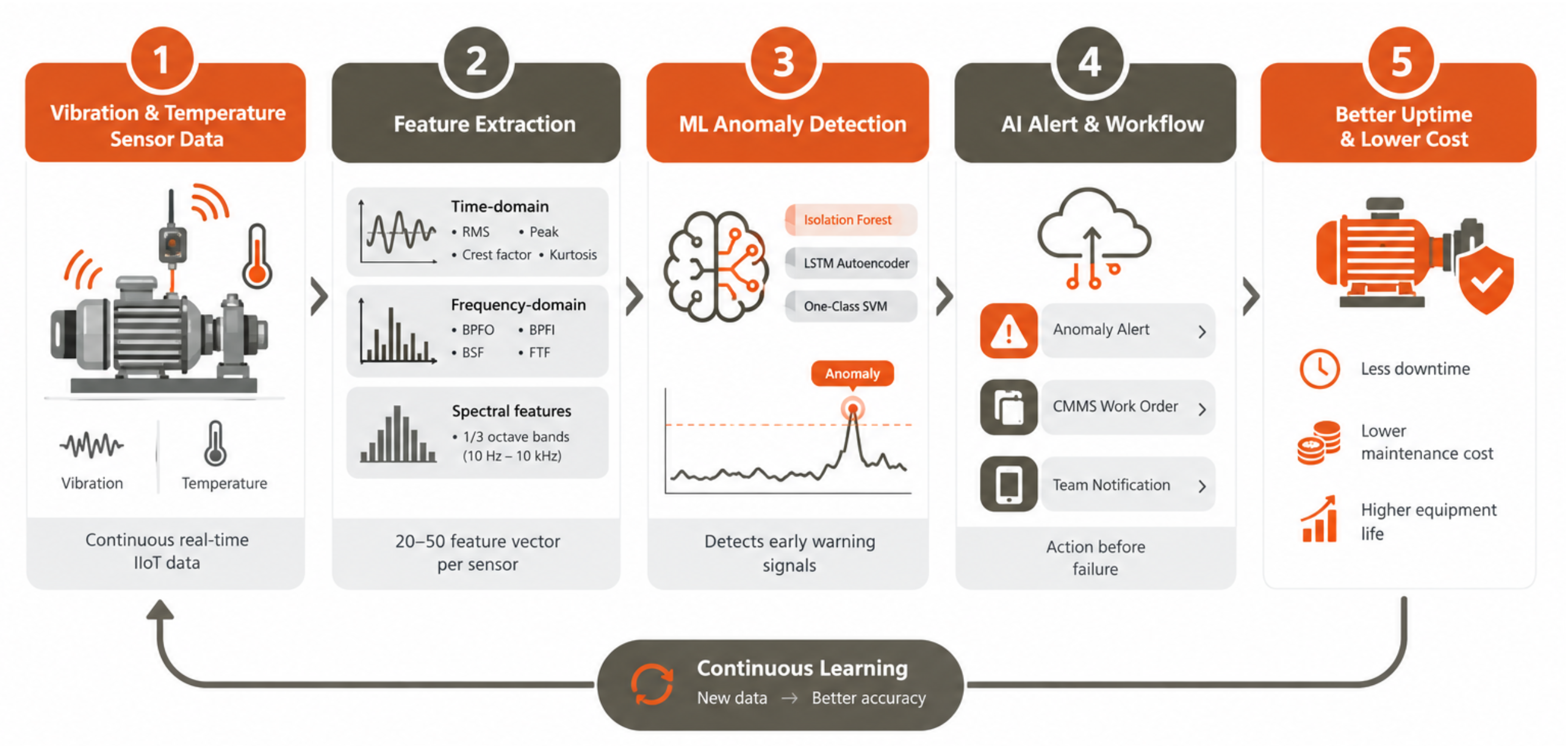
Machine learning predictive maintenance IIoT is moving from pilot projects to production deployments in industrial facilities — driven by the combination of abundant IIoT sensor data (vibration, temperature, current, pressure collected continuously at low cost), accessible ML tooling (Python scikit-learn, TensorFlow, Azure ML, AWS SageMaker), and the well-documented economic case for predicting equipment failures before they cause production stoppages. The promise is compelling: traditional time-based maintenance wastes resources replacing components before they fail; reactive maintenance allows failures that cause costly downtime; AI predictive maintenance industrial finds the early warning signals in sensor data that predict the right time to intervene — achieving the theoretical optimum of maintaining equipment exactly when it needs it and not before. The practical implementation challenge is the quality and quantity of labelled failure data: supervised machine learning predictive maintenance IIoT models need historical examples of failure sequences to learn from, but many industrial facilities have infrequent failures on critical assets — a major pump bearing might fail once every 3–5 years, providing only a handful of failure events over a decade of operation. This drives adoption of unsupervised anomaly detection IIoT sensor approaches (Isolation Forest, LSTM Autoencoder, statistical process control) that learn normal operating patterns from healthy sensor data and flag deviations, without requiring labelled failure history. ML vibration analysis industrial — applying spectral feature extraction and ML classification to vibration sensor data — is the most mature and ROI-demonstrated branch of machine learning predictive maintenance IIoT, with documented fault detection lead times of 2–8 weeks before catastrophic failure on rotating machinery. This guide covers the ML algorithm options for anomaly detection IIoT sensor data, the feature engineering pipeline for ML vibration analysis industrial, and the production deployment architecture for a complete predictive maintenance algorithm IoT system.
Machine Learning Predictive Maintenance IIoT: Algorithm Selection
- Isolation Forest — Unsupervised Anomaly Detection: Isolation Forest is the recommended starting algorithm for anomaly detection IIoT sensor data in machine learning predictive maintenance IIoT deployments with limited failure history. It requires only normal-period training data (no labelled failures), is computationally lightweight for edge inference, handles high-dimensional feature vectors (30–100 features from vibration spectral analysis and process parameters), and is interpretable relative to deep learning alternatives. Scikit-learn implementation: `IsolationForest(contamination=0.01, random_state=42).fit(normal_features)` — train on 8 weeks of feature vectors, then score new feature vectors in real time; scores below `-0.3` indicate anomaly. The contamination parameter (expected anomaly rate) is set based on acceptable false positive rate for the predictive maintenance algorithm IoT application.
- LSTM Autoencoder — Temporal Anomaly Detection: LSTM Autoencoders learn the time-sequential patterns in multi-sensor IIoT data and flag anomalies as high reconstruction error — the autoencoder cannot faithfully reconstruct patterns it has never seen (anomalous operating conditions). Machine learning predictive maintenance IIoT LSTM Autoencoder models are more powerful than Isolation Forest for anomalies that manifest as temporal pattern changes (vibration signature changes gradually over days) rather than statistical outliers in single time windows. They require GPU training (Keras/TensorFlow) on 4–12 weeks of 10-second sensor data windows — higher barrier than Isolation Forest but provide better anomaly detection IIoT sensor accuracy for complex multivariate time series from rotating machinery.
- ML Vibration Analysis Industrial — Feature Engineering: ML vibration analysis industrial requires converting raw vibration waveforms (sampled at 1–10 kHz) into numeric feature vectors for ML input. Key features per vibration window (0.5–2 second): time-domain (RMS velocity, peak, crest factor, kurtosis — sensitive to impulse events from bearing defects); frequency-domain (energy in BPFO, BPFI, BSF, FTF bearing defect frequency bands computed from bearing geometry and RPM); and overall spectral features (1/3-octave band energies from 10 Hz to 10 kHz). These 20–50 numeric features per sensor per window feed the predictive maintenance algorithm IoT model — a properly engineered feature vector from vibration carries far more diagnostic information than the raw waveform for most ML algorithms.
- AI Predictive Maintenance Industrial — Production Deployment: AI predictive maintenance industrial production systems run trained models as edge inference services (ONNX runtime on edge PC) or cloud microservices (REST API). The inference service receives feature vectors from the IIoT data pipeline at each sensor reading interval, computes an anomaly score, and triggers a CMMS work order when the score exceeds the threshold. Model retraining is scheduled monthly or triggered after each confirmed failure event — incorporating new failure signatures into the training data to improve machine learning predictive maintenance IIoT recall over time.
Predictive Maintenance Algorithm IoT: Comparison
| Algorithm | Anomaly Detection IIoT Sensor Data Need | ML Vibration Analysis Industrial Suitability |
|---|---|---|
| Isolation Forest | Normal data only (unsupervised) — most practical | Good for spectral feature vectors; lightweight edge inference |
| LSTM Autoencoder | Normal data sequences; GPU training | Excellent for temporal pattern changes; higher accuracy |
| One-Class SVM | Normal data; small feature sets | Good for 10–20 features; interpretable boundary |
| Supervised Classifier | Labelled failure history required | Best accuracy if failure data available; rare in practice |
Machine Learning Predictive Maintenance IIoT with Precisol Automation
Precisol Automation's Wireless Vibration and Temperature Sensor provides the continuous vibration and temperature data streams required for ML vibration analysis industrial — with configurable sampling rates and direct IIoT gateway integration for feeding machine learning predictive maintenance IIoT pipelines. The PreciCloud IoT Cloud Dashboard includes anomaly scoring and alert management for AI predictive maintenance industrial without requiring custom ML infrastructure.
See rotating machinery predictive maintenance in our predictive maintenance in carbon manufacturing plant case study, or explore predictive maintenance for rotating machinery for the complete sensor-to-ML-model anomaly detection IIoT sensor pipeline.
Frequently Asked Questions
How does machine learning improve predictive maintenance in IIoT?
Machine learning predictive maintenance IIoT detects multivariate anomaly patterns in sensor data that fixed-threshold rule-based systems miss — learning the correlation structure of all monitored parameters during healthy operation and flagging deviations. AI predictive maintenance industrial models using Isolation Forest or LSTM Autoencoders detect gradual bearing degradation 2–8 weeks before failure by identifying subtle shifts in vibration spectral features, temperature trends, and motor current that individually appear normal but collectively signal imminent failure — far earlier than single-parameter threshold alarms.
What anomaly detection algorithms are used for IIoT sensor data?
Anomaly detection IIoT sensor algorithms: Isolation Forest (unsupervised, lightweight, runs on edge, requires only normal data — best starting point for machine learning predictive maintenance IIoT); LSTM Autoencoder (deep learning, learns temporal patterns, higher accuracy for slow degradation — needs GPU training); One-Class SVM (boundary-based, interpretable, good for small feature sets); supervised classifiers (highest accuracy but requires labelled failure history — impractical for infrequent industrial failures). ML vibration analysis industrial uses spectral features (BPFO, BPFI, RMS, kurtosis) as input to these algorithms.
How do you implement a machine learning predictive maintenance model for IIoT?
Machine learning predictive maintenance IIoT implementation: collect 4–12 weeks of normal-period sensor data → extract vibration spectral features (RMS, kurtosis, bearing defect band energies) and process features (rolling temperature, current statistics) → train Isolation Forest on normal feature vectors (scikit-learn, 10 minutes on CPU) → deploy as REST API or edge ONNX model → score incoming features in real time → alert on anomaly score threshold exceedance → trigger CMMS work order. Retrain monthly with confirmed failure data to improve predictive maintenance algorithm IoT recall over time.