Fermentation Process Monitoring with IoT: Bioreactor Control for Consistent Yield
01 October 2026
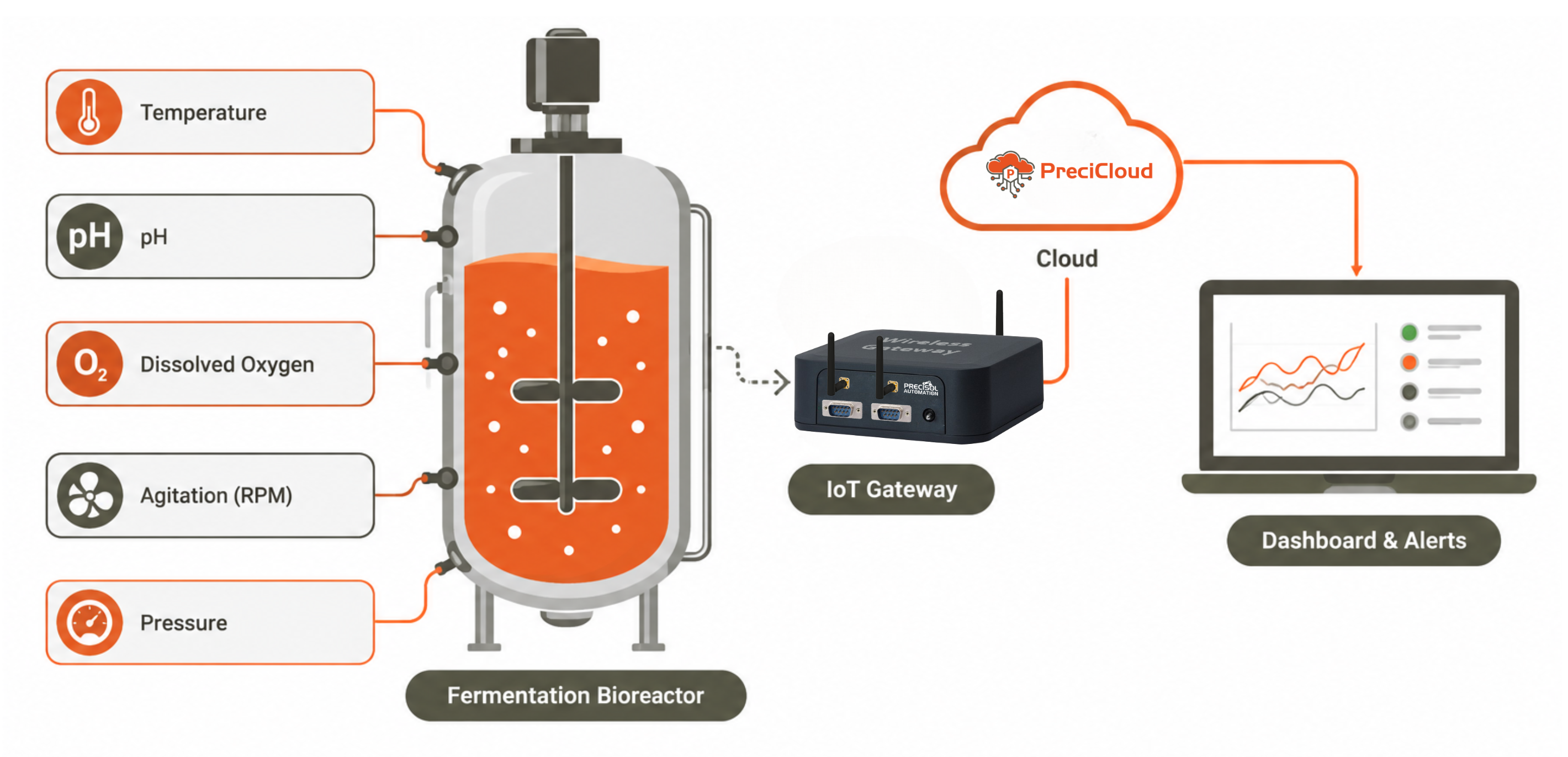
Fermentation process monitoring IoT provides the continuous, multi-parameter process visibility that pharmaceutical API fermentation, bioethanol production, brewing, food fermentation, and industrial enzyme manufacturing need to achieve consistent batch yield, maintain product quality, and meet GMP compliance requirements for biological process data records. Fermentation is a living process — the microorganisms in a bioreactor are sensitive to temperature, pH, dissolved oxygen, and nutrient availability in ways that interact in complex, nonlinear patterns. A temperature deviation of 2°C from the optimum, or a pH drift of 0.5 units during the exponential growth phase, can reduce batch yield by 10–30% or shift metabolite production from the desired product to unwanted by-products — changes that are unrecoverable once the culture has been stressed. Bioreactor monitoring IoT with in-line sensors for temperature, pH, dissolved oxygen, agitation, and pressure creates the continuous process data stream needed to detect these deviations within minutes of their onset and initiate corrective control actions — whether through automated control loops (acid/base dosing on pH, agitation cascade on DO) or operator alerts that allow manual intervention before the deviation compromises the batch. Fermentation temperature control is the most critical of these parameters: enzyme kinetics, growth rate, and product formation are all temperature-dependent, and maintaining fermentation temperature within ±0.5°C of setpoint throughout a 24–96 hour batch is the foundation of batch-to-batch yield consistency. pH monitoring fermentation and dissolved oxygen monitoring complete the essential parameter set for aerobic fermentation processes — making fermentation process monitoring IoT the data platform on which consistent fermentation performance is built.
Critical Parameters in Fermentation Process Monitoring IoT
- Fermentation Temperature Control: Fermentation temperature control via Pt100 RTD sensors and cooling/heating jacket control loops maintains process temperature within ±0.5°C of the organism's optimal temperature throughout the batch. Fermentation process monitoring IoT records the complete temperature profile for every batch — enabling comparison of batch performance against temperature history, and identification of temperature deviations that correlate with yield variation across multiple batch records.
- pH Monitoring Fermentation: pH is actively managed in most fermentation processes — acid production from microbial metabolism reduces pH; alkali (NaOH, NH4OH) is dosed to maintain the specified setpoint. pH monitoring fermentation IoT with in-line pH probe and automatic dosing pump control maintains pH within ±0.2 units continuously. Bioreactor monitoring IoT logs pH profile, dosing volume, and pH setpoint deviation for each batch — enabling correlation of pH control performance with product yield and quality.
- Dissolved Oxygen (DO) Monitoring: Aerobic fermentation processes require DO above the critical threshold (typically 20–30% air saturation for most organisms) throughout the batch. Fermentation process monitoring IoT DO sensors connected to cascaded control loops (agitation speed, then airflow rate, then O2 supplementation if needed) maintain DO automatically. DO crash detection (sudden drop indicating culture oxygen demand surge or agitation failure) is a critical alarm in bioreactor monitoring IoT systems — an extended DO crash can kill an aerobic culture and lose the entire batch.
- Pressure Monitoring: Bioreactor headspace pressure affects dissolved oxygen saturation (higher pressure increases DO at a given airflow) and ensures sterile barrier integrity (positive pressure prevents contaminant ingress). Fermentation process monitoring IoT pressure monitoring alarms on pressure loss (indicating vessel seal failure or outlet valve issues) — a critical sterility assurance parameter in GMP pharmaceutical fermentation.
Fermentation Process Monitoring IoT: Sensor and Data Reference
| Parameter | Bioreactor Monitoring IoT Sensor | Control/Compliance Function |
|---|---|---|
| Temperature | Pt100/Pt1000 RTD — fermentation temperature control loop | Growth rate control; batch record for GMP compliance |
| pH | In-line pH probe — pH monitoring fermentation + acid/base dosing | Metabolite formation optimisation; batch-to-batch consistency |
| Dissolved Oxygen | Optical or polarographic DO probe — cascade control | Aerobic metabolism support; crash detection |
| Agitation (RPM) | Tachometer or VFD output — fermentation process monitoring IoT | DO control cascade; shear monitoring for fragile cells |
| Pressure | Diaphragm pressure transmitter (steam-sterilisable) | Sterile barrier integrity; DO setpoint adjustment |
Deploy Fermentation Process Monitoring IoT with Precisol Automation
Precisol Automation's Wireless Temperature Sensor provides external vessel temperature monitoring for fermentation vessels and utilities (cooling water supply temperature) where direct vessel penetration is not required. The Wireless Pressure Sensor provides pressure monitoring for bioreactor headspace and process utility lines in fermentation process monitoring IoT installations. IIoT gateways with Modbus RS485 or analogue input capability connect to in-vessel 4–20 mA sensors (pH, DO) for bioreactor monitoring IoT cloud data transmission.
See process monitoring IoT in industrial manufacturing in our IT-OT bridge for process automation case study, or explore fermentation temperature monitoring for specific guidance on deploying fermentation temperature control monitoring with Precisol IoT sensors and gateways.
Frequently Asked Questions
What parameters does fermentation process monitoring IoT measure?
Fermentation process monitoring IoT measures temperature (fermentation temperature control ±0.5°C precision), pH (pH monitoring fermentation with in-line probe and dosing loop), dissolved oxygen (DO cascade control for aerobic fermentations), agitation speed, headspace pressure, CO2 off-gas, and nutrient concentration. Bioreactor monitoring IoT sensors must withstand steam sterilisation (SIP) for GMP applications and generate validated batch records with NIST-traceable calibration for pharmaceutical API fermentation compliance.
How does bioreactor monitoring IoT improve fermentation yield consistency?
Bioreactor monitoring IoT improves yield consistency by detecting deviations — temperature excursion, pH drift, DO crash — within minutes rather than at the next manual sampling point hours later. Real-time fermentation process monitoring IoT with automatic control loops maintains fermentation temperature control, pH monitoring fermentation dosing, and DO within setpoint continuously. Batch-to-batch process data accumulation from bioreactor monitoring IoT enables comparison of current batch performance against historical batch profiles — identifying early signs of deviation before yield is compromised.
What IoT sensors are used in fermentation and bioreactor monitoring?
Fermentation process monitoring IoT uses steam-sterilisable in-vessel sensors: Pt100 RTD probes for fermentation temperature control, in-line glass electrode pH probes for pH monitoring fermentation, polarographic or optical DO sensors, agitation tachometers, and diaphragm pressure transmitters. These connect to bioreactor monitoring IoT control systems via 4–20 mA or Modbus. GMP pharmaceutical fermentation requires IQ/OQ/PQ qualification and NIST-traceable calibration for all fermentation process monitoring IoT instrumentation.