Food Safety Temperature Monitoring with IoT: HACCP Compliance Automated
30 September 2026
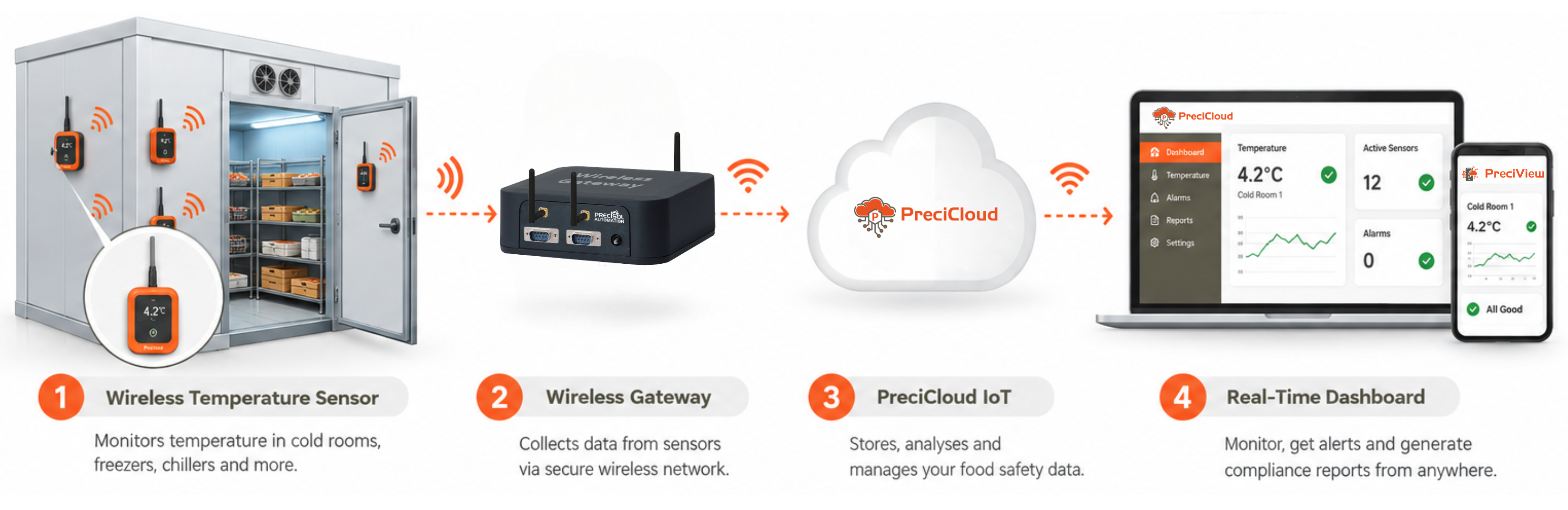
Food safety temperature monitoring with IoT wireless sensors automates the most critical and most frequently required compliance activity in food manufacturing, cold storage, food service, and retail — the continuous monitoring of temperature control at HACCP Critical Control Points that food safety regulations worldwide mandate and that manual temperature log systems consistently fail to deliver reliably. Temperature is not one of many food safety hazards — it is the primary control mechanism for almost all biological food safety hazards, because microbial pathogens (Salmonella, Listeria monocytogenes, E. coli O157, Campylobacter) have narrow temperature ranges within which they multiply to dangerous concentrations. Keeping food cold (≤5°C), cooking it hot enough (≥75°C), and chilling it rapidly enough after cooking are the three temperature control principles that prevent the vast majority of foodborne illness — and HACCP temperature monitoring IoT systems provide the automated, continuous evidence that these controls were maintained at every moment, for every batch, throughout the entire food production and distribution chain. Without food safety temperature monitoring IoT, food businesses rely on manual temperature checks recorded in paper log books — a system that, under the time pressure of food production and service, generates incomplete records, inaccurate readings, and in worst cases, falsified entries that provide false confidence rather than genuine safety evidence. Cold chain food monitoring via IoT wireless sensors and cellular gateways extends this visibility from cold rooms to transport vehicles and retail display cases — creating an end-to-end food storage temperature IoT monitoring chain that matches the regulatory requirement to maintain evidence of temperature control from farm to fork.
HACCP Temperature Monitoring IoT: Critical Control Points
- Refrigerated Storage (CCP): Walk-in chillers, blast chiller rooms, and cold room stores must maintain food at ≤5°C (or product-specific temperature). Food safety temperature monitoring IoT sensors deploy at multiple points in each cold room (entry, centre, and worst-case location from mapping), alarming immediately if temperature rises above the HACCP critical limit — detecting refrigeration failure, door left open, or overloading before temperatures reach pathogen growth range.
- Cooking and Pasteurisation (CCP): Cooking is the pathogen-kill CCP in most food processing. HACCP temperature monitoring IoT records core product temperature during cooking (in batch ovens, pasteurisers, retorts) and compares against the time-at-temperature requirement for the product specification — generating the cooked batch records that regulatory compliance requires and that recall investigations reference when a safety incident occurs.
- Rapid Chilling (CCP): The cooling CCP after cooking is the highest-risk step in food manufacturing — food passes through the pathogen growth temperature range during cooling and must transit it quickly. Food safety temperature monitoring IoT records the cooling curve for each batch in blast chiller rooms, alarming if cooling rate is slower than specification and generating the batch cooling records for HACCP record keeping.
- Cold Chain Food Monitoring — Distribution: Cold chain food monitoring via IoT data loggers or wireless sensors in refrigerated vehicles records continuous temperature during delivery — generating the transit temperature evidence required by supermarket supplier quality assurance programmes (BRC GFSI, FSSC 22000, SQF) and meeting FSMA Sanitary Transportation rule requirements in the US context.
Food Safety Temperature Monitoring: CCP Reference
| HACCP CCP | Food Safety Temperature Monitoring Limit | HACCP Temperature Monitoring IoT Alert |
|---|---|---|
| Refrigerated Storage | ≤5°C (critical limit); alert limit ≤4°C | Alert at >4°C; critical action at >5°C for >30 min |
| Frozen Storage | ≤-18°C; defrost cycles monitored separately | Food storage temperature IoT alert if >-15°C sustained |
| Cooking (Pathogen Kill) | ≥75°C core for 2 min; or equivalent time-temperature | Batch record fail if core temperature not achieved |
| Rapid Chilling | 60°C to ≤10°C in ≤2 hours; to ≤5°C in ≤4 hours | Cold chain food monitoring alert if cooling curve deviates |
| Hot Holding | ≥60°C continuous | HACCP temperature monitoring IoT alarm if <60°C detected |
Deploy Food Safety Temperature Monitoring IoT with Precisol Automation
Precisol Automation's Wireless Temperature Sensor provides battery-powered, calibration-traceable food safety temperature monitoring nodes for cold room, blast chiller, and hot-hold deployment — with food industry IP65/IP67 environmental ratings and NIST-traceable calibration certificates for HACCP records. The Wireless Humidity Sensor adds humidity monitoring for food storage areas where RH affects product shelf life. PreciCloud IoT provides the HACCP temperature monitoring IoT platform with continuous logging, CCP alarm management, and compliance reporting.
See wireless temperature monitoring delivering compliance in our warehouse temperature monitoring case study, or explore food and vaccine storage monitoring for cold chain food monitoring deployment guidance using Precisol's wireless temperature sensors.
Frequently Asked Questions
Why is IoT food safety temperature monitoring important for HACCP compliance?
IoT food safety temperature monitoring automates HACCP Critical Control Point monitoring — replacing manual hourly logs (incomplete, inaccurate, or falsified under time pressure) with continuous tamper-evident electronic records. HACCP temperature monitoring IoT systems alarm immediately on CCP limit breach, generate complete compliance records for food safety audits, and provide the evidence trail that FSMA, EU Regulation 852/2004, and FSSAI regulations require for food storage temperature IoT compliance.
What temperatures does HACCP require for food storage and safety?
HACCP temperature monitoring IoT is configured for: refrigerated storage ≤5°C; frozen storage ≤-18°C; cooking CCP ≥75°C core; rapid chilling from 60°C to ≤10°C in 2 hours; hot holding ≥60°C; and cold chain food monitoring during distribution ≤5°C (chilled) or ≤-15°C (frozen). Food safety temperature monitoring alarms on CCP critical limit breach with corrective action documentation — generating the mandatory HACCP records that food safety inspectors verify during audits.
How does cold chain food monitoring IoT work for food distribution and retail?
Cold chain food monitoring IoT uses wireless temperature sensors in refrigerated trucks, cold rooms, and retail display cases — transmitting via cellular or Wi-Fi to a cloud food safety temperature monitoring platform. Distribution vehicles generate transit temperature records (required by BRC, FSSC 22000, SQF, and FSMA Sanitary Transportation rules). Retail food storage temperature IoT sensors eliminate manual temperature check rounds with continuous HACCP temperature monitoring IoT and automated SMS alerts on display case temperature deviations.