Flow Monitoring in Industrial Pipelines: IoT Approaches and Solutions
10 August 2026
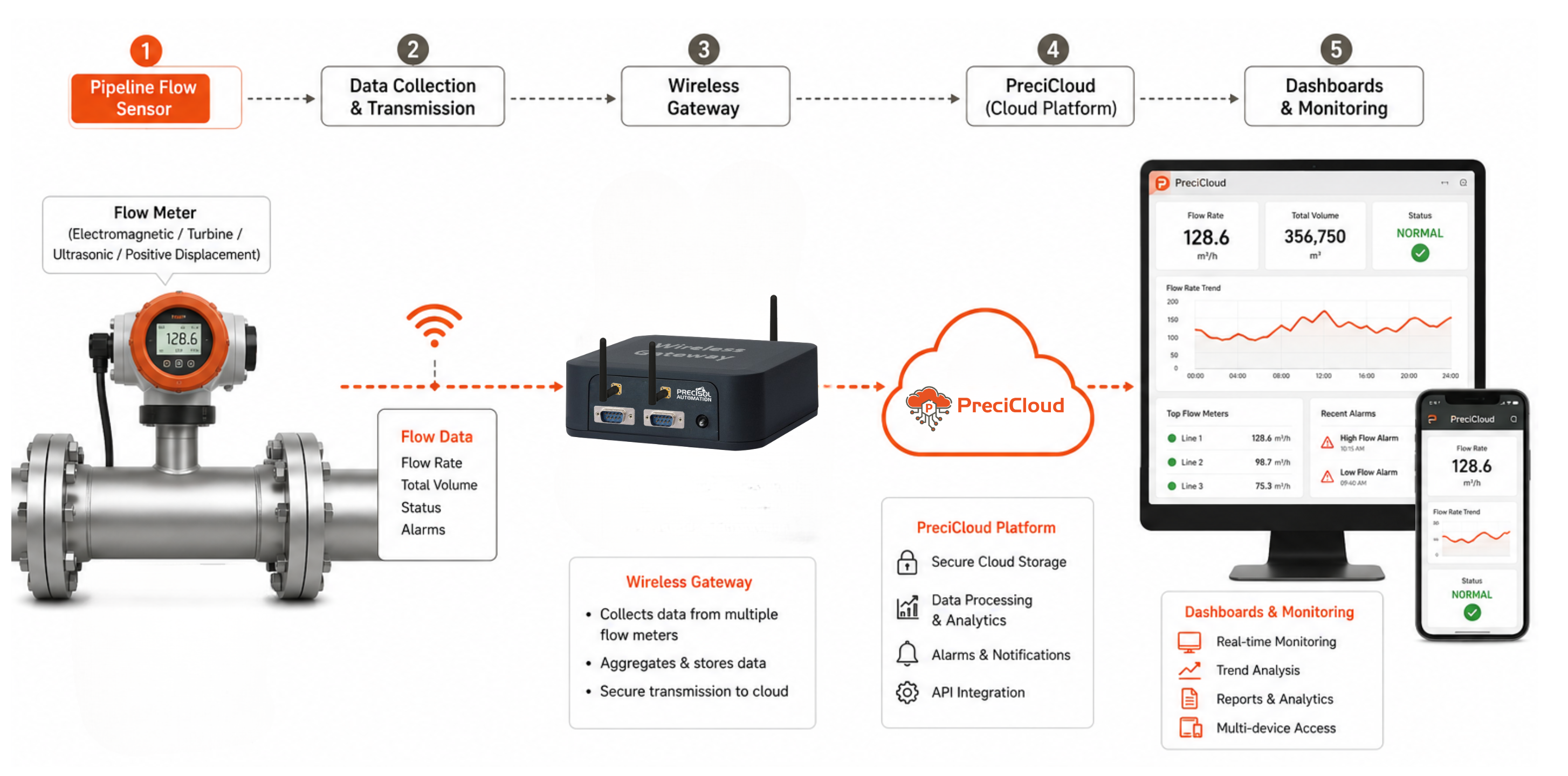
Flow monitoring industrial pipelines with IoT technology provides continuous, real-time visibility of liquid and gas flow rates — enabling process optimisation, leak detection, resource accounting, and efficiency tracking that periodic manual readings cannot support. A pipeline flow sensor (electromagnetic, ultrasonic, turbine, or Coriolis meter) measures the flow rate and total volume passing through the pipeline, and an IoT flow measurement gateway transmits that data wirelessly to a cloud platform where it is displayed, trended, and analysed against set-points. Flow monitoring industrial applications span water distribution utilities, chemical and process plants, dairy and food pipelines, irrigation systems, and HVAC chilled water networks — anywhere that knowing flow rate in real time adds operational value. Liquid flow IoT systems that integrate flow data with upstream pressure, downstream pressure, and tank level data deliver a complete hydraulic picture of the pipeline network, enabling more sophisticated flow rate monitoring and process management than flow alone can provide.
Industrial Flow Monitoring Technologies for IoT Integration
The choice of pipeline flow sensor technology determines the accuracy, installation complexity, and IoT flow measurement interface for the application:
- Electromagnetic Flow Meter (Magmeter): The most widely used pipeline flow sensor for flow monitoring industrial applications involving conductive liquids. Mag meters have no moving parts, no pressure drop, and high accuracy (±0.2–0.5% of reading). Most provide 4–20 mA, pulse, or Modbus RTU output — all compatible with IoT flow measurement gateways. Ideal for water, wastewater, chemical slurries, and dairy pipelines.
- Ultrasonic Flow Meter: Clamp-on ultrasonic meters enable liquid flow IoT without cutting the pipeline or interrupting flow — sensors are mounted externally on the pipe wall. Suitable for clean water, chemicals, and hydrocarbon pipelines. Accuracy of ±1–2% for clamp-on types. Transit-time ultrasonic meters provide better accuracy than Doppler types for clean liquids in IoT flow measurement applications.
- Turbine Flow Meter: Provides a pulse output proportional to flow rate — simple to interface with an IoT flow measurement pulse counter gateway. High accuracy for clean liquids (±0.5%) and wide flow rate monitoring range. Moving parts require periodic calibration; not suitable for viscous, dirty, or abrasive liquids.
- Positive Displacement Meter: High accuracy for viscous liquids and custody transfer flow monitoring industrial applications. Pulse output interfaces naturally with liquid flow IoT gateways. Common in heating oil metering and viscous chemical dosing flow rate monitoring.
IoT Flow Measurement Integration Methods
| Pipeline Flow Sensor Output | IoT Flow Measurement Gateway Interface | Flow Rate Monitoring Resolution |
|---|---|---|
| Pulse output (reed switch or transistor) | Pulse counter input on IoT gateway — accumulates totaliser | Flow rate monitoring calculated from pulse frequency × K-factor |
| 4–20 mA analog output | Analog input on IoT gateway — maps to flow range | Continuous liquid flow IoT at gateway sample rate |
| Modbus RTU (RS485) | RS485 Modbus master on IoT flow measurement gateway | Full meter data: flow rate, total volume, velocity, diagnostics |
| HART (4–20 mA) | HART modem on IoT gateway — extracts digital data from analog signal | Richest flow monitoring industrial data including diagnostics |
Deploy Industrial Flow Monitoring with Precisol Automation
Precisol Automation's Wireless Pulse Counter connects directly to turbine, positive displacement, and electromagnetic flow meters with pulse outputs — enabling battery-powered, wireless IoT flow measurement without cable infrastructure at remote or difficult-access pipeline locations. The compatible Wireless Gateway aggregates flow data from multiple pipeline flow sensor nodes across the facility and transmits real-time flow monitoring industrial data to a cloud dashboard with totaliser tracking, flow rate monitoring alerts, and historical trend analysis.
See IoT flow measurement transforming dairy pipeline monitoring in our remote flow monitoring in dairy pipeline case study, or explore how Precisol enables smart flow meter monitoring for water management and industrial process flow monitoring industrial applications.
Frequently Asked Questions
What is industrial flow monitoring and why is it important?
Flow monitoring industrial applications measure pipeline flow rates in real time via a pipeline flow sensor connected to an IoT flow measurement gateway. It enables automated leak detection, process control, resource accounting, and efficiency tracking — replacing local gauge reading with continuous liquid flow IoT data accessible from any device and location.
What types of flow meters are used for IoT flow measurement?
Flow monitoring industrial deployments use electromagnetic (mag) meters for conductive liquids, clamp-on ultrasonic meters for non-invasive liquid flow IoT, turbine meters with pulse output for clean liquids, and positive displacement meters for viscous flow rate monitoring. All provide pulse, 4–20 mA, or Modbus RTU output compatible with IoT flow measurement gateways.
How does wireless flow monitoring work for remote pipeline locations?
Wireless flow monitoring uses a pipeline flow sensor with pulse or Modbus output connected to a battery or solar-powered IoT gateway transmitting via LoRa or cellular. The gateway accumulates flow totals locally during connectivity gaps. Liquid flow IoT at remote sites eliminates data cable runs to distant flow rate monitoring locations, enabling cost-effective coverage of long pipeline networks.