Warehouse Temperature and Humidity Monitoring with IoT Sensors
07 August 2026
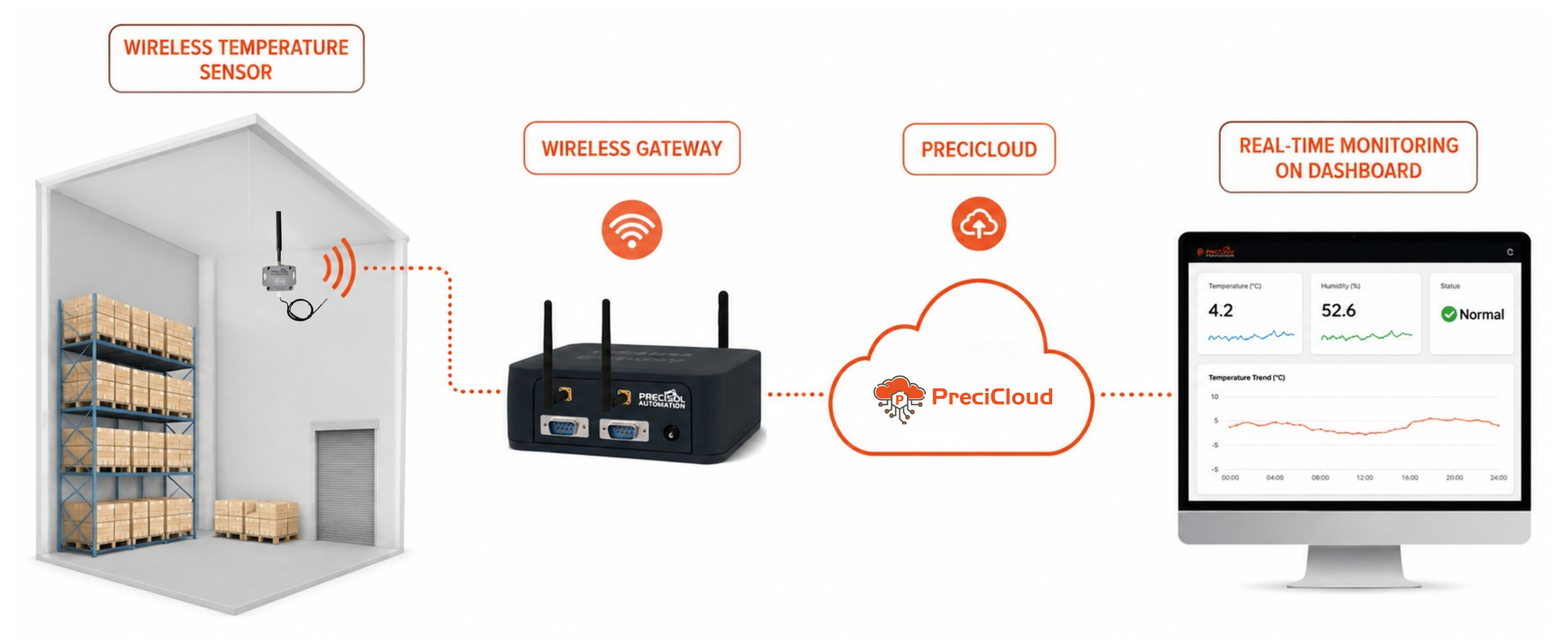
Warehouse temperature monitoring with wireless IoT sensors provides continuous, automated visibility of temperature and humidity conditions across storage facilities — detecting HVAC failures, thermal stratification, and humidity excursions before they damage inventory or trigger regulatory non-compliance. Whether the warehouse stores pharmaceuticals requiring GDP-compliant cold storage monitoring IoT, food products with strict temperature tolerances, electronics susceptible to humidity damage, or general goods that require basic warehouse environment control, wireless humidity sensor IoT and temperature sensor networks deliver the spatial and temporal data resolution needed to manage warehouse conditions effectively. A temperature alert system connected to these sensors gives operations teams immediate notification of deviations — via SMS, email, or push notification — enabling rapid response that prevents stock loss and compliance failures.
What Warehouse Temperature and Humidity Monitoring Detects
A multi-sensor warehouse temperature monitoring grid reveals conditions that spot checks and a single central thermometer cannot:
- HVAC Failures: When a refrigeration unit or air-conditioning system fails, warehouse temperature monitoring detects the temperature rise within minutes — far faster than manual rounds. The temperature alert system fires an alert while time remains to transfer sensitive stock or activate backup cooling.
- Thermal Stratification: Warehouses with high racking systems experience significant temperature variation between floor level and top-rack level — sometimes 5–8°C in an ambient warehouse. Warehouse temperature monitoring at multiple heights reveals this stratification, enabling warehouse environment control adjustments (HVAC set-points, air circulation fans) to maintain uniform conditions.
- Humidity Excursions: Humidity sensor IoT monitoring detects when relative humidity exceeds limits — moisture ingress, failed dehumidifiers, or seasonal condensation — before mould growth, packaging degradation, or electronics corrosion causes stock damage. Cold storage monitoring IoT tracks humidity alongside temperature in pharmaceutical cold rooms where condensation is a compliance concern.
- Door and Loading Bay Events: Warehouse temperature monitoring data reveals thermal events caused by dock doors opening during loading/unloading. This information helps operations teams optimise loading schedules and door management procedures to minimise temperature impact on cold storage monitoring IoT zones.
Warehouse Temperature Monitoring Sensor Placement Strategy
| Warehouse Zone | Warehouse Temperature Monitoring Approach | Humidity Sensor IoT Requirement |
|---|---|---|
| Ambient Storage (15–25°C) | One sensor per 300–500 m², plus near loading docks | Basic humidity sensor IoT if hygroscopic products stored |
| Cool Room (2–8°C) | GDP-compliant mapping: ≥9 sensors per room, all heights and corners | Cold storage monitoring IoT includes humidity sensor IoT for condensation |
| Frozen Storage (−18 to −22°C) | Cold storage monitoring IoT at multiple rack heights; critical zone coverage | Humidity monitoring for defrost cycle efficiency tracking |
| High-Bay Racking | Warehouse temperature monitoring at floor, mid-rack, and top-rack levels | Humidity sensor IoT for warehouse environment control stratification mapping |
| Loading Dock | Temperature alert system for doors open event detection | Humidity sensor IoT optional — track ingress events during high-humidity weather |
Temperature Alert System Configuration for Warehouses
An effective temperature alert system for warehouse temperature monitoring uses multiple alert tiers: a pre-alarm (when temperature approaches the limit — e.g., 1°C inside the acceptable band) gives staff time to investigate before an actual breach occurs; a main alarm (limit exceeded) triggers immediate cold storage monitoring IoT response; and a time-integrated alarm (temperature exceeds limit for more than a configurable duration — e.g., 15 minutes) distinguishes sustained breaches from brief transients. Warehouse environment control response procedures — who is notified, what actions are required, when product must be quarantined — should be defined for each alarm tier and documented in the warehouse temperature monitoring system configuration for regulatory audit.
Deploy Warehouse Temperature and Humidity Monitoring with Precisol
Precisol Automation's Wireless Temperature Sensor and Wireless Humidity Sensor provide battery-powered, wireless warehouse temperature monitoring and humidity sensor IoT coverage without any cabling through racking structures. Sensors pair with a wireless gateway that transmits all cold storage monitoring IoT data to a cloud platform with configurable temperature alert system thresholds and automated report generation for regulatory audit.
See wireless warehouse temperature monitoring protecting products at scale in our warehouse temperature monitoring case study, or explore how Precisol supports vaccine storage monitoring with GDP-compliant cold storage monitoring IoT.
Frequently Asked Questions
Why is warehouse temperature monitoring important?
Warehouse temperature monitoring detects HVAC failures and temperature excursions before stock is damaged. Cold storage monitoring IoT is additionally required for pharmaceutical and food regulatory compliance — providing tamper-evident records. Humidity sensor IoT monitoring detects condensation and moisture ingress risks that manual spot checks miss.
How many temperature sensors does a warehouse need?
One humidity sensor IoT node per 200–500 m² is adequate for basic warehouse temperature monitoring. GDP-compliant cold storage monitoring IoT requires a minimum of 9 sensors per cold room, placed at corners, centre, and multiple heights to capture thermal stratification. Warehouse environment control monitoring in high-bay facilities requires sensors at each racking level to detect vertical temperature gradients.
What is GDP and how does it relate to warehouse temperature monitoring?
GDP (Good Distribution Practice) requires continuous cold storage monitoring IoT with calibrated sensors, tamper-evident records, deviation logs, and temperature alert system documentation for pharmaceutical products. IoT-based warehouse temperature monitoring generates automated, audit-ready records that satisfy GDP requirements far more reliably than manual temperature data loggers.