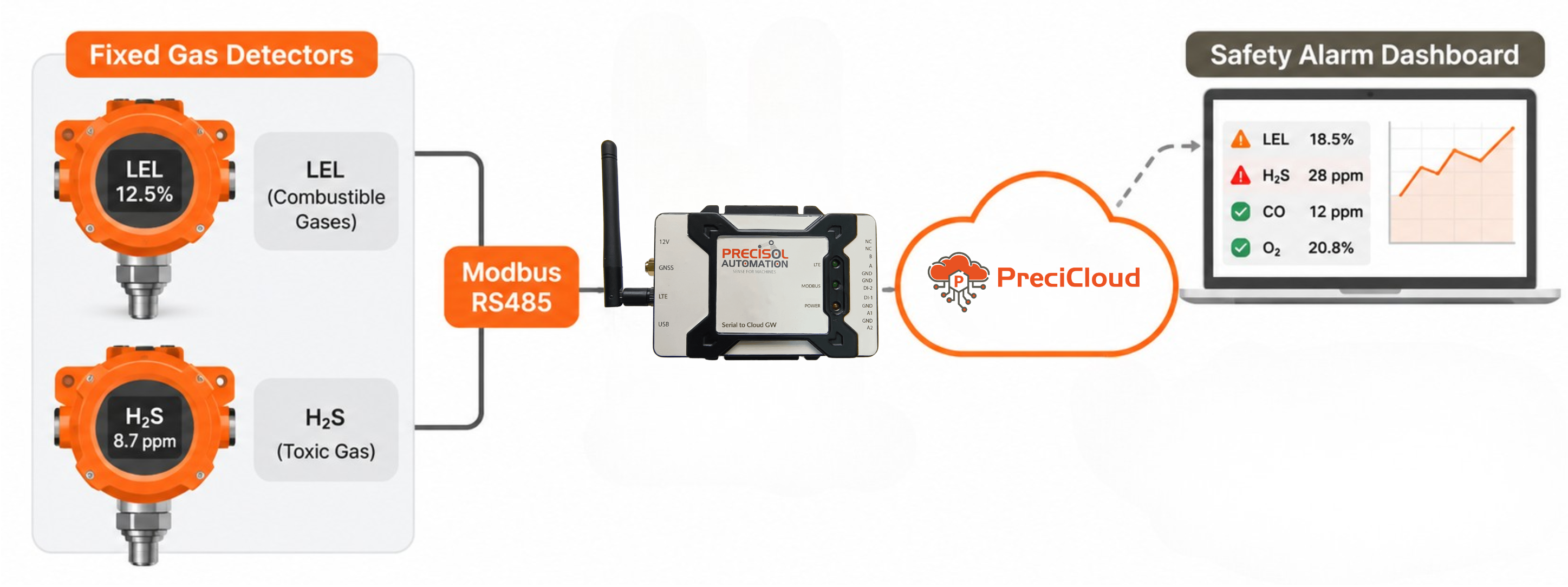
Industrial gas detection IoT integration bridges the gap between the permanently installed fixed gas detector infrastructure that industrial facilities already rely on for personnel safety and regulatory compliance — and the real-time remote monitoring, alarm notification, and compliance record-keeping capabilities that a connected IIoT platform provides. Traditional fixed gas detector systems connect via hardwired relay outputs to control room alarm panels, providing local alarm indication but no remote visibility outside the control room, no cloud alarm logging for regulatory audit trails, and no ability for safety managers or facility directors to monitor gas detection status from outside the plant. Fixed gas detector IoT monitoring adds an IIoT data layer connecting each detector's Modbus RS485 or 4–20 mA output to an IIoT gateway, providing cloud dashboards showing all gas concentrations in real time, historical alarm event logs for OSHA/HSE compliance records, and immediate SMS/email/mobile push notifications to safety personnel when any detector enters alarm — regardless of whether anyone is physically watching the control room panel. LEL gas monitoring industrial for combustible hydrocarbons and H2S gas detector IoT for toxic gas in oil and gas, wastewater, and chemical processing facilities are the most critical applications — where a gas release and delayed detection can result in explosion, fire, or mass casualty events. Combustible gas sensor industrial IoT integration also enables maintenance optimisation: cloud tracking of each detector's calibration due date, sensor cell age, and test event history — eliminating the manual paper-based maintenance records that are a significant regulatory compliance burden for facilities with 50–200 fixed gas detectors. This guide covers the sensor technologies for industrial gas detection IoT, the specific requirements for LEL gas monitoring industrial and H2S gas detector IoT, and the Modbus integration architecture for connecting existing fixed gas detectors to an IIoT cloud monitoring platform.
Industrial Gas Detection IoT: Sensor Technologies
- Catalytic Bead (Pellistor) — LEL Gas Monitoring Industrial: Catalytic bead sensors are the standard technology for LEL gas monitoring industrial combustible gas detection. A heated platinum bead catalyst oxidises the flammable gas, increasing bead temperature and resistance proportional to gas concentration. Output: 0–100% LEL. Standard alarm setpoints: 10% LEL warning, 20% LEL high alarm. Catalytic bead sensors are susceptible to poisoning from silicone compounds, lead, and sulfur — facilities with these contaminants use infrared sensors instead. Catalytic bead combustible gas sensor industrial detectors must be calibrated regularly (typically every 6 months per EN 60079-29-1) with a certified calibration gas mixture — industrial gas detection IoT tracks calibration due dates and schedules maintenance alerts automatically.
- Electrochemical Sensor — Toxic Gas and H2S Gas Detector IoT: Electrochemical sensors for CO, H2S, NH₃, SO₂, NO₂, and O₂ detect target gases via an oxidation or reduction reaction at the working electrode, producing a current proportional to gas concentration. H2S gas detector IoT electrochemical sensors (0–100 ppm or 0–500 ppm) are the standard for oil and gas, wastewater, and chemical facilities. Electrochemical sensors have a finite life (typically 2–3 years for H2S sensors) — fixed gas detector IoT monitoring tracks sensor cell age and sends replacement reminders. Temperature and humidity affect electrochemical sensor response — temperature-compensated transmitters maintain accuracy across the industrial installation range.
- Fixed Gas Detector IoT Monitoring — Modbus Integration: Fixed gas detector IoT monitoring via Modbus RS485 connects up to 32 detector transmitters on a single RS485 network per IIoT gateway port (multiple ports support larger detector networks). Each detector transmitter holds Modbus registers for: gas concentration value (in ppm or % LEL); alarm relay 1 and 2 status; fault/error status; sensor life remaining (as a percentage); and calibration due date. The IIoT gateway polls all detector registers at 30–60 second intervals and publishes to cloud for industrial gas detection IoT dashboard and alarm notification. Emergency response integration: when any detector registers alarm relay state = ON, the IIoT gateway can trigger a digital output to activate emergency ventilation fans or close HVAC isolation dampers — closing the safety loop from detection to automated response.
- LEL and H2S Cloud Alarm Management: Industrial gas detection IoT cloud alarm management provides: zone-based alarm grouping (all detectors in a specific area presented as a zone with aggregate alarm status); escalating notification (Warning → email alert; High Alarm → SMS + phone call to safety officer); event log with gas concentration at each alarm transition for OSHA/HSE records; and weekly calibration due report listing all detectors requiring service within the next 30 days — replacing the paper binder maintenance system with an automatically updated cloud compliance tool.
Industrial Gas Detection IoT: Gas Types and Alarm Setpoints
| Gas | Sensor Technology | Warning / Alarm Setpoints |
|---|---|---|
| Methane / Hydrocarbons | Catalytic bead — LEL gas monitoring industrial | 10% LEL warning / 20% LEL high alarm |
| H2S (Hydrogen Sulfide) | Electrochemical — H2S gas detector IoT | 10 ppm warning / 20 ppm alarm (IDLH: 50 ppm) |
| CO (Carbon Monoxide) | Electrochemical — combustible gas sensor industrial | 25 ppm warning / 50 ppm alarm (TLV-TWA: 25 ppm) |
| NH₃ (Ammonia) | Electrochemical | 25 ppm warning / 50 ppm alarm (IDLH: 300 ppm) |
| O₂ (Oxygen) | Electrochemical — fixed gas detector IoT monitoring | 19.5% low alarm / 23% high alarm |
Industrial Gas Detection IoT with Precisol Automation
Precisol Automation's Serial IIoT Gateway connects to fixed gas detector IoT monitoring systems via Modbus RS485 — polling gas concentration, alarm relay status, and sensor health registers from all detectors on the RS485 network and publishing to cloud via MQTT TLS for real-time industrial gas detection IoT dashboards and alarm notification. The PreciCloud IoT Cloud Dashboard provides zone-based gas monitoring displays, alarm event logging for compliance records, and calibration maintenance scheduling.
See process safety monitoring integration in our IT-OT bridge for process automation case study, or explore remote monitoring for Modbus PLCs for the IIoT gateway Modbus integration pattern used in H2S gas detector IoT and LEL gas monitoring industrial remote monitoring deployments.
Frequently Asked Questions
What is fixed gas detector IoT monitoring in industrial facilities?
Fixed gas detector IoT monitoring integrates permanently installed gas detectors (electrochemical, catalytic bead, infrared) with IIoT gateways via Modbus RS485 or 4–20 mA — providing cloud dashboards showing all gas concentrations in real time, alarm event logs for regulatory compliance, and instant SMS/email notifications to safety personnel on alarm. Industrial gas detection IoT covers LEL gas monitoring industrial (combustible hydrocarbons), H2S gas detector IoT (toxic), CO and O₂ monitoring, with alarm setpoints matched to applicable safety standards (OSHA, ATEX, EN 60079).
What is LEL gas monitoring and why is it critical for industrial safety?
LEL gas monitoring industrial measures combustible gas concentration as a percentage of the Lower Explosive Limit — the minimum concentration that can ignite. Catalytic bead (pellistor) combustible gas sensor industrial detectors alarm at 10% LEL (warning) and 20% LEL (high alarm), providing substantial safety margin below the ignition threshold. Fixed gas detector IoT monitoring of LEL enables remote alarm notification, automated ventilation interlocks, calibration tracking, and regulatory audit trail logging — critical for ATEX Zone facilities with methane, hydrogen, propane, and other flammable gases.
How does H2S gas detector IoT monitoring work in oil, gas, and wastewater facilities?
H2S gas detector IoT electrochemical sensors (0–100 ppm or 0–500 ppm) measure hydrogen sulfide concentration via oxidation current proportional to H2S concentration. Fixed gas detector IoT monitoring connects detectors via Modbus RS485 to IIoT gateways, which publish concentration, alarm relay status, and sensor health to cloud platforms. Alarm at 10 ppm warning / 20 ppm high alarm notifies safety officers via SMS/email regardless of control room staffing. Industrial gas detection IoT cloud platforms log all H2S alarm events with concentration and timestamp for OSHA compliance records, and track electrochemical sensor cell age for replacement scheduling.