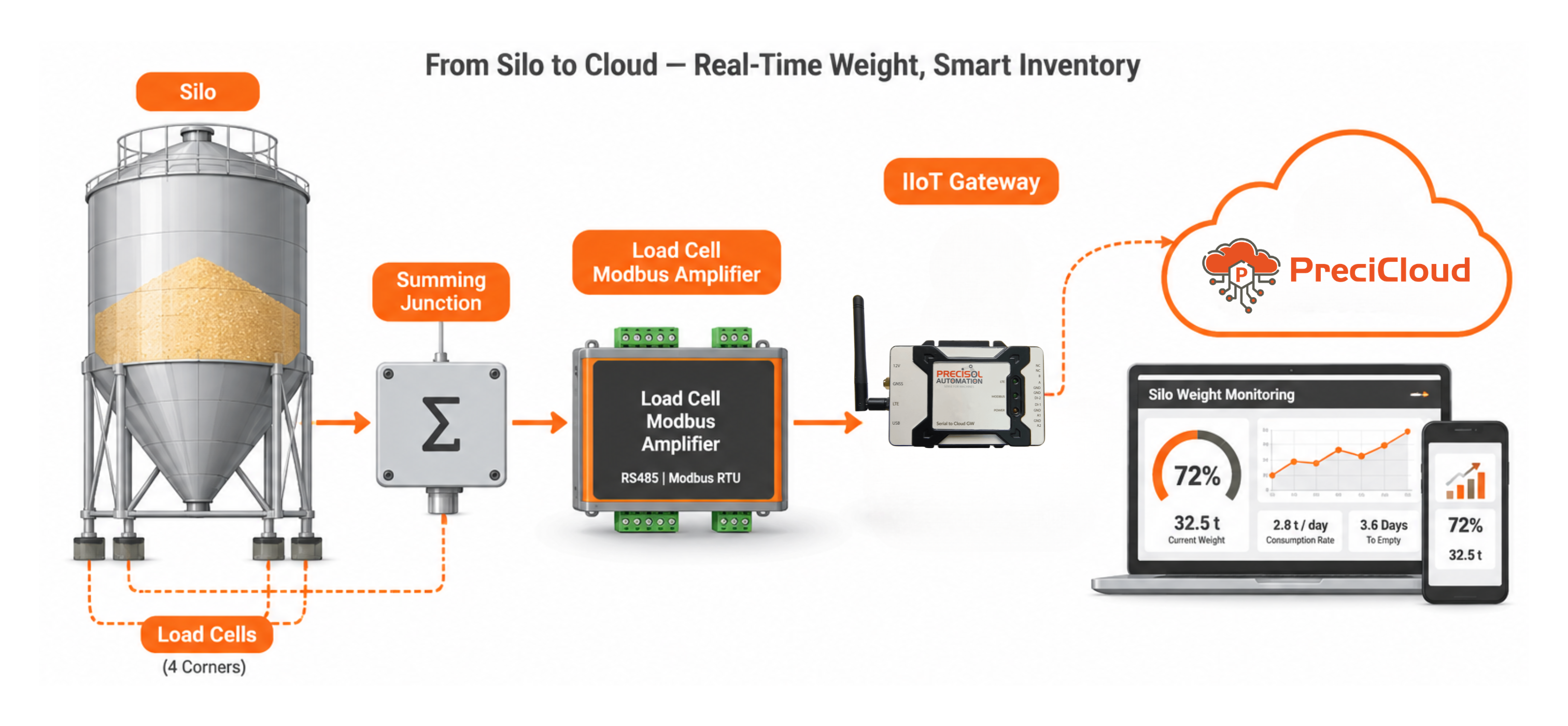
Load cell IoT monitoring connects the well-established technology of strain-gauge load cells — the foundation of virtually every industrial weighing application from silo inventory to truck weighbridges — to the IIoT connectivity and cloud analytics that transform isolated weighing data into actionable inventory intelligence accessible from any device, anywhere. Industrial plants have used load cells for decades for static weighing, silo inventory, and batch control, but the data from these systems has historically been trapped in local weight indicators or PLC programmes, invisible to plant managers, procurement teams, or remote logistics coordinators who need stock level information without calling the plant. Industrial weighing system IoT integration using a load cell Modbus amplifier as the digital interface between analogue load cells and IIoT gateways provides the data pipeline that makes silo weight monitoring IoT cloud dashboards possible — giving every stakeholder real-time visibility into stock levels, consumption rates, and days-to-empty projections without installing new infrastructure in the silo structure. Remote load monitoring IIoT applications extend beyond inventory: overload protection alerts when a loaded vessel exceeds safe structural limits; blending control verification confirming each batch ingredient addition meets recipe tolerance; vehicle weighbridge transaction logging with automatic ticket generation and remote database storage; and continuous belt conveyor mass flow monitoring calculating tonnes-per-hour throughput for production reporting. This guide covers load cell operating principles, the load cell Modbus amplifier interface that enables load cell IoT monitoring, silo weight monitoring IoT installation best practices, and the complete remote monitoring integration from load cell to cloud dashboard.
Load Cell IoT Monitoring: Key Application Areas
- Silo Weight Monitoring IoT — Inventory Management: Silo weight monitoring IoT with load cells under each support leg provides inventory measurement independent of material angle of repose, bulk density variation, or foam — problems that affect ultrasonic and radar level sensors. Four compression load cells (one per leg) in a summing junction provide a single weight output for the entire silo content. For remote cement, flour, grain, or chemical silos without mains power, battery- or solar-powered weight transmitters with cellular or LoRaWAN communication provide remote load monitoring IIoT without infrastructure extension. Silo weight monitoring IoT cloud dashboards show current stock, daily consumption trend, and automatic low-stock alerts to procurement — eliminating manual stock checks and production stoppages from unexpected material run-outs.
- Load Cell Modbus Amplifier — Digital Interface: The load cell Modbus amplifier (weight transmitter) is the critical interface component for load cell IoT monitoring. Key specification requirements: input sensitivity range matching the load cell output (typically 0–30 mV for a 10 VDC excited load cell at full scale); 24-bit ADC resolution for accurate small-signal reading; Modbus RTU RS485 output with configurable baud rate and address; IP65 rated enclosure for industrial environments; and DIN-rail or panel-mount options. Configuration involves two-point calibration: zero (empty vessel, live zero to compensate for tare structure weight) and span (apply a known test weight or use calibration constants from the load cell certificate). The load cell Modbus amplifier holds calibration coefficients in non-volatile memory, maintaining accuracy after power cycle.
- Industrial Weighing System IoT — Batching and Blending: Industrial weighing system IoT for batching connects the load cell IoT monitoring cloud platform to the production recipe management system — the recipe specifies ingredient weights, and the IIoT system monitors actual weight additions via the load cell Modbus amplifier, logging each addition with timestamp and actual weight vs. target weight. Batch deviation alarms fire if any addition differs from target by more than the process tolerance. Remote load monitoring IIoT provides remote quality assurance — the production manager can review all batch weight logs from any location without plant access.
- Remote Load Monitoring IIoT — Truck Weighbridge: Truck weighbridge remote load monitoring IIoT uses multiple high-capacity load cells (each rated 50–200 tonnes) in a weighbridge deck, connected via summing junction and load cell Modbus amplifier to an IIoT gateway that publishes each weighing transaction (vehicle ID, gross weight, tare weight, net weight, timestamp) to the cloud weighbridge management system — enabling automatic ticket generation, compliance record keeping, and remote transaction audit without a weighmaster physically present at the weighbridge.
Load Cell IoT Monitoring: System Architecture
| Component | Load Cell IoT Monitoring Role | Specification / Protocol |
|---|---|---|
| Load Cells | Mechanical force to mV signal conversion | 2–3 mV/V, C3 OIML accuracy, IP67 — silo weight monitoring IoT |
| Summing Junction | Parallel cell combination and trimming | 4–8 input channels, adjustable trimmer potentiometers |
| Load Cell Modbus Amplifier | mV to digital weight, RS485 Modbus RTU output | 24-bit ADC, 0–30 mV input, Modbus RTU RS485 |
| IIoT Gateway | Modbus polling, MQTT cloud publishing | Modbus RTU master → MQTT TLS — remote load monitoring IIoT |
| Cloud Platform | Silo weight monitoring IoT dashboard, alerts | Time series database, mobile-accessible dashboard |
Load Cell IoT Monitoring with Precisol Automation
Precisol Automation's Serial IIoT Gateway integrates with load cell Modbus amplifier RS485 outputs — polling gross weight, net weight, and status registers from multiple weight transmitters on a single RS485 bus and publishing to cloud via MQTT TLS for silo weight monitoring IoT dashboards and remote load monitoring IIoT inventory alerts. The PreciCloud IoT Cloud Dashboard provides stock level visualisation, consumption rate trending, and low-level alarm management for industrial weighing system IoT applications.
See process data integration in our IT-OT bridge for process automation case study, or explore remote monitoring for Modbus PLCs for the Modbus RS485 polling gateway configuration used in load cell IoT monitoring deployments.
Frequently Asked Questions
How does load cell IoT monitoring work for industrial weighing systems?
Load cell IoT monitoring connects strain gauge load cells to a load cell Modbus amplifier (weight transmitter) that digitises the millivolt signal and outputs calibrated weight via RS485 Modbus RTU. An IIoT gateway polls the weight transmitter registers at configurable intervals and publishes gross weight, net weight, and status to the cloud via MQTT. The cloud platform provides silo weight monitoring IoT dashboards with real-time stock levels, daily consumption trends, and remote load monitoring IIoT alerts for low stock, overload, or system faults.
What are the typical applications of silo weight monitoring IoT in industrial plants?
Silo weight monitoring IoT applications: raw material inventory management (cement, grain, chemical powder) with automatic low-stock reorder alerts; bulk liquid tank inventory (weight-based, independent of density variation); batch recipe ingredient verification (remote load monitoring IIoT confirms each addition meets tolerance); truck weighbridge transaction logging with cloud record keeping; and belt conveyor mass flow calculation for production reporting. Industrial weighing system IoT gives procurement, logistics, and production teams remote visibility into material stocks without plant visits.
How do you connect a load cell system to Modbus for IoT remote monitoring?
Load cell Modbus connection: load cells → summing junction box (combines parallel cells, balance trimming) → load cell Modbus amplifier (RS485 Modbus RTU, configure device address and baud rate) → IIoT gateway Modbus RTU port (poll weight register at 1–60 second interval) → MQTT publish to cloud → remote load monitoring IIoT dashboard. Calibrate load cell Modbus amplifier with dead-load zero tare and known test weight span. Multiple weight transmitters share the RS485 bus with unique addresses — one IIoT gateway monitors 10–30 silos for complete industrial weighing system IoT coverage.