Heavy Vehicle Diagnostics: Remote Fault Monitoring with Telematics
12 August 2026
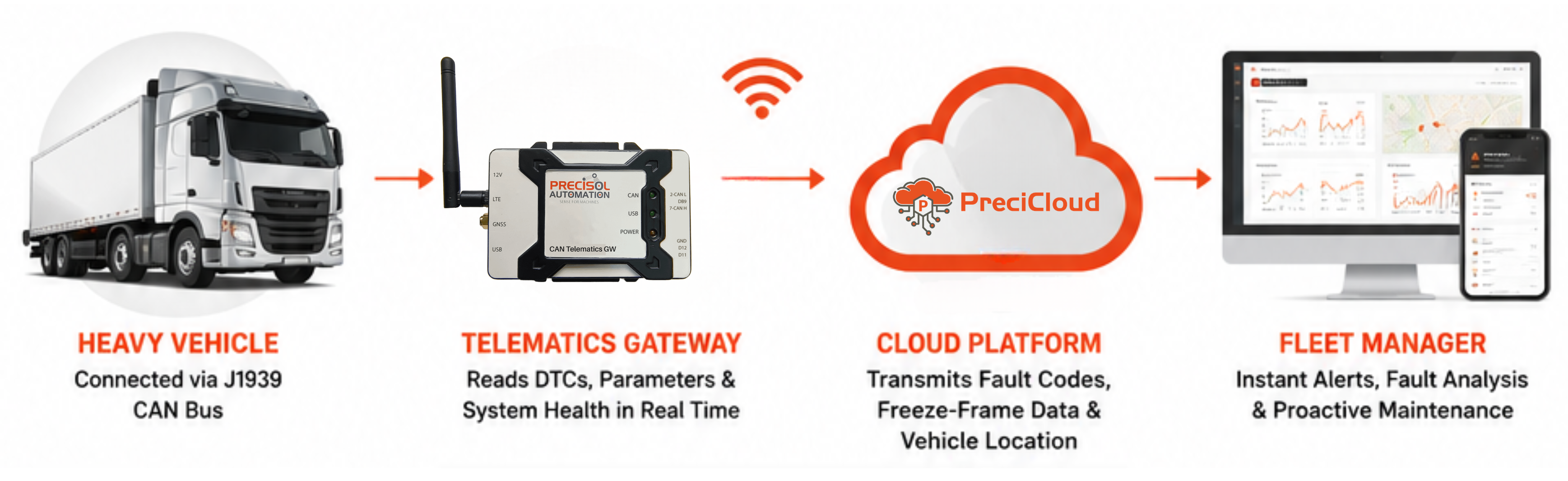
Heavy vehicle diagnostics via telematics transforms how fleet managers identify and respond to mechanical faults in commercial vehicles — moving from reactive workshop visits triggered by dashboard warning lights to proactive, cloud-based remote fault monitoring that alerts maintenance teams the moment a fault code appears on any vehicle in the fleet. A commercial vehicle telematics device connected to the truck's J1939 CAN bus reads all active and pending Diagnostic Trouble Codes, engine operating parameters, and system health data in real time. When the truck diagnostics system detects a new DTC, it immediately transmits the fault details, freeze-frame data, and vehicle location to the cloud platform — enabling the fleet manager to assess severity, arrange parts procurement, and direct the vehicle to the nearest qualified workshop before a minor fault becomes a costly roadside breakdown. DTC remote reading at the point of fault occurrence, rather than at the next scheduled workshop visit, is the core value proposition of modern heavy vehicle diagnostics telematics.
J1939 and Remote Fault Monitoring: The Technical Foundation
Most heavy commercial vehicles manufactured after 2000 communicate over SAE J1939 — a CAN bus protocol standardised for trucks, buses, and off-highway equipment. J1939 defines Suspect Parameter Numbers (SPNs) for every measurable vehicle parameter and Failure Mode Identifiers (FMIs) that classify how a parameter is failing. A commercial vehicle telematics gateway connected to the J1939 CAN bus reads all PGN (Parameter Group Number) broadcasts continuously — extracting engine RPM, coolant temperature, fuel rate, torque demand, and DM1 (Diagnostic Message 1) active fault broadcasts. The truck diagnostics system decodes each SPN-FMI combination into a human-readable fault description that fleet maintenance teams can act on immediately, without needing OEM scan tools at the vehicle's location. DTC remote reading via J1939 commercial vehicle telematics works across multi-brand fleets because J1939 SPNs and FMIs are standardised across manufacturers — a DTC from a Volvo FH and a Scania R series uses the same SPN-FMI framework, making heavy vehicle diagnostics consistent regardless of vehicle brand.
What Remote Fault Monitoring Detects in Heavy Vehicles
- Engine System Faults: Heavy vehicle diagnostics via J1939 detects injector faults, EGR valve failures, turbocharger issues, and coolant temperature abnormalities — engine system DTCs that the commercial vehicle telematics system reads before MIL (Malfunction Indicator Lamp) escalates to engine derate or shutdown.
- Aftertreatment System: SCR (Selective Catalytic Reduction), DPF (Diesel Particulate Filter), and DEF (AdBlue) system faults are increasingly frequent sources of heavy truck downtime. Remote fault monitoring via the truck diagnostics system detects DPF soot loading approaching regeneration threshold, DEF quality faults, and SCR catalyst efficiency codes before they trigger mandatory derate conditions.
- Transmission and Driveline: Automatic transmission temperature alerts, torque converter fault codes, and inter-axle differential lock issues are detectable through DTC remote reading on the J1939 bus — often before the driver notices any performance degradation.
- ABS and Brake System: Wheel speed sensor faults, ABS controller errors, and EBS (Electronic Brake System) warnings appear on the J1939 bus as safety-critical heavy vehicle diagnostics alerts that require immediate response from the truck diagnostics system.
DTC Severity Triage in Commercial Vehicle Telematics
| DTC Category | Heavy Vehicle Diagnostics Response | Remote Fault Monitoring Action |
|---|---|---|
| Red (Safety Critical) | Immediate stop required — brake, steering, tyre pressure faults | Instant alert; truck diagnostics system initiates driver contact |
| Amber (Derate Risk) | Complete current trip; aftertreatment, engine load faults | Commercial vehicle telematics alert; workshop booking initiated |
| Yellow (Monitor) | Address at next scheduled service; sensor drift, minor emissions faults | Remote fault monitoring log; flagged for next maintenance event |
| Informational | No immediate action — service reminders, filter life indicators | DTC remote reading auto-logged for fleet data analytics trending |
Remote Heavy Vehicle Diagnostics with Precisol Automation
Precisol Automation's CAN Telematics Gateway provides real-time heavy vehicle diagnostics via J1939 CAN bus connection — transmitting DTC alerts, parameter trends, and freeze-frame data to cloud remote fault monitoring platforms with 4G LTE cellular connectivity. The CAN Telematics Logger supplements this with local data storage for truck diagnostics system applications on mining and off-highway vehicles operating in areas with intermittent cellular coverage.
See commercial vehicle telematics and remote fault monitoring preventing fleet downtime in our heavy truck fleet management case study, or explore how Precisol enables haul truck fleet management with comprehensive heavy vehicle diagnostics.
Frequently Asked Questions
How does remote heavy vehicle diagnostics work?
A commercial vehicle telematics device reads J1939 DTC and parameter data continuously from the truck CAN bus. On new fault detection, the remote fault monitoring system transmits the DTC, FMI, freeze-frame, and location to a cloud truck diagnostics system — enabling immediate severity assessment and workshop dispatch without returning the vehicle for a scan tool check.
What is J1939 and why is it important for heavy vehicle diagnostics?
J1939 is the SAE CAN bus standard for heavy commercial vehicles, defining standardised SPNs and FMIs for fault reporting across all compliant manufacturers. Commercial vehicle telematics systems read J1939 to perform DTC remote reading across multi-brand fleets with a single truck diagnostics system — no OEM-specific tools required.
Can remote fault monitoring prevent breakdowns?
Yes. Remote fault monitoring detects developing faults — rising coolant temperature trends, pre-DTC parameter anomalies, DPF soot loading — before the truck diagnostics system escalates to derate or shutdown. Commercial vehicle telematics platforms identify which heavy vehicle diagnostics DTC patterns most frequently precede breakdown, enabling targeted preventive action before failure.