Off-Highway Vehicle Monitoring: Telematics for Construction and Mining
13 August 2026
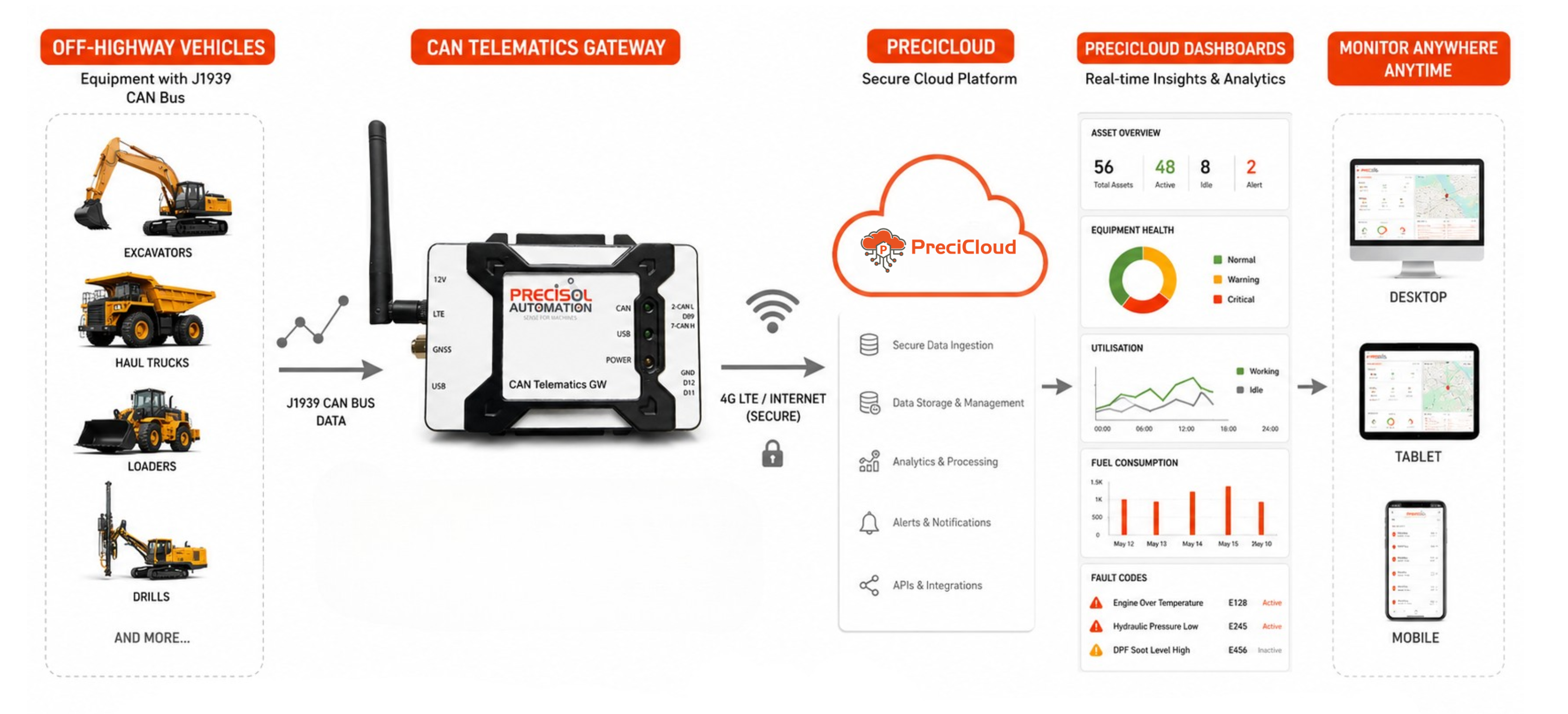
Off-highway vehicle monitoring with telematics and CAN data logging delivers the real-time visibility and condition data that construction sites and mining operations need to manage expensive, hard-to-access equipment effectively. Construction equipment telematics connects to the machine's J1939 CAN bus to extract engine data, fault codes, hydraulic system health, and utilisation metrics — transmitting this data via cellular to a cloud platform where fleet managers can monitor every machine's status, health, and productivity without physically visiting the site. Mining vehicle tracking extends this capability to haul trucks, drills, and loaders operating in underground and surface mines where equipment downtime directly impacts ore production targets. Whether the application is maximising excavator utilisation on a road construction project or preventing heavy equipment IoT-monitored haul truck failures in a remote mining operation, off-road vehicle data logging and telematics provide the actionable data that improves uptime, reduces fuel costs, and enhances safety.
What Construction Equipment Telematics Monitors
Unlike road vehicles where J1939 data is standardised across manufacturers, construction equipment telematics must navigate both standardised J1939 parameters and manufacturer-proprietary CAN messages. Most major OEMs — Caterpillar, Komatsu, Volvo CE, Liebherr, Doosan — broadcast engine and basic machine data on J1939, while hydraulic system data, working mode, and payload data use proprietary CAN messages. Off-highway vehicle monitoring systems handle both through J1939 decoding plus configurable DBC (CAN database) files for OEM-specific messages. Key parameters captured by construction equipment telematics:
- Engine and Powertrain: Engine RPM, fuel consumption (rate and total), engine hours, coolant temperature, oil pressure, and engine load factor — the core data for fuel efficiency analysis and maintenance scheduling in off-highway vehicle monitoring.
- Hydraulic System: Hydraulic oil temperature, pump pressure, and relief valve events — heavy equipment IoT monitoring of hydraulic health helps prevent costly seal failures and hydraulic pump damage in excavators and cranes that depend on hydraulic power for all work functions.
- Machine Utilisation: Working time versus idle time breakdown, operator-selected work mode (light/heavy/maximum power), and GPS-derived duty cycle data that construction equipment telematics platforms use to calculate machine utilisation rate and cost per working hour.
- Fault Codes: Active J1939 DTCs from engine, transmission, hydraulic, and electrical system ECUs — enabling off-road vehicle data logging platforms to alert site managers of developing faults before they escalate to breakdown.
Mining Vehicle Tracking: Beyond Construction Equipment Telematics
| Parameter | Construction Equipment Telematics | Mining Vehicle Tracking |
|---|---|---|
| Location Tracking | GPS geofencing for site boundary monitoring | High-precision haul road tracking, pit position mapping |
| Speed Monitoring | General over-speed alerting | Haul road speed limit compliance per road segment |
| Payload | Not typically monitored | Payload weight per cycle; overload detection and alerts |
| Safety Systems | Basic off-highway vehicle monitoring | Proximity detection, fatigue monitoring, collision avoidance |
| Fuel Management | CAN bus fuel consumption; tank level | Heavy equipment IoT fuel reconciliation per truck ID |
Off-Road Vehicle Data Logging for Remote Sites
Off-road vehicle data logging addresses a fundamental challenge of off-highway vehicle monitoring: equipment often operates in remote areas with intermittent or no cellular connectivity. A CAN telematics logger with onboard storage captures all J1939 data locally — maintaining a continuous off-road vehicle data logging record even during connectivity gaps — then uploads the buffered data when a cellular connection is re-established. For deep underground mining vehicle tracking where cellular coverage is physically impossible, Wi-Fi upload zones at workshop and tipping points provide periodic data upload windows. Heavy equipment IoT platforms that tolerate intermittent connectivity — processing uploaded historical data alongside live data — are essential for genuine construction equipment telematics coverage on remote sites.
Deploy Off-Highway Vehicle Monitoring with Precisol Automation
Precisol Automation's CAN Telematics Logger provides local off-road vehicle data logging with cellular upload for construction equipment telematics and mining vehicle tracking — capturing J1939 engine and fault data continuously regardless of cellular coverage. The CAN Data Logger offers expanded storage and configuration flexibility for heavy equipment IoT applications where complex multi-bus data capture is required.
See mining vehicle tracking and off-highway vehicle monitoring improving safety and productivity in our mining vehicle safety monitoring case study, or explore how Precisol enables proactive maintenance of construction equipment with continuous CAN bus data logging.
Frequently Asked Questions
What is off-highway vehicle monitoring and how is it different from on-road fleet telematics?
Off-highway vehicle monitoring tracks construction, mining, and agricultural equipment operating off public roads. Unlike on-road fleet telematics which focuses on GPS and tachograph compliance, construction equipment telematics monitors engine hours, hydraulic health, machine utilisation, and site productivity. Mining vehicle tracking adds payload management, haul road speed compliance, and heavy equipment IoT safety systems specific to mining operations.
What data does construction equipment telematics collect?
Construction equipment telematics reads J1939 CAN bus data — engine RPM, fuel consumption, engine hours, coolant temperature, hydraulic oil temperature, machine load, and DTCs. Off-highway vehicle monitoring systems also capture GPS position, idle time, and geofence events. Mining vehicle tracking adds payload weight, haul road speed, and heavy equipment IoT proximity detection data.
How does off-highway vehicle monitoring improve equipment uptime?
Off-highway vehicle monitoring improves uptime through DTC early detection, condition-based maintenance on actual engine hours from heavy equipment IoT data, and remote diagnostics via off-road vehicle data logging. Mining vehicle tracking platforms add predictive analytics correlating fault history with failure probability — enabling targeted preventive maintenance before construction equipment telematics systems escalate to breakdown.