HVAC Predictive Maintenance with IoT: Detect Chiller and AHU Faults Early
05 October 2026
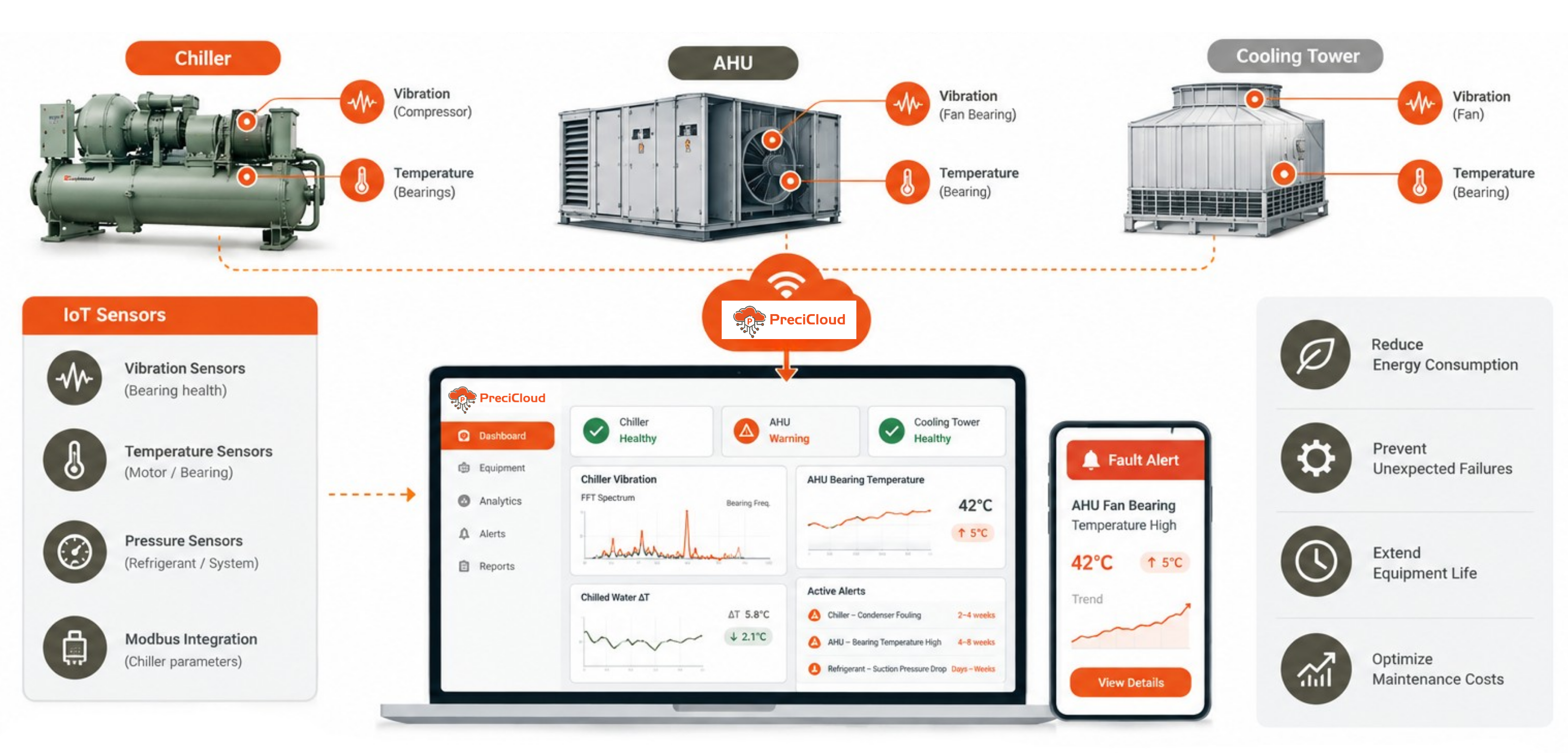
HVAC predictive maintenance IoT is transforming how facilities engineers, building management teams, and HVAC service contractors maintain the chillers, AHUs, cooling towers, and pumps that keep modern buildings comfortable and operational — shifting from calendar-based service visits that react to scheduled intervals to data-driven, condition-based maintenance that detects faults weeks before they cause equipment failure. HVAC systems represent the single largest energy consumer in most commercial buildings (typically 40–60% of building electricity) and the most consequential maintenance liability: chiller failure in a data centre, hospital, or manufacturing clean room causes immediate operational crisis. Yet most HVAC maintenance is still executed on the same approach developed in the 1960s — quarterly filter changes, annual belt replacements, and bi-annual bearing greasing on schedules that have no relationship to the actual condition of the equipment being maintained. HVAC fault detection IoT via vibration sensors on compressors and AHU fans, combined with operational parameter monitoring from chiller Modbus interfaces, creates the continuous condition visibility that makes condition-based maintenance practical and cost-effective for building HVAC systems at scale. Chiller predictive maintenance from IoT data detects condenser tube fouling (reducing COP before it appears on the utility bill), refrigerant charge loss (gradual suction pressure decline), and compressor bearing wear (vibration frequency signature increase) — each requiring different responses at different urgency levels that a sophisticated HVAC predictive maintenance IoT platform manages automatically. AHU monitoring IoT adds fan bearing health, filter differential pressure, and coil performance monitoring to complete the picture across all HVAC sub-systems.
Key Fault Detection Modes in HVAC Predictive Maintenance IoT
- Chiller Predictive Maintenance — Condenser Fouling: Scale and biofilm buildup on condenser tubes increases leaving condenser water temperature, reduces COP, and increases compressor power at constant conditions. Chiller predictive maintenance IoT detects condenser fouling 2–4 weeks before it reaches the level of visible COP degradation — by monitoring the temperature rise across the condenser at constant load and ambient. Early chemical cleaning or mechanical cleaning prevents the progressive efficiency loss that fouled condensers impose across months of operation.
- AHU Fan Bearing Monitoring (AHU Monitoring IoT): Fan bearings in air handling units — often in ceiling voids, plant rooms, and rooftops inaccessible for frequent inspection — develop early-stage bearing defect signatures in their vibration spectrum long before they fail. AHU monitoring IoT wireless vibration sensors on fan bearing housings transmit bearing frequency data to the HVAC predictive maintenance IoT platform, which detects BPFO and BPFI bearing defect frequency amplitudes and trends them against baseline — alerting maintenance teams 4–8 weeks before bearing failure causes fan seizure and AHU shutdown.
- Refrigerant Leak Detection (HVAC Fault Detection IoT): Refrigerant charge loss is the most common DX chiller and split system fault — gradual refrigerant leak reduces suction pressure, decreases cooling capacity, and causes compressor overheating. HVAC fault detection IoT from suction pressure trending detects refrigerant charge reduction before capacity loss is noticeable, enabling scheduled refrigerant recharge and leak repair without the emergency call-out and downtime that a full low-refrigerant trip causes.
- HVAC Condition Monitoring — Chilled Water Delta-T: Chilled water delta-T (supply versus return temperature difference) indicates how effectively the HVAC system is extracting heat at the AHU coils. Declining delta-T at constant load (confirmed by HVAC predictive maintenance IoT comparison) indicates AHU coil fouling, low chilled water flow, or valve malfunction — problems that reduce cooling efficiency and increase chiller energy without triggering a fault alarm on the BMS.
HVAC Predictive Maintenance IoT: Fault Detection Reference
| HVAC Component | HVAC Fault Detection IoT Parameter | Detection Lead Time vs. Failure |
|---|---|---|
| Chiller Compressor Bearing | Vibration FFT — chiller predictive maintenance bearing frequency signatures | 3–6 weeks before failure |
| Condenser Tube Fouling | HVAC condition monitoring — leaving condenser water temp at constant load | 2–4 weeks before significant COP impact |
| AHU Fan Bearing | AHU monitoring IoT — bearing frequency spectrum trending | 4–8 weeks before seizure |
| Refrigerant Charge Loss | HVAC fault detection IoT — suction pressure trend at constant load | Days to weeks — progressive decline detectable before capacity loss |
| Cooling Tower Fan Erosion | Fan vibration increase at 1× RPM — blade imbalance signature | Weeks before vibration trip or catastrophic blade failure |
Deploy HVAC Predictive Maintenance IoT with Precisol Automation
Precisol Automation's Wireless Vibration and Temperature Sensor provides the battery-powered bearing health monitoring nodes for AHU monitoring IoT and chiller predictive maintenance — magnetically mounting on compressor and fan bearing housings in plant rooms and rooftop units without any cabling. The PreciCloud IoT Cloud Dashboard hosts the HVAC predictive maintenance IoT analytics with vibration FFT trend displays, HVAC fault detection IoT alerts, and HVAC condition monitoring parameter trending.
See wireless bearing health monitoring delivering predictive maintenance in our predictive maintenance in carbon manufacturing case study, or explore predictive maintenance for rotating machinery as the framework for extending HVAC predictive maintenance IoT across full building mechanical plant portfolios.
Frequently Asked Questions
What does HVAC predictive maintenance IoT monitor for fault detection?
HVAC predictive maintenance IoT monitors chiller compressor vibration and bearing temperatures (chiller predictive maintenance), AHU fan bearing vibration spectra (AHU monitoring IoT), chilled water delta-T and COP trending (HVAC condition monitoring), refrigerant pressure trends, cooling tower fan vibration, and motor current. HVAC fault detection IoT platforms trend these parameters against baseline — detecting condenser fouling, refrigerant charge loss, and bearing degradation 2–8 weeks before protective shutdown.
How does chiller predictive maintenance with IoT work?
Chiller predictive maintenance IoT connects to chiller Modbus/BACnet interfaces for operational data (COP, pressures, temperatures) and adds vibration sensors on compressor bearings. HVAC predictive maintenance IoT platforms establish performance baselines and detect deviations: declining COP at constant conditions (condenser fouling), suction pressure trends (refrigerant loss), and bearing vibration frequency signatures (mechanical wear) — all detectible 3–6 weeks before failure, enabling scheduled HVAC fault detection IoT intervention during planned downtime.
What is the difference between HVAC predictive maintenance and preventive maintenance?
HVAC preventive maintenance replaces components on fixed schedules regardless of condition — wasting budget while still missing faults developing between service visits. HVAC predictive maintenance IoT monitors actual equipment condition continuously via HVAC condition monitoring — detecting bearing degradation, condenser fouling, and refrigerant loss in time for scheduled repair. Studies show HVAC predictive maintenance IoT delivers 25–40% maintenance cost reduction and 15–25% uptime improvement versus fixed-schedule preventive maintenance.